Flexion Deploys Reflect v1.0 for Long-Horizon Humanoid Autonomy
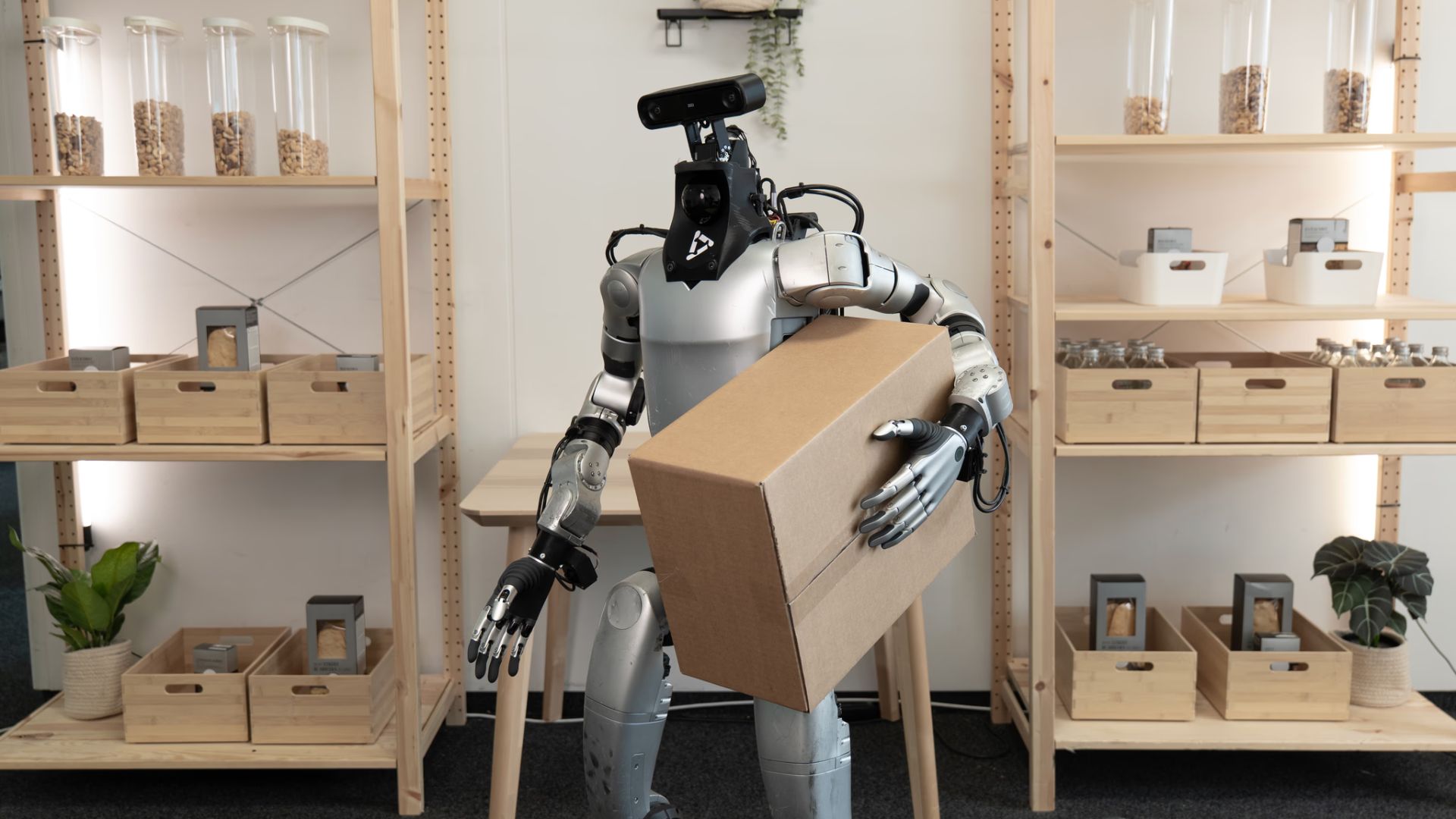
Swiss startup Flexion Robotics unveiled Reflect v1.0, a robotics platform that let a humanoid robot complete a 16-step office-delivery mission - retrieving a parcel, using stairs and an elevator, unpacking it, and storing the contents - fully autonomously from a single natural-language instruction. Flexion reports that reinforcement learning raised its internal mission-completion rate from 38% to 90% on that evaluation, using a custom vision-language model as mission controller alongside a motion layer, whole-body controller, and custom runtime software. The claim is Flexion's own internal benchmark: independent replication, published evaluation methodology, or third-party benchmarks have not yet been released. eWeek reports Flexion was founded by former Nvidia robotics researchers, with ABI Research estimating the robot foundation-model market could reach $150 billion by 2036.
Reflect v1.0's headline number - completion jumping from 38% to 90% on a 16-step mission - is Flexion's own internal benchmark, not an independently verified result, and that distinction matters more than the number itself: for practitioners evaluating long-horizon robot autonomy, the interesting claim here is architectural (folding mission-level reasoning, motion, control, and runtime into one platform trained end-to-end with reinforcement learning), not yet a proven production capability.
What happened
Swiss startup Flexion Robotics introduced Reflect v1.0, a robotics intelligence platform for long-horizon humanoid autonomy, demonstrating a humanoid completing a 16-step, unscripted office-delivery mission from a single natural-language instruction: retrieve a parcel using the stairs, take the elevator up, unpack the box, and store the items in a drawer, all without a human operator during execution, according to Flexion's own announcement and reporting by Interesting Engineering, eWeek, and AI Insider. The platform's mission controller is a custom vision-language model that observes the robot's camera feed, reasons about progress, and replans; a motion layer combines a vision-language-action model with reinforcement-learning skills; a whole-body controller (called Reflex) handles balance and manipulation; and a custom runtime (FlexComm) manages communication and safety checks. Flexion reports that on an internal 16-step mission evaluation, a supervised-fine-tuned version of the mission controller completed only 38% of missions end-to-end, while adding reinforcement learning across every layer raised that to 90%. The company also reports the platform can handle boxes from 100 grams to 3.5 kilograms and has supported more than 100 consecutive stair traversals.
Technical context
Systems that fold a language-conditioned mission planner directly into the perception-control loop trade some modular verification clarity for end-to-end adaptability, a pattern also visible in other 2026 humanoid platforms racing to combine reasoning and control in one stack. Flexion says off-the-shelf vision-language models were not reliable enough to drive complete missions on their own, acting too eagerly on incomplete visual confirmation, and that reinforcement-learning fine-tuning across the full stack, not supervised fine-tuning alone, was what closed the 38%-to-90% gap. eWeek reports that Flexion was founded by former Nvidia robotics researchers, citing ABI Research analyst George Chowdhury's view that humanoid-robotics value may sit more in the AI and software layer than in the robot body itself; ABI Research estimates the robot foundation-model market could reach $150 billion by 2036, per eWeek's citation of a WIRED profile.
For practitioners
Flexion's own disclosed limitations are as informative as its result: the system still operates within a bounded task distribution, some objects remain hard to grasp, the mission controller can misread visual input, and recovery behaviors do not cover every failure mode. Teams evaluating similar long-horizon autonomy platforms should look for the evaluation methodology behind headline success rates (number of seeds, stochasticity, what counts as a failure), whether reproducible benchmarks or open datasets exist, and how the system surfaces uncertainty mid-mission, none of which Flexion has published alongside this announcement.
What to watch
Whether Flexion publishes technical papers, open evaluation methodology, or third-party demonstrations that validate the 38%-to-90% claim outside its own 16-step evaluation set; how the platform performs across a broader distribution of tasks and environments than the single demonstrated mission; and whether competing humanoid-software efforts, such as ShengShu Technology's Motubrain (per Interesting Engineering), converge on similar mission-controller-plus-RL architectures.
Key Points
- 1Flexion's Reflect v1.0 unifies a VLM mission controller, RL-trained motion skills, whole-body control, and runtime software into one autonomy stack.
- 2Flexion's own internal 16-step evaluation reports completion rising from 38 percent with supervised fine-tuning to 90 percent after reinforcement learning was added.
- 3The demonstrated gains are a single company-reported benchmark; independent replication, open evaluation methodology, and broader-task validation remain unpublished.
Scoring Rationale
A notable robotics-software architecture claim - unifying mission control, motion planning, whole-body control, and runtime into one long-horizon autonomy stack - but every reported metric (38%-to-90% completion, box-handling range, stair-traversal count) is Flexion's own internal benchmark with no independent replication or published evaluation methodology. A previously stored claim of '300 live demonstrations at ICRA 2026' could not be verified in any of four independently fetched sources and has been removed as unsupported. Score reflects a solid, single-vendor product story pending outside validation, not an industry-shaking result.
Sources
Public references used for this report.
Practice interview problems based on real data
1,625 SQL & Python problems across 15 industry datasets — the exact type of data you work with.
Try 250 free problems