Evil Martians Adopts Human-in-the-Loop Illustration Workflow
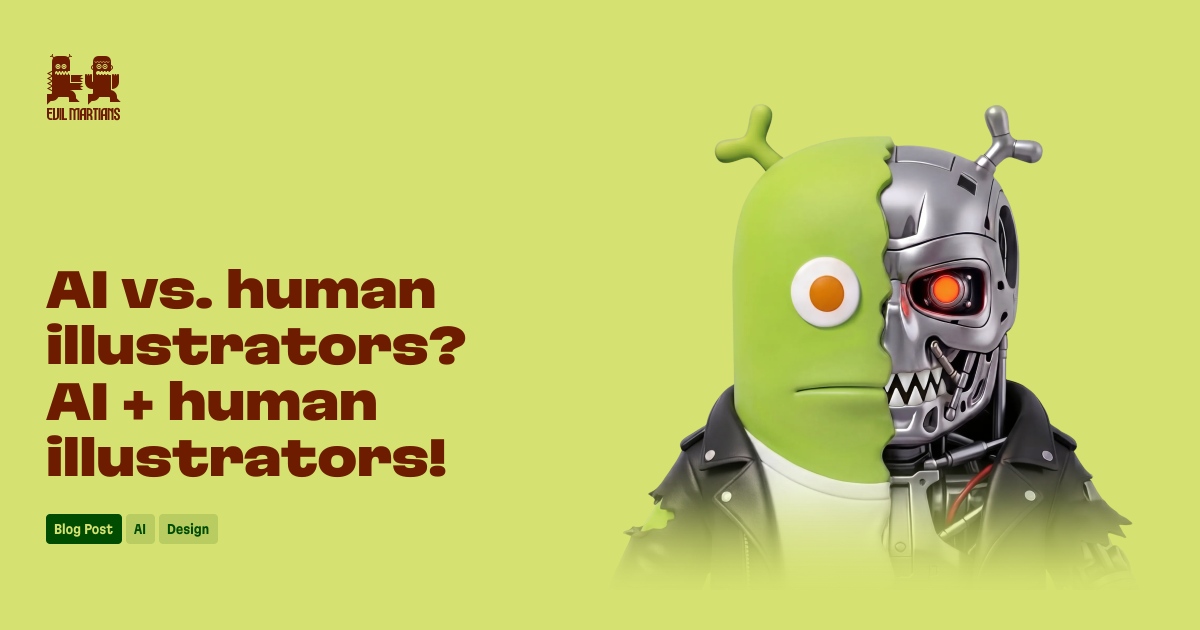
Developer-tools blog Evil Martians spent roughly two years trying to fully automate its cover illustrations with AI before landing on a human-in-the-loop workflow that many content teams will recognize. After cycling through Midjourney, Recraft, Nanobanana, and a custom GPT tool, the studio found each approach got illustrations "90% there," but drifting mascot proportions, hallucinated details, and transparency issues required manual cleanup costing $600-700 in staff time per image - more expensive than hiring a human illustrator outright. The fix: editors write a one-line visual brief, AI-first design agency KOJI generates and an illustrator finishes the last mile, cutting cost to $100 per illustration and letting the 500K-reader blog commission 2-3x more covers than before.
Evil Martians' year-long struggle to automate its blog illustrations is a concrete, well-documented case study in where AI image generation breaks down at production scale, and what fixing it actually costs. The team's own numbers suggest human-in-the-loop wasn't a compromise on the way to full automation - it was cheaper and more consistent than either pure-AI or pure-human approaches once illustration volume mattered.
What happened
According to a July 1, 2026 post on the Evil Martians blog, the developer-tools studio, which produces 50+ technical articles a year for an audience of 500,000+ developers, spent about two years trying to fully automate cover illustrations for its mascot-anchored blog using Midjourney, Recraft, Nanobanana, and a custom-built GPT app. Each approach got the team "90% there," but small failures - drifting mascot proportions, hallucinated details, opaque backgrounds where transparency was needed - required manual fixes the team says cost $600-700 in staff time per illustration. The studio ultimately partnered with KOJI, an AI-first design agency that pairs AI generation with a professional illustrator who owns final cleanup; editors now hand KOJI a one-line visual brief and reference images, and KOJI returns a draft within 24 hours. Evil Martians says each illustration now costs about $100, versus $200-300 for a fully human illustrator or the equivalent of 8+ hours of the team's own time to clean up AI-only output, and that the studio now commissions 2-3 times more illustrations than before.
For practitioners
The failure modes Evil Martians describes - character and brand consistency across a series, transparency and aspect-ratio mismatches, and small hallucinated details that only become obvious on a second look - are common blockers for any team trying to put generative image models into a production content pipeline. Its fix keeps humans at both ends: editorial judgment defines the brief upfront, and a human illustrator signs off on the final asset, while bulk generation and iteration in between is where AI does the heavy lifting.
What to watch
Evil Martians frames the lesson as broader than illustration: teams shipping AI features often see a working demo and an early production batch succeed, then hit a failure mode that wasn't visible in a demo drawn from a lucky distribution. Whether other devtools teams adopt a similar bookend-human, AI-in-the-middle structure for other content types, not just illustration, is worth tracking as more studios publish their own AI production post-mortems.
Key Points
- 1Evil Martians tried Midjourney, Recraft, Nanobanana, and a custom GPT tool for two years before pure AI illustration reliably fell short at scale.
- 2Manual cleanup of AI-only illustrations cost the team $600-700 in staff time per image, more than hiring a human illustrator directly.
- 3Pairing AI generation with an illustrator who owns final cleanup cut cost to $100 per image and let the blog commission 2-3x more art.
Scoring Rationale
A detailed, primary-sourced first-person case study with concrete cost data ($600-700 vs $100 per illustration) and a reusable production pattern for teams operationalizing generative image tools. Solid practitioner relevance but scoped to one company's workflow rather than a broader industry shift.
Sources
Public references used for this report.
Practice interview problems based on real data
1,625 SQL & Python problems across 15 industry datasets — the exact type of data you work with.
Try 250 free problems