DuckDuckGo Sees Surge in 'No AI' Search
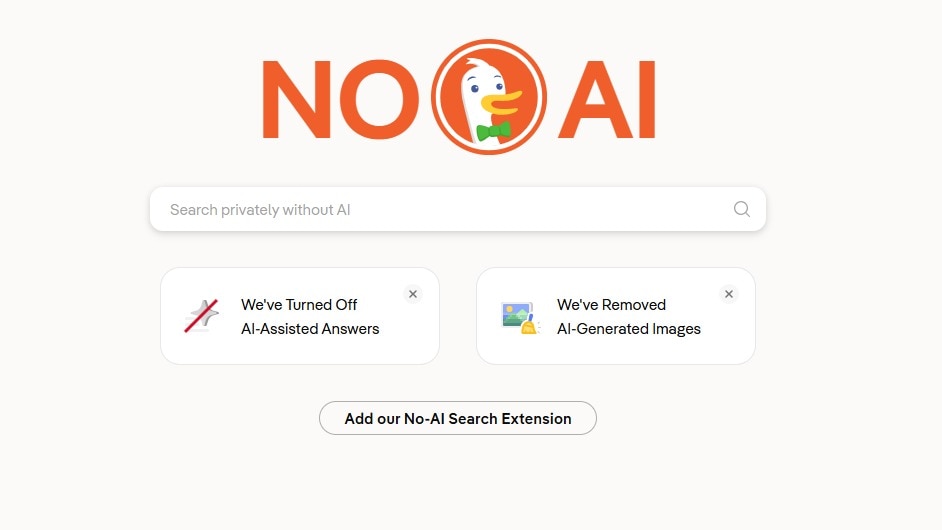
DuckDuckGo has seen a sharp jump in "No AI" search usage since Google's May 19 I/O overhaul made AI Overviews the default search experience, with TechCrunch reporting visits to DuckDuckGo's AI-free page running roughly 84% above baseline and U.S. app installs up 18.1% week-over-week, while other outlets describe No AI page traffic as more than tripling since the announcement. DuckDuckGo has responded by expanding access to its AI-free noai.duckduckgo.com page and shipping Chrome and Firefox extensions that set it as the default search experience. CEO Gabriel Weinberg told reporters, "Google is force-feeding AI with no way to opt out," framing the surge as a market response to losing user choice rather than a new AI product launch.
For teams that build or depend on search-referred traffic, this is a live natural experiment in how quickly users move when a major platform removes an opt-out: a single-vendor default change produced a measurable, multi-week shift toward a privacy-and-choice-focused alternative, not toward a competing AI product.
What happened
Since Google's May 19, 2026 I/O announcement of an AI-first Search redesign, which replaces the traditional "10 blue links" with AI Overviews and an interactive AI Mode by default, DuckDuckGo has reported a sustained surge in interest in its "No AI" search experience. TechCrunch reports visits to DuckDuckGo's AI-free search page running roughly 84% above baseline and up nearly 30% week-over-week, with U.S. app installs up 18.1% week-over-week and U.S. iOS installs peaking at 69.9% week-over-week; The Next Web separately reports installs climbing 18% overall with Apple-device installs peaking near 70% on a single day, and multiple outlets, including Tom's Guide and PC Gamer, describe traffic to the No AI page as more than tripling since the announcement. DuckDuckGo has responded by making the noai.duckduckgo.com page easier to find and shipping Chrome and Firefox extensions that set the AI-free experience as the default.
Technical context
The change on DuckDuckGo's side is a UI and default-preference shift, an explicit opt-out page and browser extensions, not a new model or training method. The Next Web and Futurism note DuckDuckGo continues to operate its own AI product, duck.ai, which exposes third-party models from Anthropic, Meta, Mistral, and OpenAI; the No AI page and duck.ai are separate, coexisting products aimed at different user preferences.
For practitioners
CEO Gabriel Weinberg has framed the surge as a response to lost user choice, telling reporters, "Google is force-feeding AI with no way to opt out," and that DuckDuckGo wants "to be the place that puts users in charge and allows them to decide how much or how little AI they want." For teams building search-dependent products, the practical takeaway is that offering an explicit, low-friction opt-out can measurably shift traffic and installs within days, independent of any change in underlying model quality; the same reporting links rising interest in "generative engine optimization" tools to this broader shift away from link-first results.
What to watch
- •Whether DuckDuckGo's installs and No AI page traffic sustain past the initial post-I/O spike or settle back toward baseline.
- •Whether other browsers or search providers add their own explicit AI opt-out mechanisms in response to the competitive pressure.
- •How publishers' referral traffic and SEO strategy shift as AI Overviews reduce click-through to traditional search results.
Editorial analysis
The episode underscores that user trust in AI features is closely tied to perceived control, not just capability: DuckDuckGo's own AI product, duck.ai, remains available and largely unaffected by the backlash, suggesting the reaction is specifically to Google removing choice rather than to AI search broadly. Whether this translates into durable market-share gains for DuckDuckGo, or is absorbed once Google ships its own opt-out controls, is the open question practitioners tracking search distribution should watch.
Key Points
- 1DuckDuckGo's AI-free search page traffic rose roughly 84% above baseline and app installs jumped 18.1% week-over-week after Google made AI Overviews the default.
- 2The surge reflects user pushback against losing an opt-out, not dissatisfaction with AI quality, since DuckDuckGo's own AI product, duck.ai, saw no comparable backlash.
- 3For practitioners, the episode shows an explicit low-friction AI opt-out can measurably shift search traffic and installs within days of a rollout.
Scoring Rationale
Well-corroborated across eight sources including TechCrunch, The Next Web, Futurism, MacRumors, and the Independent, with consistent quantified traffic and install figures. Notable for SEO, search-product, and distribution practitioners as a real-time signal of how quickly users shift when a platform removes an AI opt-out, though it is a market/UX reaction story rather than a technical or policy event.
Sources
Public references used for this report.
Practice with real Ad Tech data
90 SQL & Python problems · 15 industry datasets
250 free problems · No credit card
See all Ad Tech problems