
Distributed AI Systems publishes practical production guide
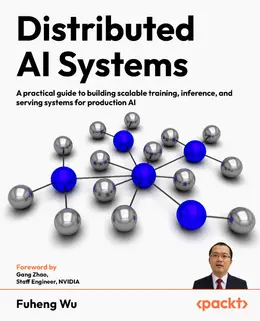
Packt Publishing released Distributed AI Systems, a 558-page paperback by Oracle machine learning tech lead Fuheng Wu, as a practical guide to building scalable training, inference, and serving systems for production AI, with a first edition dated June 2026 and an Amazon listing showing a July 9, 2026 release and ISBN 978-1807301712. The book covers GPU hardware and parallelism strategies, distributed training with PyTorch DDP and DeepSpeed/ZeRO, inference engines including vLLM and SGLang, and Kubernetes-based production serving stacks. Wu has worked on distributed training and GPU systems at Oracle's Generative AI organization and previously at Uber's self-driving unit. For MLOps engineers, a single reference spanning training through serving can shorten onboarding and standardize evaluation and rollback practices, though readers should verify specific tooling versions against current releases given how fast this infrastructure evolves.
A single practitioner reference that spans distributed training, inference, and serving reduces the context-switching MLOps teams face when standardizing production AI infrastructure, and a book written by someone building these systems at hyperscaler scale carries more practical weight than typical framework documentation.
What happened
Packt Publishing's official product page lists Distributed AI Systems as a 558-page paperback, first edition, priced at $49.99 (with a $35.99 ebook option), authored by Fuheng ("Henry") Wu. Amazon's listing shows a July 9, 2026 release date, ISBN-13 978-1807301712, and a $47.49 preorder price; Barnes & Noble also lists the title for sale. Packt's table of contents covers GPU hardware, networking and parallelism strategies, distributed training with PyTorch DDP, scaling with Fully Sharded Data Parallel (FSDP), DeepSpeed and ZeRO optimization, distributed inference fundamentals, vLLM and SGLang, Kubernetes for AI workloads, production LLM serving stacks, and distributed benchmarking.
Technical context
The chapter list maps closely to the practical bottlenecks MLOps teams hit when scaling beyond a single GPU: resource estimation and memory-footprint planning, choosing between data and model parallelism, and building inference stacks that can serve concurrent requests at trillion-parameter scale. Covering training, inference, and orchestration in one volume is relatively uncommon among AI engineering books, which tend to specialize in one layer of the stack.
For practitioners
Wu's background, distributed training and GPU systems work at Oracle's Generative AI organization, prior work on Uber's self-driving AI team, and open-source contributions including SGLang and genai-bench, suggests the material is grounded in production experience rather than purely academic treatment. Teams evaluating orchestration tools, parallelism strategies, or monitoring and rollback procedures for production AI stacks may find it a useful reference point, though any specific tooling recommendations should be validated against current framework versions given how quickly this space moves.
What to watch
Check Packt's product page for sample chapters, and watch for a companion code repository, since worked examples and runnable code are typically what separate a useful production reference from a purely conceptual one.
Key Points
- 1Packt published the 558-page book Distributed AI Systems by Oracle ML tech lead Fuheng Wu, covering training through production serving.
- 2Few AI engineering books span distributed training, inference, and orchestration in one volume, reducing context-switching for MLOps teams.
- 3Teams standardizing production AI infrastructure may use it as a reference, but should verify tooling recommendations against current releases.
Scoring Rationale
A legitimate, practitioner-authored reference book covering the current production AI infrastructure stack; useful for MLOps teams standardizing practices but not a research or product breakthrough, so impact stays in the minor/solid band.
Sources
Public references used for this report.

Practice interview problems based on real data
1,625 SQL & Python problems across 15 industry datasets — the exact type of data you work with.
Try 250 free problems


