Companies Redesign Workflows Before Adding AI Agents
Product Coalition author Weiwei Hu argues that companies should redesign work before adding AI agents, using enterprise examples where teams kept manual Excel, email, and slide-deck handoffs under a new AI layer. The piece is not a product launch; it is a practitioner warning that agents cannot recover tacit knowledge, unclear data ownership, or missing metrics after deployment. For teams, the useful action is to map where AI creates measurable value, define data contracts and checkpoints, assign human oversight, and track business outcomes rather than chatbot usage. Reworked and McKinsey context point in the same direction: agentic systems work best when the workflow is rebuilt around the decision path, not bolted onto broken process.
The useful LDS angle is operational: agentic AI projects fail quietly when teams automate the visible interface but leave the real workflow undocumented. A chatbot or agent layer can make work look modern while the system underneath still depends on manual handoffs, hidden judgment, and metrics that do not connect to business outcomes.
What happened
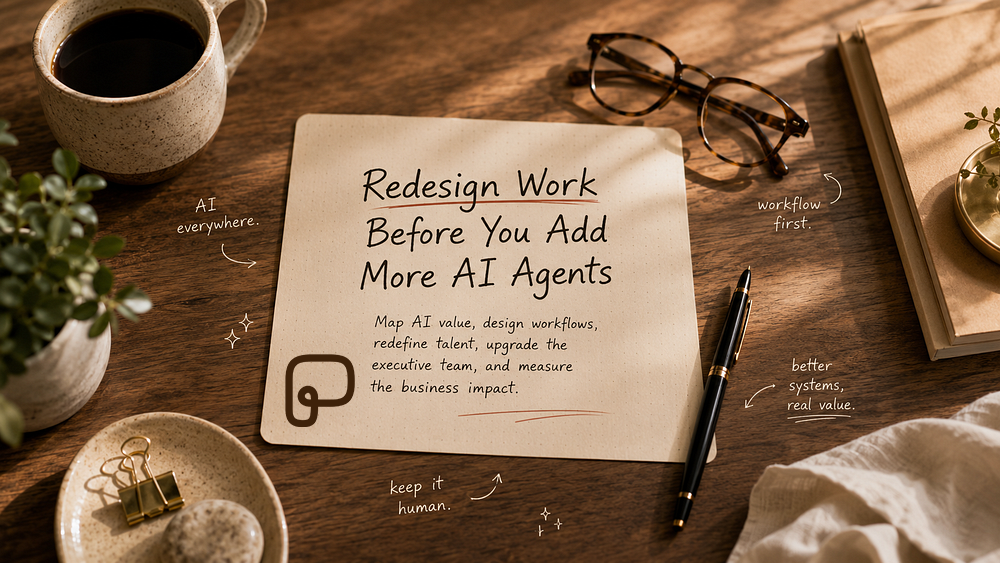
In a Product Coalition post, Weiwei Hu argues that companies should redesign work before adding more AI agents. The post describes enterprise teams that were using AI while the underlying work still ran through Excel handoffs, email, slide decks, and undocumented process knowledge. Hu's recommended sequence is to map AI value, design workflows, redefine talent roles, upgrade executive oversight, and measure business impact.
Industry context
The argument fits a broader pattern in enterprise AI adoption. Reworked makes a similar case that deploying agents into broken workflows can scale the mess rather than fix it. McKinsey's agentic AI work likewise emphasizes redesigned workflows and orchestration frameworks, not standalone agents, as the route to useful production systems.
Technical context
For engineering and data teams, the blocker is often data shape rather than model access. Agents need canonical sources, data contracts, permission boundaries, checkpoints, logs, and clear human ownership. Without those controls, an agent can retrieve stale context, act on the wrong system of record, or optimize a local task while making the end-to-end process harder to audit.
For practitioners
Start by drawing the current workflow and marking decision triggers, data owners, manual exceptions, and measurable outcomes. Then decide whether the agent should advise, execute deterministic steps, route exceptions, or coordinate across systems. That design choice should come before model selection, prompt tuning, or a new user interface.
What to watch
The signal to watch is whether teams report fewer manual handoffs, faster cycle times, cleaner exception handling, and business KPIs tied to automated steps. Usage counts alone are weak evidence; agentic automation is only improving the workflow if the decision path becomes more reliable and measurable.
Key Points
- 1Workflow mapping should come before agent deployment because tacit knowledge and manual handoffs define the system's real failure modes.
- 2Data contracts, checkpoints, and human ownership make agent actions auditable instead of turning process gaps into model errors.
- 3Business KPIs matter more than chatbot usage when judging whether agentic automation has changed enterprise work.
Scoring Rationale
This is a useful practitioner essay about enterprise agent adoption, supported by broader workflow-redesign context, but it is not a launch, funding event, benchmark, or regulatory development. The score is solid but bounded because the primary evidence is one authorial Product Coalition post rather than multiple independent reports about a concrete deployment.
Sources
Public references used for this report.
Practice with real Ad Tech data
90 SQL & Python problems · 15 industry datasets
250 free problems · No credit card
See all Ad Tech problems