Bedrock Robotics Deploys Autonomous Excavators on Active Jobsites
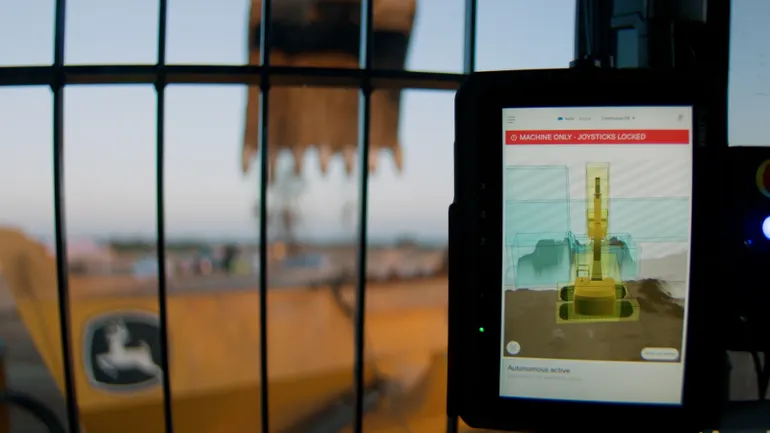
Bedrock Robotics announced in mid-August that its retrofitted excavators were operating without onboard operators at three active construction sites in Texas and Nevada. Construction Dive reported deployments including a Nevada water-treatment facility with Sundt Construction and a 1.2 million-cubic-yard civil sitework project with Zachry Construction. The company had tested the system under human supervision for about a year before the operator-out deployment.
Bedrock Robotics announced in mid-August that excavators fitted with its autonomous operating system are performing excavation without onboard operators at three active commercial construction sites in Texas and Nevada.
According to Construction Dive, the San Francisco company has deployed its Operator system at a Nevada water-treatment facility with Sundt Construction and at a 1.2 million-cubic-yard civil sitework project with Zachry Construction. AI for CRE Collective separately reported that the deployments span three active sites, including a water-treatment project.
Retrofit autonomy on existing equipment
Bedrock does not manufacture excavators. Its system retrofits existing fleets with sensors, onboard compute and machine-learning software, according to Construction Dive and AI for CRE Collective. The outlets describe the stack as enabling an excavator to perceive its surroundings, plan movements and execute a task assigned by a site manager.
Construction Dive reports that the announcement follows about a year of testing under human supervision and marks Bedrock's transition to fully autonomous excavation activity on the cited projects. The available reports do not specify the autonomy system's sensor configuration, operating-domain constraints, remote-supervision procedures, safety validation metrics or intervention rates.
A harder operating domain than road autonomy
AI for CRE Collective notes that construction sites change continuously as people, equipment and materials move through the work area. Excavation also requires machines to interact with variable soil and materials, rather than primarily navigate a fixed road environment. Those characteristics make reliable perception, work planning and safety controls central engineering questions for autonomous heavy equipment.
The deployment is notable because it places autonomy into production earthwork rather than a controlled demonstration environment. Across comparable industrial-autonomy deployments, practitioners typically evaluate operational systems against task completion quality, uptime, human intervention frequency, geofencing and safety performance, not merely whether a vehicle can move autonomously.
AI for CRE Collective reports that Bedrock CEO Boris Sofman and other founding-team members previously worked at Waymo. It also reports that Bedrock has identified bulldozers, loaders and dump trucks as future equipment categories for its technology, though the current announcement concerns excavators.
Key Points
- 1Bedrock's retrofit system is operating excavators without cab operators on three active Texas and Nevada construction sites.
- 2Reported deployments move autonomous excavation from supervised testing into live production work, where safety and intervention metrics become critical.
- 3For industrial ML teams, comparable deployments require robust perception and planning amid changing terrain, workers, equipment and materials.
Scoring Rationale
The deployment is a notable real-world application of autonomy and machine learning in heavy construction equipment. It matters to practitioners working on robotics, perception and safety-critical systems, although technical performance and safety details have not been publicly reported.
Sources
Public references used for this report.
Practice interview problems based on real data
1,625 SQL & Python problems across 15 industry datasets — the exact type of data you work with.
Try 250 free problems