Avnet and Weston Robot Launch Edge AI Inspector
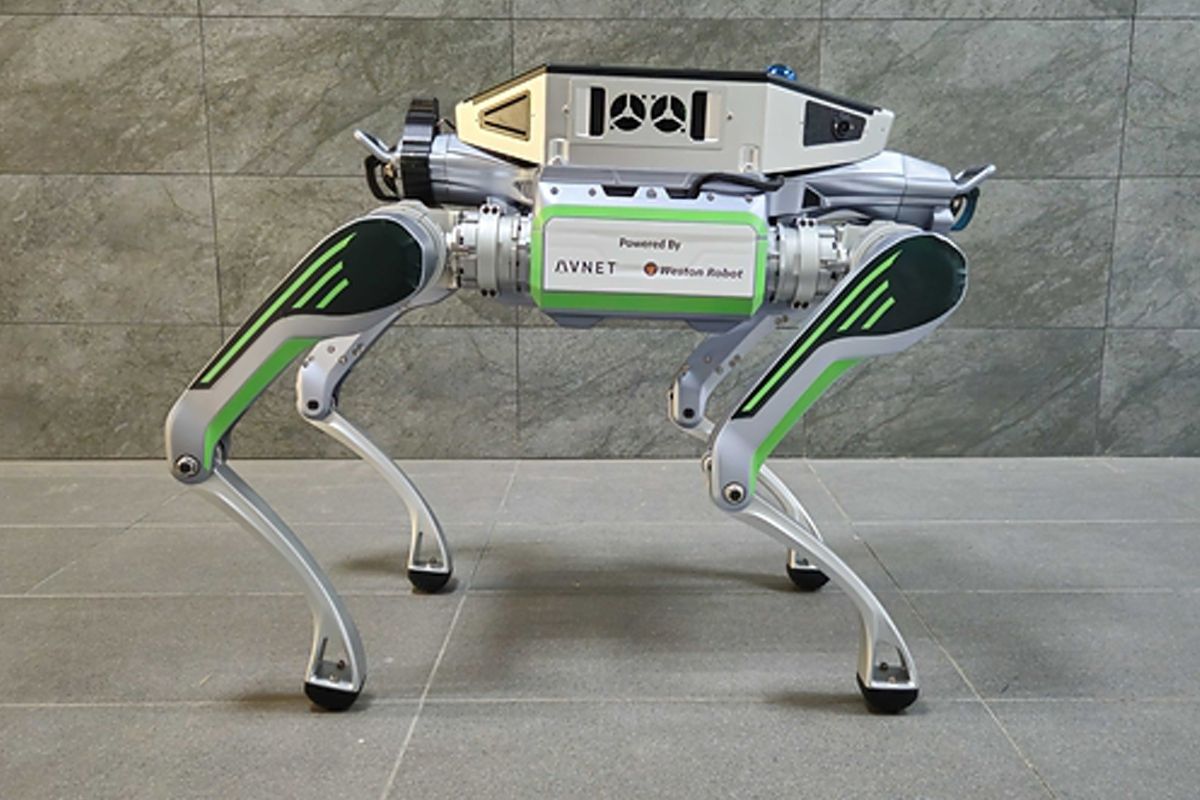
Avnet and Weston Robot announced an AMD-powered autonomous inspection platform for industrial facilities on August 5. According to the companies' announcement, the quadruped-based system runs AI inference locally with up to 50 TOPS of compute and combines visual and thermal inspection, 3D LiDAR mapping, and autonomous navigation for GPS-denied sites.
Avnet and Weston Robot announced an autonomous industrial inspection platform on August 5 that combines edge AI compute, sensing, and robot navigation. The platform is designed for facilities including factories, warehouses, ports, tunnels, utilities, and other critical-infrastructure sites, according to the companies' announcement republished by ANTARA/PRNewswire.
The system uses AMD Ryzen AI Embedded processors and provides up to 50 TOPS of local AI performance, according to The Robot Report and Gasgoo. Rather than requiring continuous cloud connectivity for inference, the platform executes workloads on the robot. The companies describe that architecture as enabling lower-latency decisions and operation in environments with constrained connectivity.
Inspection and navigation stack
According to Gasgoo, the platform's inspection functions include object and anomaly detection; identification of personnel and vehicles; personal protective equipment, or PPE, compliance monitoring; unauthorized-entry detection; and thermal and visual inspections for hotspots, fluid leaks, and equipment faults. The ANTARA/PRNewswire release similarly lists continuous monitoring and detection of equipment abnormalities before they develop into operational failures.
For mobility, the robot uses 3D LiDAR SLAM to create maps and navigate where GPS is weak or unavailable, Gasgoo reports. The Robot Report described Avnet's implementation as a component-filled backpack mounted on a quadruped robot and reported support for thermal and visual analytics alongside 3D LiDAR mapping. Weston Robot primarily resells Unitree robotic systems and also provides custom autonomous mobile robot platforms, according to The Robot Report.
The companies have not published benchmark results for detection accuracy, navigation reliability, throughput, battery endurance, or performance across particular industrial environments in the materials reviewed.
From prototype components to deployment
The ANTARA/PRNewswire announcement states that Avnet is contributing advanced-computing platforms, engineering expertise, and access to a technology-partner ecosystem. It describes the collaboration as intended to reduce complexity between robotics development and production deployment. The Robot Report adds that Weston Robot's fleet-management software can be combined with the inspection system for patrol and inspection missions.
For ML and robotics teams, the notable technical choice is the use of local inference in a mobile inspection workflow. Industrial vision systems often operate under bandwidth, latency, and connectivity constraints that can make cloud-dependent pipelines difficult to use for time-sensitive safety or maintenance tasks. In comparable deployments, edge inference shifts attention toward model size, accelerator compatibility, thermal limits, observability, and processes for validating models against site-specific lighting, equipment, and safety conditions.
The announcement provides a hardware-and-integration description rather than a detailed account of the models, training data, sensor-fusion approach, or fleet-management interfaces. Those details would determine how readily customers can integrate the platform with maintenance, safety, and operational-technology systems.
Key Points
- 1Avnet and Weston Robot combine quadruped mobility, embedded AMD compute, and edge inference for autonomous industrial inspection workloads.
- 2Reported features span anomaly detection, PPE monitoring, thermal inspection, and LiDAR SLAM, covering both perception and navigation requirements.
- 3Comparable edge-robotics deployments typically require site-specific validation, model observability, and integration with operational maintenance and safety workflows.
Scoring Rationale
The announcement is a notable industrial edge-AI deployment that combines mobile robotics, embedded inference, and industrial sensing. It is relevant to teams building physical AI systems, although the sources provide no model benchmarks, customer deployments, or technical evaluation data.
Sources
Public references used for this report.
Practice interview problems based on real data
1,625 SQL & Python problems across 15 industry datasets — the exact type of data you work with.
Try 250 free problems