Astera Labs showcases 320-lane PCIe 6.0 switch
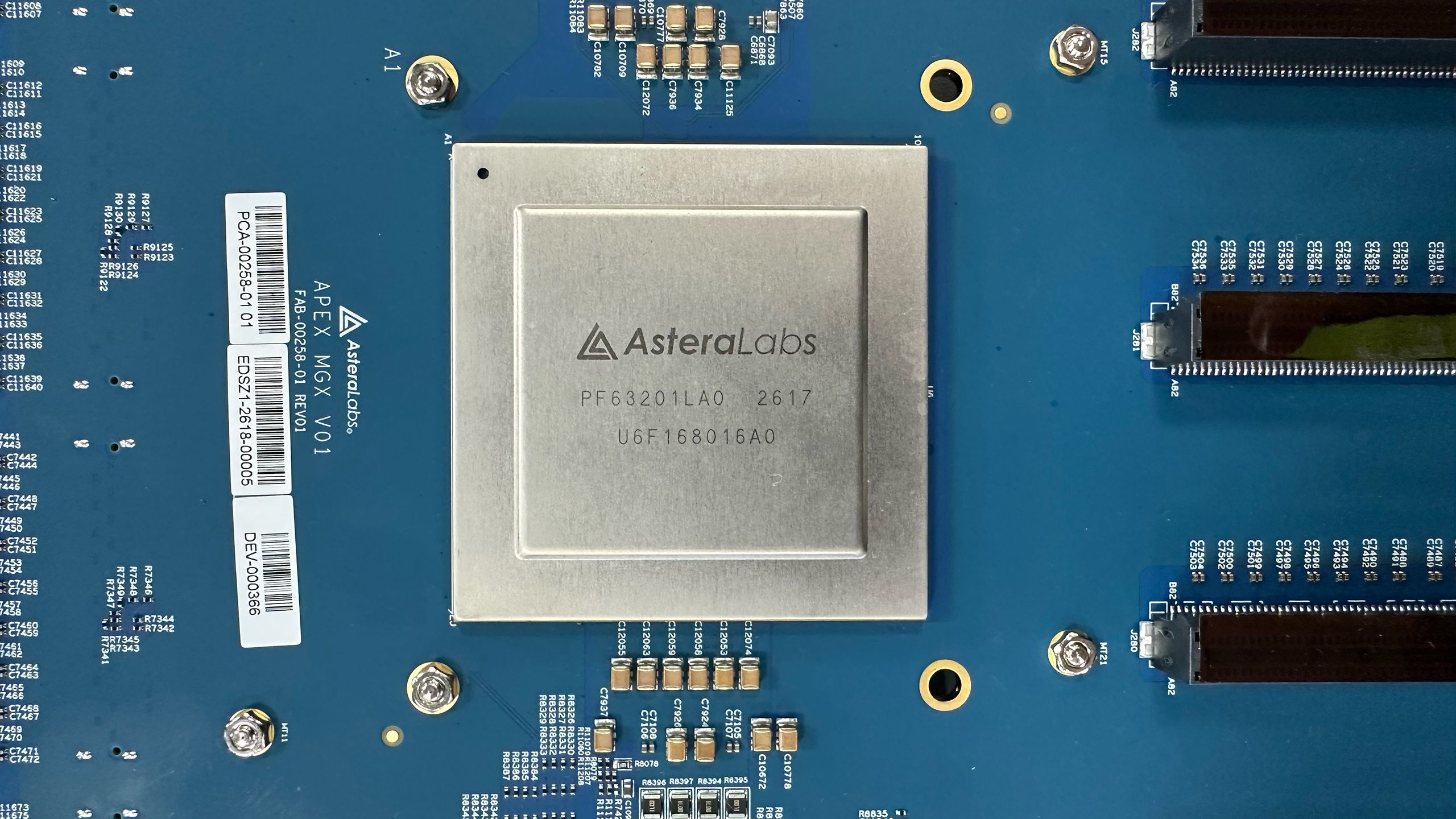
Astera Labs (Nasdaq: ALAB) used Computex 2026 to showcase its Scorpio X-Series 320 Lane Smart Fabric Switch, which the company calls the industry's largest open, memory-semantic PCIe 6.0 fabric switch. The device carries 320 PCIe 6.0 lanes, enough to wire 20 accelerators directly at x16, and Tom's Hardware reported it can scale up to 80 accelerators over PCIe alone, without proprietary links such as NVLink or UALink. By raising switch radix, Astera Labs says architects can collapse multi-hop topologies into a single hop, cutting latency and using fewer switch chips. New Hypercast and In-Network Compute engines offload collective operations such as AllReduce and AllGather. Astera Labs said the switch is shipping to hyperscalers now, with a production ramp in the second half of 2026.
What was announced
At Computex 2026 in Taipei (June 2-5), Astera Labs (Nasdaq: ALAB) showcased the Scorpio X-Series 320 Lane Smart Fabric Switch, which it describes as the industry's largest open, memory-semantic PCIe 6.0 fabric switch. The company also expanded its Scorpio P-Series family to span 32 to 320 lanes, giving data center architects a range of switch sizes for different system topologies. Astera Labs first announced the part on May 5, 2026, and used Computex to demonstrate it alongside its broader rack-scale connectivity portfolio.
Why 320 lanes matters
The headline figure is lane count. As ServeTheHome notes, 320 lanes equals 16 lanes each for 20 PCIe devices, making this a large switch by current standards. More lanes let designers attach more GPUs, NICs, NVMe drives, and other accelerators with fewer switch chips and fewer hops between them. Tom's Hardware reported the switch can scale up to 80 accelerators over standard PCIe alone, without proprietary links such as NVLink or UALink. Higher radix also collapses multi-hop topologies toward a single hop, which reduces end-to-end latency across a cluster.
Beyond raw bandwidth
Astera Labs is positioning Scorpio as an intelligent fabric rather than a passive switch. Two new features, Hypercast and In-Network Compute, offload the collective communication operations that dominate distributed AI workloads. According to Astera Labs, Hypercast is a hardware data-replication engine for all-gather, all-scatter, and all-to-all exchanges, while In-Network Compute targets all-reduce and reduce-scatter. The company claims these engines boost collective operations by up to 2x; its own footnote defines that as at least a 50 percent reduction in AllReduce latency versus traditional Ring AllReduce, based on internal analysis. A memory-semantic design lets accelerators reach fabric resources through native load/store operations, which Astera Labs says cuts software overhead. The family is managed through the company's COSMOS software, which provides non-disruptive firmware updates, OpenBMC management, and real-time telemetry.
Competitive context
The launch continues Astera Labs' move from PCIe retimers into the switching market, a segment Broadcom has dominated for years. Industry voices supplied by Astera Labs framed the fabric, not the GPU, as the emerging bottleneck for production AI: Moor Insights and Strategy's Patrick Moorhead said accelerator refresh cycles are exposing how rigid closed interconnects can be, and SemiAnalysis's Dylan Patel said the design credibly addresses both in-network compute and latency reduction. These are vendor-supplied endorsements and should be read as such. As a general industry pattern, open, standards-based interconnects appeal to operators that want to mix accelerators from multiple vendors and avoid being locked to one supplier's roadmap.
Availability and market
Astera Labs said the Scorpio X-Series 320 Lane switch is shipping to leading hyperscalers now, with a production ramp in the second half of 2026. The company cited a merchant scale-up switch silicon market it projects to reach $20 billion by 2030. As with any vendor roadmap, the performance claims and ship timing reflect Astera Labs' own statements and have not been independently benchmarked; one ServeTheHome reader noted the launch lacked public pricing and detailed performance data.
Key Points
- 1WHAT: Astera Labs unveiled the Scorpio X-Series 320-lane PCIe 6.0 fabric switch, billed as the industry's largest open, memory-semantic switch.
- 2WHY: Higher switch radix connects more accelerators in a single hop, cutting latency and reducing the chip count for large scale-up clusters.
- 3SO WHAT: It pushes Astera Labs deeper into PCIe switching long dominated by Broadcom, as AI bottlenecks shift from GPUs to the fabric.
Scoring Rationale
Notable hardware advancement for data-center interconnects and accelerator scaling; relevant to system architects and infrastructure teams but not a paradigm shift.
Sources
Public references used for this report.
Practice interview problems based on real data
1,625 SQL & Python problems across 15 industry datasets — the exact type of data you work with.
Try 250 free problems