Apple Clarifies AFM Architecture Excludes Google's Gemini
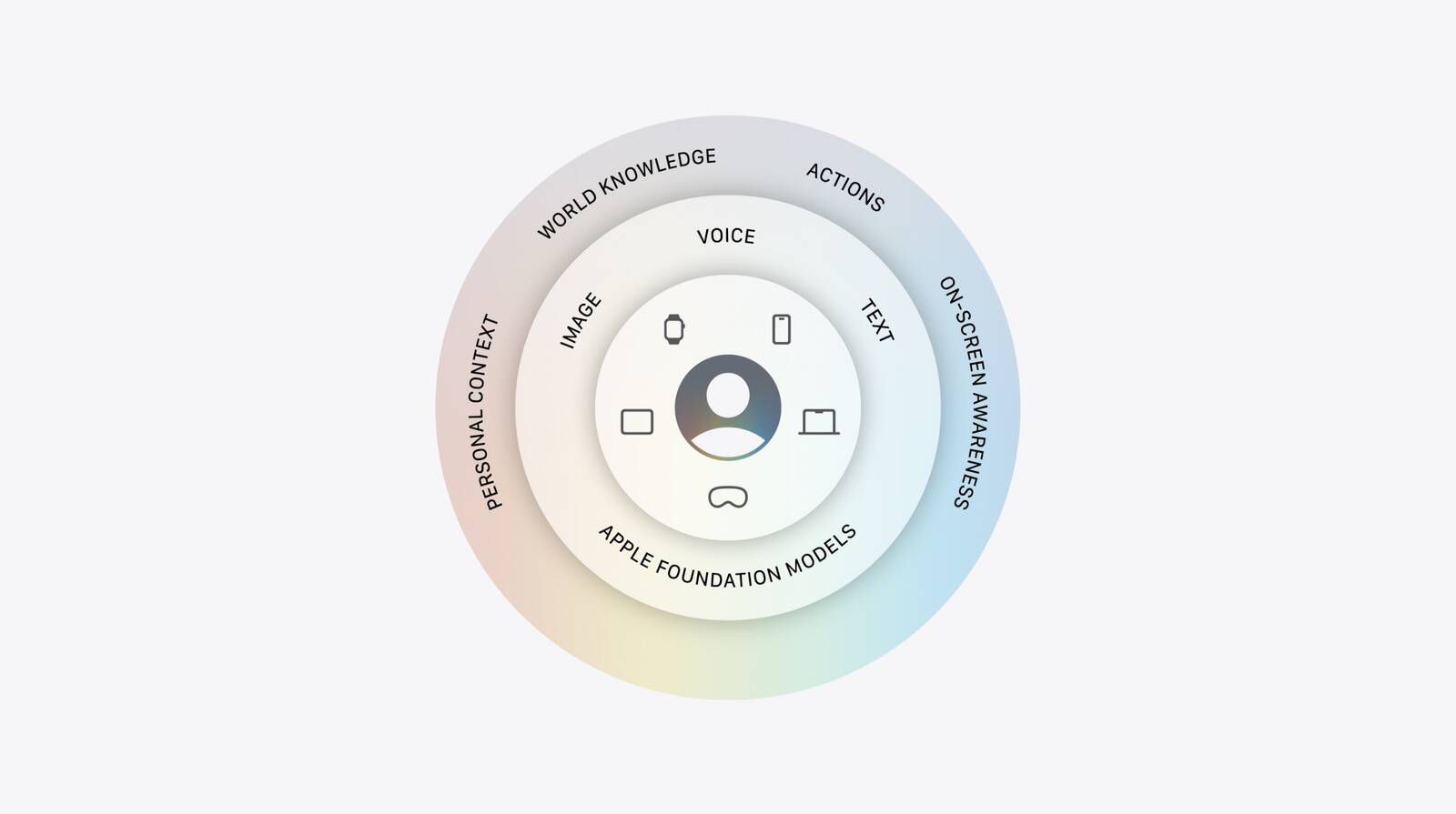
Apple executives described the architecture of the new Apple Foundation Models (AFM) family at WWDC and said Google Gemini components are not included in the shipped models. MacRumors reports Craig Federighi told reporters, "The amount of the Google Assistant we use is none," and Amar Subramanya said the AFM family spans two on-device models and three server-side models. Subramanya is quoted saying the models were "custom built" and "refined using outputs from Gemini frontier models," indicating Google's role was distillation-based rather than direct code or infrastructure reuse, according to MacRumors and reporting summarized by AppleInsider.
What happened
Apple presented the architecture of its new Apple Foundation Models (AFM) family at WWDC. Per MacRumors, Craig Federighi, Apple's SVP of Software Engineering, said, "The amount of the Google Assistant we use is none," and explained that Apple does not use Gemini models deployed to Google's customers, Google client-side code, or Google Search as the AFM knowledge backbone. MacRumors reports Amar Subramanya, Apple's AI VP, described the AFM family as comprising two on-device models and three server-side models. Subramanya is quoted as saying the models are "custom built" and "refined using outputs from Gemini frontier models."
Technical details
Per reporting in MacRumors, the on-device tier includes AFM Core, a next-generation dense architecture, and AFM Core Advanced, described as a sparse, natively multimodal model that enables features such as invitation and expressive voices without cloud requests. The server-side tier includes AFM Cloud for latency-optimized Private Cloud Compute, AFM Cloud Image for image generation and editing, and AFM Cloud Pro, which MacRumors reports is designed for agentic tool use and complex reasoning with quality Subramanya called "similar to Gemini frontier models." AppleInsider's coverage echoes the claim that end-user interactions do not include Google code or Gemini agents.
Editorial analysis - technical context
Companies building mixed on-device and private-cloud model stacks often use smaller, optimized on-device models for latency and privacy while reserving larger server models for complex reasoning and tool use. Distillation or model-refinement workflows that use outputs from a third-party frontier model as training signal are a pragmatic shortcut to capture capabilities without adopting third-party deployment code or infrastructure, a pattern increasingly visible in commercial model development.
Context and significance
For practitioners, Apple's AFM architecture formalizes a widely observed tradeoff: push interactive, privacy-sensitive features on-device while routing heavy reasoning and generative tasks to controlled server environments. The reported use of distilled outputs from Gemini frontier models, per MacRumors' attribution to Subramanya, highlights a hybrid data strategy where third-party model outputs are used as training targets rather than as integrated runtime components.
What to watch
Observers should track technical documentation and developer APIs Apple publishes for AFM Core Advanced and AFM Cloud Pro to confirm latency, model size, quantization details, and privacy-preserving guarantees. Also monitor third-party tests comparing AFM Cloud Pro to contemporaneous frontier models for reasoning and agentic capabilities, and any formal statements Apple publishes about data provenance and refinement pipelines; to date the public comments cited above are the primary sources for the training and refinement claims.
Key Points
- 1Apple reports AFM comprises two on-device and three server models, separating latency-sensitive and heavy-reasoning workloads.
- 2Apple attributes AFM training to proprietary data and says models were refined using outputs from Gemini frontier models, indicating a distillation-style role for third-party models.
- 3Industry trend: hybrid on-device plus private-cloud stacks let vendors balance privacy, latency, and capability without shipping third-party runtime code.
Scoring Rationale
Apple clarified that its new Apple Foundation Models (AFM) ship without Google Gemini components at runtime, while confirming the models were refined using outputs from Gemini frontier models in a distillation-style approach. Notable for ML practitioners as a window into a major vendor's production on-device/server model split and data strategy, though it is a clarification within the broader WWDC news rather than a standalone breakthrough.
Sources
Public references used for this report.
Practice interview problems based on real data
1,625 SQL & Python problems across 15 industry datasets — the exact type of data you work with.
Try 250 free problems