Analyzes LLM Token Economics on Dedicated GPUs
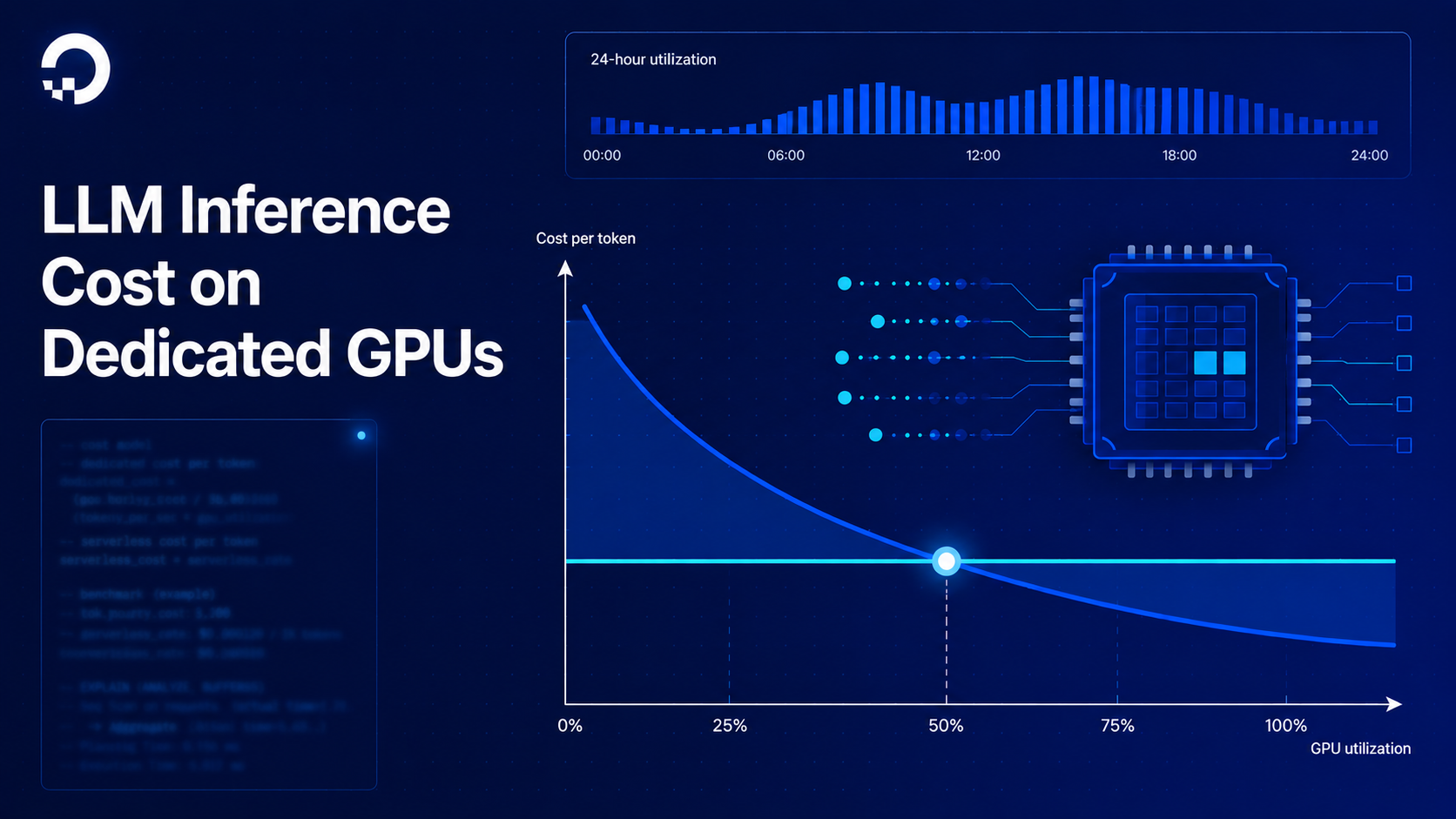
DigitalOcean published a July 8, 2026 tutorial modeling LLM inference cost on dedicated GPUs, using GPU hourly rate, token throughput, and utilization to calculate cost per million tokens. The practical point is that a cheap hourly instance can still be expensive if traffic is bursty and the GPU sits idle; the tutorial's example uses llama3.3-70b-instruct on an H200 at $3.44/hour and shows cost changing as utilization falls. Because this is a vendor-authored technical tutorial, teams should treat the exact numbers as workload-specific, but the cost model is useful for capacity planning, batching policy, and deciding when dedicated hardware beats pay-per-token APIs.
Inference cost planning is most useful when it starts from utilization rather than peak benchmark throughput. The DigitalOcean tutorial is a practical reminder that dedicated GPUs only become economical when traffic shape, batching, and latency targets keep expensive hardware productively loaded.
What happened
DigitalOcean published a July 8, 2026 tutorial on LLM inference cost across traffic profiles on dedicated GPUs. The article defines cost per token as GPU hourly rate divided by tokens per second and time, then applies that framing to dedicated hardware scenarios. Its worked example uses llama3.3-70b-instruct FP8 on a DigitalOcean H200 GPU Droplet at $3.44 per hour and discusses how lower utilization raises cost per million tokens.
Technical context
The tutorial is vendor-authored, so its exact hardware pricing and throughput should not be treated as universal benchmarks. The reusable part is the accounting model: peak throughput, real utilization, batch sizing, and traffic burstiness must be measured together. A deployment that looks cheap at saturated throughput can become expensive if request volume arrives unevenly or latency limits prevent efficient batching.
For practitioners
Teams evaluating dedicated inference should replay their own prompt lengths, output lengths, concurrency, and service-level targets through a cost model before committing to hardware. The useful comparison is not hourly GPU price alone; it is effective dollars per million generated tokens at the utilization a service can actually sustain.
What to watch
Look for the same calculation across different accelerators, quantization settings, runtimes, and model sizes. Independent reproduction would make the numbers more portable, while internal traces remain the best guide for a team's own serving economics.
Key Points
- 1Cost per token depends on both GPU hourly price and sustained throughput, so utilization matters as much as instance selection.
- 2Batch size, traffic shape, and KV-cache behavior can move dedicated-GPU economics away from peak benchmark numbers.
- 3Teams should validate the model with their own prompts, latency targets, and utilization traces before changing serving strategy.
Scoring Rationale
This is a solid practitioner tutorial because it gives an explicit cost model for LLM inference on dedicated GPUs. The score moves from 6.1 to 5.6 because the article is vendor-authored and educational rather than a market-moving product or research event.
Sources
Public references used for this report.
Practice interview problems based on real data
1,625 SQL & Python problems across 15 industry datasets — the exact type of data you work with.
Try 250 free problems