AI Detects Smuggled Seahorses and Shark Fins
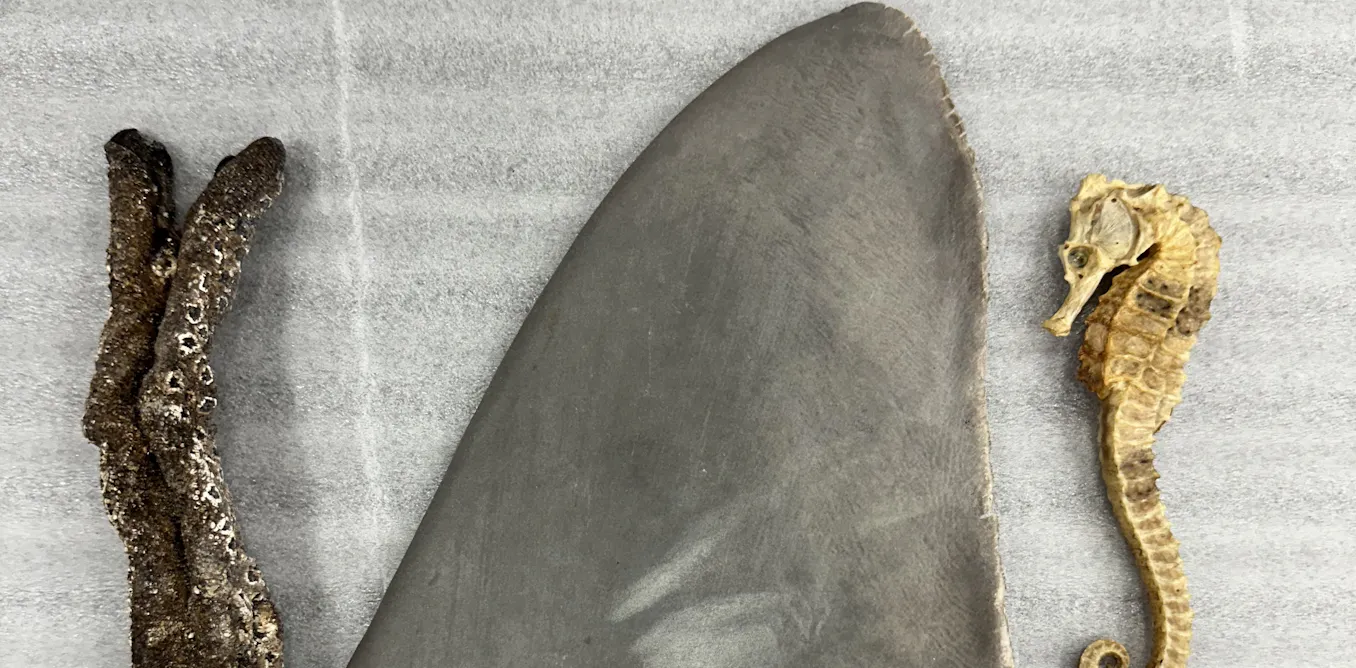
Researchers trained an AI algorithm on hundreds of three-dimensional x-ray scans of 68 dried marine samples to detect smuggled seahorses, shark fins and sea cucumbers, reporting an overall detection accuracy of 92% and a false positive rate near 13%, according to the study published in Frontiers in Ocean Sustainability and reported by Scientific American, The Conversation and Phys.org. Per the Frontiers article, subclass performance was 95% for shark fins, 96% for seahorses and 86% for sea cucumbers. Lead author Vanessa Pirotta, a wildlife scientist at Macquarie University, is quoted in multiple outlets on the potential to deploy the approach at airports; The Conversation discloses Pirotta received funding from Rapiscan Systems for the research.
What happened
Researchers published a study in Frontiers in Ocean Sustainability that trained an AI algorithm on hundreds of three-dimensional x-ray scans of 68 dried marine samples, including shark fins, seahorses and sea cucumbers, to test automated detection in luggage and parcels. Reporting in Scientific American, The Conversation, and Phys.org summarizes the paper's headline metrics: overall detection accuracy of 92% with a reported false positive rate of about 13%, and subclass detection rates of 95% (shark fin), 96% (seahorse) and 86% (sea cucumber) (Frontiers paper; media coverage June 7, 2026). Multiple outlets include direct quotes from lead author Vanessa Pirotta of Macquarie University about the potential operational role of such tools.
Technical details
The authors repurposed the kind of 3D x-ray imaging already deployed at many airports, training a neural-network classifier on volume-rendered scans of dried specimens, per the Frontiers article as summarized by Scientific American and Phys.org. The published performance metrics come from evaluation across hundreds of test images; the Frontiers abstract and supplementary materials report the subclass detection percentages and the overall false positive figure. The Conversation piece includes funding disclosures, noting Vanessa Pirotta received support from Rapiscan Systems.
Industry context
Practical considerations for deployment
Regulatory and ethical context
What to watch
Editorial analysis
Wildlife trafficking is a global, multi-billion-dollar illegal trade that routinely routes products through baggage and mail, and enforcement agencies already operate 3D x-ray scanners at checkpoints. Public reporting frames this work as an attempt to turn existing screening infrastructure into a targeted detection layer for marine wildlife items, potentially reducing manual inspection load while raising questions about integration and operational thresholds.
Integrating an automated detector into checkpoint workflows typically requires calibration for false positive tolerance, operator training, and validation across diverse packaging and concealment tactics. Comparable deployments in customs and biosecurity show that even high nominal accuracy can produce burdensome alert volumes if false positive rates are not tuned to operational capacity. The published 13% false positive figure therefore matters as an operational parameter rather than an end-to-end success metric.
Automated screening for contraband or protected wildlife intersects with customs law, chain-of-custody for evidence, and potential privacy concerns when image data are stored. Observers of similar technology rollouts note the need for transparent testing, documented provenance for training samples, and oversight mechanisms to avoid misuse of screening outputs.
Observers should look for independent validation on larger, more heterogenous datasets and for field trials that report detection rates and false positives under real-world throughput conditions. Reporting that cites deployment pilots at mail facilities or airports, vendor partnerships, or government evaluations would mark the transition from lab results to operational use. Also watch for published model governance artifacts such as retained-sample lists, performance breakdowns by concealment type, and clear funding disclosures beyond the authors' current statements.
Key Points
- 1AI trained on 3D x-rays detected trafficked marine items with 92% accuracy, offering a complementary screening layer for airports and mail hubs.
- 2Reported 13% false positives mean operational tuning and human-review capacity will determine real-world usefulness and workload impact.
- 3Independent field validation and transparent governance (training provenance, pilots, legal oversight) will be the next evidence gates before wide deployment.
Scoring Rationale
A real, peer-reviewed applied result that repurposes existing 3D x-ray infrastructure for a concrete conservation and enforcement use case, with strong lab-stage accuracy metrics and broad mainstream coverage. It is a vertical computer-vision application rather than a frontier-model or methods advance, and real-world value depends on field validation and operational tuning, so its importance to AI/DS/ML practitioners is solid but moderate.
Sources
Public references used for this report.
Practice interview problems based on real data
1,625 SQL & Python problems across 15 industry datasets — the exact type of data you work with.
Try 250 free problems