
Two interlocking crescents sit on your screen. You know they're two separate groups because your eyes trace the curves. But K-Means draws a straight vertical line down the middle, splitting both crescents in half. It can't follow curves because it only cares about distance to a centroid. Spectral clustering solves this by asking a different question entirely: instead of "which center is this point closest to?", it asks "which points are connected to each other?"
That shift from distance to connectivity is what makes spectral clustering one of the most powerful unsupervised learning techniques in the toolkit. Proposed formally by Shi and Malik (2000) for image segmentation and refined by Ng, Jordan, and Weiss (2001), the algorithm transforms your data into a graph, extracts the structure encoded in the graph's eigenvalues, and hands the simplified problem to K-Means. Complex shapes become trivial blobs in the right coordinate system.
Every formula and code block in this article uses one running example: the two moons dataset from scikit-learn, two interlocking crescents that expose the exact failure mode of centroid-based methods.
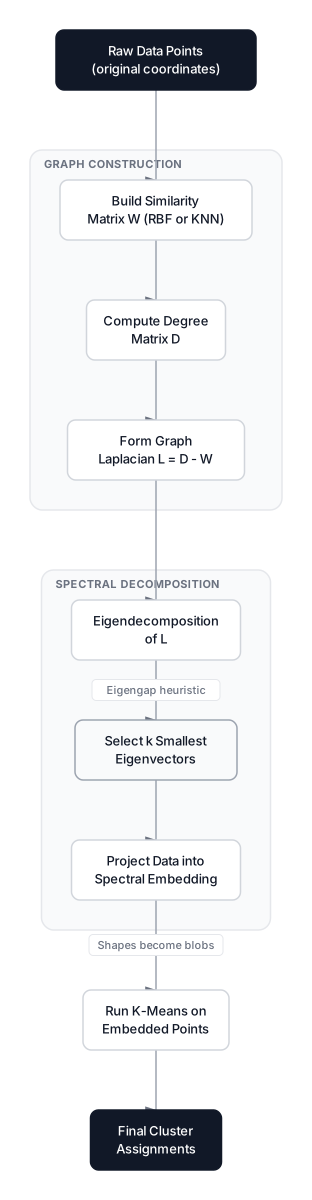 Click to expandSpectral clustering pipeline from raw data through graph construction, eigendecomposition, and final K-Means assignment
The Connectivity Principle
Spectral clustering treats data points as nodes in a weighted graph. Two points close together get a strong edge between them. Two points far apart get a weak edge (or none at all). Clustering then reduces to a graph-cutting problem: find the cuts that sever the fewest strong edges.
Think of it like islands in an archipelago. Points within the same crescent have many short bridges connecting them. Points across the gap between crescents have almost no bridges. The algorithm finds and cuts those weak connections.
This differs fundamentally from DBSCAN, which counts local density. Spectral clustering captures global shape information through the eigenstructure of the graph.
| Approach | Core Question | Shape Assumption | Needs k? |
|---|---|---|---|
| K-Means | Nearest centroid? | Spherical (convex) | Yes |
| DBSCAN | Dense neighborhood? | None (density-based) | No |
| Spectral | Connected through strong edges? | None (graph-based) | Yes |
| GMMs | Most likely Gaussian? | Elliptical | Yes (or BIC) |
Key Insight: K-Means fails on crescents not because it's a bad algorithm, but because its objective function (minimize within-cluster variance) is the wrong objective for non-convex shapes. Spectral clustering reformulates the objective as graph partitioning, which is shape-agnostic.
Building the Similarity Graph
The first step converts raw coordinates into a graph. For data points, we construct an similarity matrix where entry measures how "connected" points and are. The most common choice is the Gaussian (RBF) kernel:
Where:
- is the edge weight (similarity) between points and
- are the feature vectors of the two points
- is the squared Euclidean distance between them
- is the bandwidth parameter controlling how fast similarity decays with distance
- is the exponential function, ensuring all weights are between 0 and 1
In Plain English: For every pair of points in the two moons dataset, we compute a similarity score between 0 and 1. Points within the same crescent are close together, so their score approaches 1. Points on opposite crescents are far apart, so their score drops toward 0. The parameter controls the cutoff: small means only very nearby points count as connected.
Scikit-learn's SpectralClustering uses gamma instead of , where . Higher gamma means tighter neighborhoods.
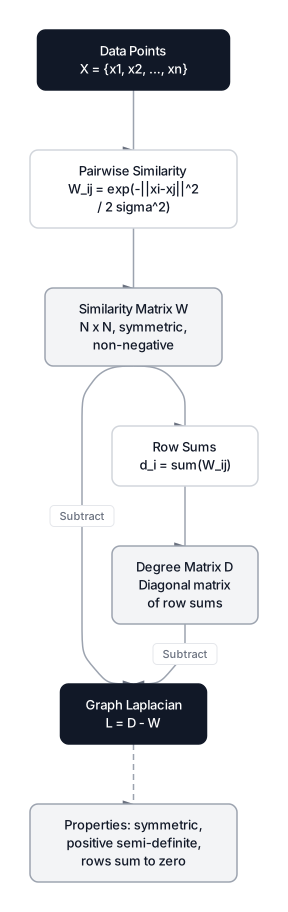 Click to expandConstruction of the graph Laplacian from raw data through similarity and degree matrices
RBF vs. K-Nearest Neighbors affinity
Two main strategies exist for constructing :
| Strategy | scikit-learn parameter | Pros | Cons |
|---|---|---|---|
| RBF kernel | affinity='rbf' | Smooth, differentiable weights | Sensitive to gamma; dense matrix |
| KNN graph | affinity='nearest_neighbors' | Sparse matrix, faster for large | Must choose n_neighbors; binary connections |
The RBF kernel connects every point to every other point with exponentially decaying weights. The KNN graph only connects each point to its nearest neighbors, producing a sparse matrix that's cheaper to decompose. For datasets under 10,000 points, both work. Beyond that, KNN is the practical choice.
Pro Tip: If your features have very different scales, standardize them before computing the similarity matrix. The RBF kernel uses Euclidean distance, so a feature ranging from 0 to 1,000 will dominate one ranging from 0 to 1.
The Graph Laplacian
The graph Laplacian is the mathematical engine that encodes cluster structure. The unnormalized Laplacian is:
Where:
- is the graph Laplacian matrix
- is the degree matrix, a diagonal matrix where (the total connection strength of point )
- is the similarity matrix
Two critical properties make the Laplacian useful. It is positive semi-definite (all eigenvalues ), and the number of zero eigenvalues equals the number of connected components. If your data has two perfectly separated clusters, has exactly two zero eigenvalues.
The quadratic form reveals the cut cost
The real power of the Laplacian shows up in its quadratic form:
Where:
- is a vector assigning a real value to each data point (a soft cluster label)
- is the similarity between points and
- are the values assigned to points and
In Plain English: This formula computes the "cost" of a particular assignment of labels to points. If two points on the same crescent have a strong edge ( near 1) but get different labels (large ), the penalty is large. Minimizing this cost keeps strongly connected points in the same cluster. The algorithm searches for the label vector that makes this cost as small as possible.
Eigenvectors Encode Cluster Structure
Finding the discrete assignment that minimizes the graph cut is NP-hard. The spectral relaxation replaces the discrete constraint (labels must be 0 or 1) with a continuous one (labels can be any real number). The solution to this relaxed problem turns out to be the eigenvectors corresponding to the smallest eigenvalues of .
The eigenvector for eigenvalue 0 is trivial (a constant vector, since every row of sums to zero). The second eigenvector, called the Fiedler vector, contains the actual partition information. Points with positive Fiedler values belong to one cluster; points with negative values belong to the other.
For $k > 2$ clusters, we take the eigenvectors with the smallest eigenvalues, stack them as columns to form an matrix, and run K-Means on the rows of that matrix. In this spectral embedding space, the complex crescent shapes have been straightened into compact blobs that K-Means separates trivially.
Key Insight: Spectral clustering doesn't avoid K-Means. It transforms the data so that K-Means becomes the right tool. The eigenvectors provide a coordinate system where connectivity-based clusters look like the spherical blobs K-Means was designed for.
K-Means vs. Spectral Clustering on Two Moons
Let's see the difference. We'll generate 300 points forming two interlocking crescents and compare K-Means (which uses distance to centroids) against spectral clustering (which uses graph connectivity). The Adjusted Rand Index (ARI) measures clustering accuracy: 1.0 means perfect recovery, 0.0 means random assignment.
Expected output:
Two Moons Dataset (300 points, noise=0.06)
K-Means  ARI: 0.2475
Spectral ARI: 1.0000
Spectral perfectly recovered both crescents (ARI = 1.0)
K-Means achieves an ARI of 0.25, barely better than random. It drew a vertical boundary through both crescents. Spectral clustering scores a perfect 1.0 because the RBF kernel captured the curved connectivity within each crescent, and the eigenvectors mapped each moon to a distinct cluster in spectral space.
The Laplacian Eigendecomposition in Practice
Let's build the Laplacian from scratch and examine its eigenvalues. The eigengap heuristic tells us how many clusters exist: look for the first large jump in the sorted eigenvalue sequence.
Expected output:
Smallest 6 eigenvalues of the unnormalized Laplacian:
[-0.      0.1023  0.3909  0.4333  1.2517  1.4617]

Eigengap after lambda_2: 0.2887
Eigengap after lambda_3: 0.0423
=> Large jump after 2 near-zero eigenvalues confirms k=2

Fiedler vector sign-cut ARI: 1.0000
Positive entries: 150, Negative: 150
The first eigenvalue is essentially 0 (the trivial constant vector). The second (0.1023) is small but nonzero because the two moons nearly touch at their tips. The jump between eigenvalue 2 and 3 (0.2887 vs. 0.0423) confirms $k = 2$. The Fiedler vector splits all 300 points into two groups of exactly 150, achieving a perfect ARI.
Common Pitfall: If the first several eigenvalues are all very close to zero with no clear gap, your data may not have well-separated clusters, or your similarity bandwidth ( or gamma) is too large, making the entire graph look like one connected component.
Choosing the Number of Clusters with the Eigengap
The eigengap heuristic is one of spectral clustering's practical advantages over density-based methods. Rather than running the algorithm for multiple values of and comparing silhouette scores (as you'd do with K-Means), you examine the eigenvalue spectrum directly.
Plot the eigenvalues in ascending order. The number of near-zero eigenvalues tells you :
- If eigenvalues are
[0.00, 0.00, 0.01, 0.85, 1.2, ...], the gap after position 3 suggests $k = 3$ - If eigenvalues are
[0.00, 0.10, 0.39, 0.43, ...], the gap after position 2 (as in our moons example) suggests $k = 2$
This works because a graph with disconnected components has exactly zero eigenvalues. Real data won't have exact zeros, but the near-zero eigenvalues will be noticeably smaller than the rest.
Pro Tip: The eigengap is not foolproof. When clusters overlap substantially or have very different sizes, the gap can be ambiguous. In those cases, fall back to the silhouette score or try Gaussian Mixture Models, which select using BIC.
Gamma Sensitivity and Tuning
The gamma parameter (or equivalently ) is spectral clustering's most important hyperparameter when using the RBF kernel. It controls the radius of connectivity: how far apart two points can be and still count as neighbors.
Expected output:
Gamma Sensitivity on Two Moons (affinity=rbf)
   gamma     ARI                          Result
--------------------------------------------------
     0.1  0.2278                 Poor clustering
     1.0  0.2965                 Poor clustering
     5.0  0.4883                 Poor clustering
    15.0  1.0000              Perfect separation
    50.0  1.0000              Perfect separation
   200.0  1.0000              Perfect separation
At low gamma (0.1 to 5.0), the kernel is too broad: every point connects to every other point with similar weight, washing out the crescent structure. At gamma = 15 and above, the kernel tightens enough to capture local connectivity within each moon while severing cross-gap connections. In practice, try a logarithmic range (0.01, 0.1, 1, 10, 100) and pick the value that produces the clearest eigengap.
Common Pitfall: Using affinity='nearest_neighbors' avoids the gamma tuning problem entirely. The n_neighbors parameter is typically easier to set: values between 5 and 20 work for most datasets. Start with n_neighbors=10 and adjust if the eigengap looks noisy.
Computational Cost and Scaling
Spectral clustering's biggest practical limitation is its time complexity for eigendecomposition and memory for storing the full similarity matrix. Here's a quick benchmark (run on a standard laptop):
import numpy as np
from sklearn.datasets import make_moons
from sklearn.cluster import SpectralClustering
from sklearn.metrics import adjusted_rand_score
import time

np.random.seed(42)

for n in [500, 1000, 2000, 5000]:
    X, y = make_moons(n_samples=n, noise=0.06, random_state=42)
    t0 = time.time()
    sc = SpectralClustering(n_clusters=2, affinity='rbf', gamma=15.0,
                            random_state=42, n_init=10)
    labels = sc.fit_predict(X)
    elapsed = time.time() - t0
    ari = adjusted_rand_score(y, labels)
    print(f'N={n:>5d}  Time={elapsed:.3f}s  ARI={ari:.4f}')
Typical output (timing varies by machine):
N=  500  Time=0.036s  ARI=1.0000
N= 1000  Time=0.062s  ARI=1.0000
N= 2000  Time=0.211s  ARI=0.9980
N= 5000  Time=1.646s  ARI=0.9976
At 5,000 points, spectral clustering already takes over a second. At 50,000 points, you'll wait minutes and consume gigabytes of RAM. The Nystrom approximation helps by computing eigenvectors on a sampled subset and interpolating. But beyond 20,000 points, DBSCAN or HDBSCAN are more practical choices.
| Dataset Size | Similarity Matrix Memory | Practical? |
|---|---|---|
| 1,000 | ~8 MB | Fast, no issues |
| 10,000 | ~800 MB | Feasible with patience |
| 50,000 | ~20 GB | Impractical without approximation |
| 100,000 | ~80 GB | Use DBSCAN or HDBSCAN instead |
When to Use Spectral Clustering
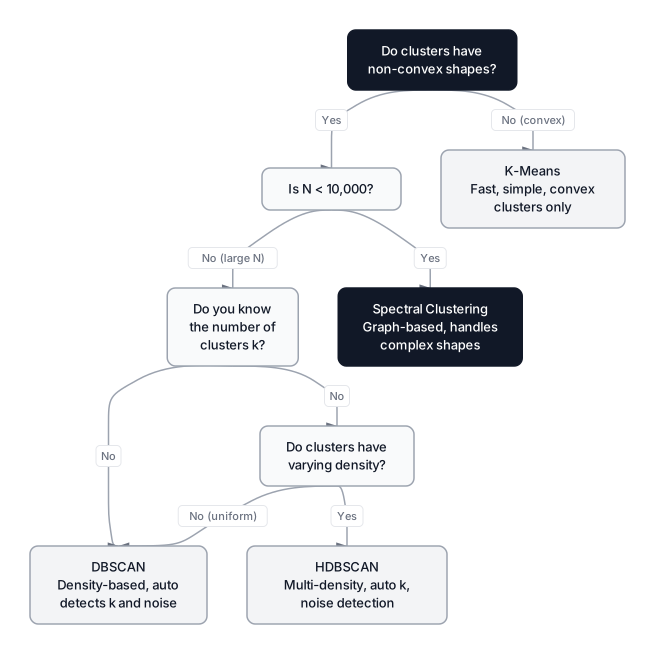 Click to expandClustering algorithm selection flowchart based on cluster shape, dataset size, and whether k is known
When spectral clustering is the right choice
- Non-convex cluster shapes. Crescents, spirals, concentric rings, interleaving structures. If K-Means fails because it can't handle the geometry, spectral clustering is the first alternative to try.
- Small to medium datasets (under 10,000 points). The cubic scaling is acceptable and the results are often superior to simpler methods.
- You know in advance. The eigengap helps confirm your choice, but you still need to specify it.
- Image segmentation. This is spectral clustering's original application domain (Shi and Malik, 2000). Pixels are nodes; edges connect neighboring pixels with similar color values.
- Community detection in small networks. Social network subgroups, biological pathway modules, citation clusters.
When NOT to use spectral clustering
- Large datasets (over 20,000 points). The eigendecomposition becomes a bottleneck. Use HDBSCAN, which handles arbitrary shapes and scales to millions of points.
- Unknown number of clusters with no eigengap. If the eigenvalue spectrum shows no clear gap, spectral clustering won't give you a confident . DBSCAN or HDBSCAN discover automatically.
- Clusters with very different densities. A single
gammavalue can't simultaneously capture a tight cluster and a diffuse one. GMMs with per-component covariance handle this better. - High-dimensional data. Euclidean distance becomes less meaningful in high dimensions (the curse of dimensionality). Apply PCA first, then cluster in the reduced space.
- Streaming or online data. Spectral clustering requires the full dataset upfront. Mini-batch K-Means or online DBSCAN variants handle incremental data.
Normalized vs. Unnormalized Laplacians
The unnormalized Laplacian ($L = D - W$) is the simplest variant, but it has a bias: high-degree nodes (points with many strong connections) dominate the eigenstructure. Two common normalized variants correct this.
Symmetric normalized Laplacian:
Random walk Laplacian:
Where:
- is the identity matrix
- is the inverse square root of the degree matrix
- is the random walk transition matrix
In Plain English: Normalization adjusts for the fact that some points in the two moons dataset have more neighbors than others (especially points near the tips vs. the middle of each crescent). Without normalization, the dense middle of each moon dominates the eigenvectors. With normalization, every point contributes proportionally to its local connectivity.
Scikit-learn's default SpectralClustering uses the random walk variant internally. In practice, the normalized versions produce more balanced cluster sizes and are preferred for most applications. The original Ng, Jordan, and Weiss (2001) algorithm uses the symmetric normalized Laplacian with row normalization of the eigenvector matrix.
When Spectral Clustering Fits
Spectral clustering reframes an impossible geometry problem as a tractable linear algebra one. By building a similarity graph, computing its Laplacian, and projecting data into eigenvector space, it transforms tangled crescents into simple blobs that K-Means separates perfectly. The eigenvectors encode cluster structure, turning a combinatorially hard graph-cut problem into a continuous optimization with a closed-form solution.
The main limitation is computational: eigendecomposition restricts it to datasets under roughly 20,000 points. For larger non-convex datasets, HDBSCAN scales better with automatic cluster detection. When clusters are convex, K-Means remains faster and simpler. For soft probabilistic assignments, Gaussian Mixture Models fill that gap.
Master the graph Laplacian and you gain a way of thinking about data that extends far beyond clustering: recommendation systems, dimensionality reduction, and semi-supervised learning all build on the same spectral foundation.
Frequently Asked Interview Questions
Q: Why does K-Means fail on non-convex clusters while spectral clustering succeeds?
K-Means assigns points to the nearest centroid, implicitly assuming spherical clusters. A centroid can't represent a crescent. Spectral clustering converts data into a graph where edges encode local similarity, then uses the Laplacian's eigenvectors to project points into a space where K-Means works correctly.
Q: What is the graph Laplacian and why is it central to spectral clustering?
The graph Laplacian $L = D - W$ encodes the graph's connectivity structure. Its quadratic form measures how much a labeling "disagrees" with the edge weights: strongly connected points with different labels produce high cost. The eigenvectors of with the smallest eigenvalues minimize this cost, giving the optimal cluster partition.
Q: How do you choose the number of clusters in spectral clustering?
Use the eigengap heuristic. Compute the Laplacian's eigenvalues in ascending order and look for the first large jump. If the first three eigenvalues are near zero and the fourth jumps significantly, choose $k = 3$. This works because a graph with perfectly disconnected components has exactly zero eigenvalues. In practice, noise makes the gap approximate, so you may also confirm with silhouette scores.
Q: What is the Fiedler vector?
The Fiedler vector is the eigenvector corresponding to the second-smallest eigenvalue of the graph Laplacian (the smallest non-trivial eigenvector). For a two-cluster problem, the sign of each entry directly assigns that point to a cluster: positive values in one group, negative in the other. It represents the relaxed solution to the minimum graph-cut problem and is the foundation for spectral bipartitioning.
Q: When would you choose spectral clustering over DBSCAN?
Use spectral clustering when you know the number of clusters, the dataset is small enough (under 10,000 to 20,000 points), and the clusters have complex shapes. DBSCAN is better when you don't know , need automatic noise detection, or have a large dataset. DBSCAN also handles varying local densities better with HDBSCAN, while spectral clustering's single gamma parameter struggles when cluster scales differ significantly.
Q: What is the computational complexity of spectral clustering, and how does it limit practical use?
Building the similarity matrix is in time and memory; eigendecomposition adds . Beyond 20,000 points, this becomes impractical without approximations like Nystrom sampling. For large datasets, HDBSCAN ( with spatial indexing) is far more efficient.
Q: What is the difference between the normalized and unnormalized graph Laplacian?
The unnormalized Laplacian $L = D - W$ can produce unbalanced clusters because high-degree nodes dominate the eigenvectors. The normalized variants (symmetric: ; random walk: ) correct for degree differences, producing more balanced partitions. In practice, normalized Laplacians are preferred and are what scikit-learn uses by default.
Q: Your spectral clustering produces one giant cluster with a few singleton outliers. What went wrong?
The gamma parameter is likely too small, making the similarity graph nearly disconnected. Most points become isolated nodes with no edges to cut. Increase gamma to strengthen connections, or switch to affinity='nearest_neighbors' which guarantees each point connects to at least n_neighbors points regardless of distance.
Hands-On Practice
Spectral Clustering is a powerful technique that uses graph theory to identify complex structures in data that traditional algorithms like K-Means often miss. While K-Means assumes clusters are spherical blobs, Spectral Clustering identifies clusters based on connectivity, making it ideal for interlocking or non-convex shapes. We'll apply Spectral Clustering to a customer segmentation dataset, demonstrating how to transform data into a similarity graph and use eigenvalues to uncover distinct customer groups.
Dataset: Customer Segments (Clustering) Customer segmentation data with 5 natural clusters based on income, spending, and age. Silhouette score ≈ 0.75 with k=5.
Changing affinity from 'nearest_neighbors' to 'rbf' alters how the graph is constructed and can change the resulting clusters. The n_neighbors value controls graph connectivity: too low can fragment the graph, while too high can merge distinct clusters.