
You have a dataset with 500 columns. Your model trains for hours, generalizes poorly, and nobody on the team can explain which variables actually matter. Something has to go. The question is whether you should pick the best columns and throw away the rest, or mathematically compress all 500 into a handful of new variables that capture the same information. That choice between feature selection and feature extraction shapes everything downstream: model accuracy, training speed, interpretability, and whether a stakeholder can actually trust your results.
Both techniques attack the same enemy (too many dimensions) but they do it in fundamentally different ways. Think of your dataset as a bowl of fruit containing strawberries, bananas, kale, and spinach. Feature selection makes a fruit salad: you toss the kale and spinach, keeping strawberries and bananas exactly as they are. Feature extraction makes a smoothie: everything goes into the blender, and the result is a new substance that retains the vitamins but no longer lets you point to any sip and say "that's a banana."
This running example, the breast cancer Wisconsin dataset with 30 numeric features describing tumor cell nuclei, will anchor every code block and formula in this article.
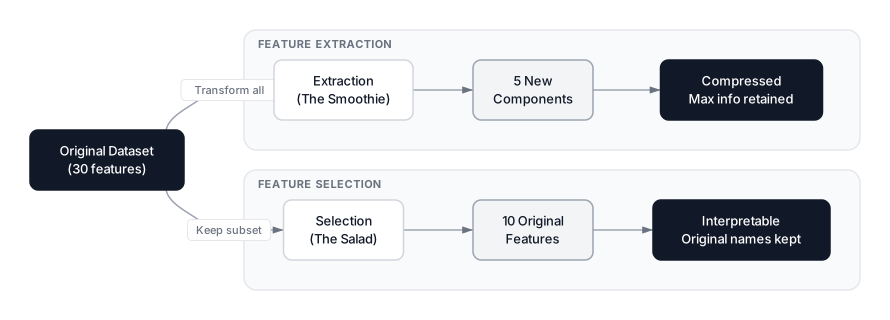 Click to expandFeature selection vs feature extraction comparison showing salad approach versus smoothie approach
The Curse of Dimensionality Explained
The curse of dimensionality is the phenomenon where adding more features makes your data exponentially sparser in the feature space, degrading the performance of distance-based and statistical algorithms. As dimensions grow, every data point drifts equally far from every other point.
Formally, as the number of dimensions grows:
Where:
- is the distance from a query point to its farthest neighbor
- is the distance from a query point to its nearest neighbor
- is the number of features (dimensions)
In Plain English: In our breast cancer dataset, if we inflated the 30 features to 3,000 by adding noise columns, a K-Means algorithm would see the nearest malignant tumor and the farthest benign tumor as almost equidistant. The algorithm can't distinguish "similar" from "different" because distances compress in high-dimensional space.
Richard Bellman coined the term in 1961 in his work on dynamic programming, and the effect hits hardest with algorithms that rely on distance metrics: KNN, K-Means, SVM with RBF kernels, and Gaussian mixture models. Tree-based methods like Random Forest handle high dimensions better because they split on one feature at a time, but even they slow down and overfit when most columns are noise.
The practical rule of thumb: you need roughly observations to maintain the same data density as you scale dimensions. With 30 features, that's an astronomically large number. Dimensionality reduction isn't optional for wide datasets; it's survival.
Feature Selection Methods: Filter, Wrapper, and Embedded
Feature selection keeps a subset of the original features and discards the rest. The surviving columns are the exact same variables you started with, so a doctor can still read "worst radius" on a report instead of "Principal Component 3." The scikit-learn feature selection module organizes these into three families.
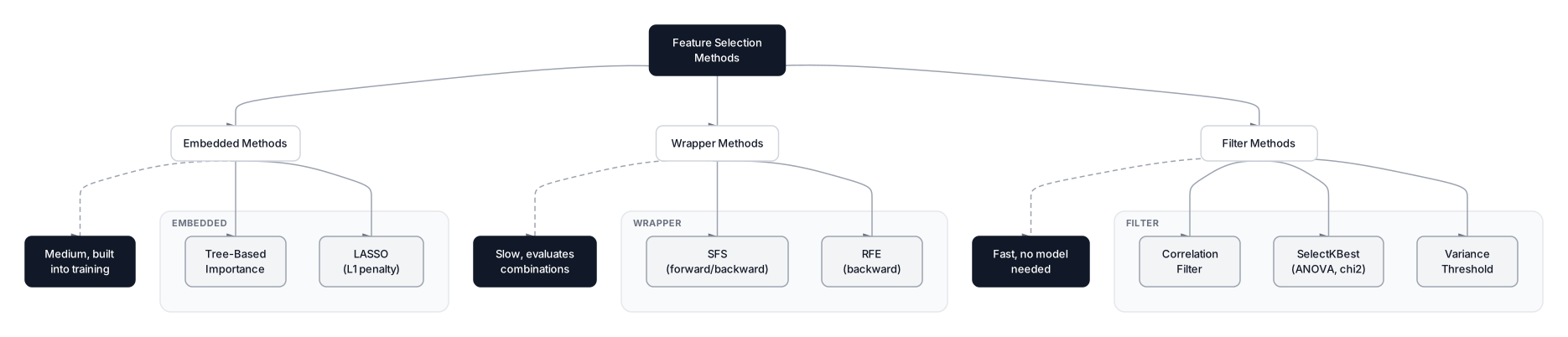 Click to expandFeature selection methods taxonomy showing filter, wrapper, and embedded approaches
Filter Methods
Filter methods rank features by a statistical score computed independently of any model. They're fast (often ) but blind to interactions between features.
- Variance Threshold: Removes features with near-zero variance. If a column is constant across 99% of rows, it carries no discriminative signal.
- Univariate tests (ANOVA F-test, chi-squared, mutual information): Score each feature against the target independently.
SelectKBestin scikit-learn 1.8 wraps all of these behind a single API. - Correlation filter: Drops one feature from every pair where Pearson correlation exceeds a threshold (say 0.95), reducing multicollinearity.
Pro Tip: Filter methods work well as a first pass. Running VarianceThreshold followed by a correlation filter can halve your feature count in seconds before you spend hours on more expensive methods.
Wrapper Methods
Wrapper methods treat feature selection as a search problem. They train a model, evaluate its performance, modify the feature set, and repeat. The search can be forward (start empty, add features) or backward (start full, remove features).
- Recursive Feature Elimination (RFE): Trains the model on all features, ranks them by importance (coefficients or impurity-based importance), drops the weakest, and repeats until the target count is reached.
- Sequential Feature Selection (SFS): Added to scikit-learn in version 0.24 and refined through 1.8, SFS performs a greedy forward or backward search using cross-validated scores at each step. It's more flexible than RFE because it works with any estimator and scoring metric.
Common Pitfall: Wrapper methods are expensive. Running RFE with a Random Forest on 10,000 features means fitting the forest thousands of times. Use RFECV with a step size greater than 1, or switch to SFS with direction='backward' and a fast estimator.
Embedded Methods
Embedded methods perform feature selection during training. The model itself decides which features matter.
- LASSO (L1 regularization): As covered in our Ridge, Lasso, and Elastic Net guide, L1 penalty drives weak coefficients to exactly zero, producing a sparse model that doubles as a feature selector.
- Tree-based importance: Random Forest and XGBoost compute how much each feature reduces impurity (Gini or entropy) across all trees. Features that never appear in any split have zero importance.
The LASSO objective for logistic regression looks like this:
Where:
- is the vector of model coefficients
- is the number of training samples
- is the true label (0 or 1) for sample
- is the predicted probability for sample
- is the regularization strength (inverse of in scikit-learn)
- is the number of features
- is the absolute value of the coefficient for feature
In Plain English: The model tries to minimize classification error on the breast cancer data, but every coefficient pays a tax proportional to its size. Features that don't contribute enough to offset the tax get their coefficient forced to zero, effectively removing them from the model. Crank up and more features get eliminated.
Feature Selection in Practice
This block demonstrates filter (SelectKBest) and wrapper (RFE) methods on the breast cancer dataset, then compares their cross-validated accuracy against using all 30 features.
Expected Output:
Dataset: 569 samples, 30 features

SelectKBest (k=10): ['mean radius', 'mean perimeter', 'mean area', 'mean concavity', 'mean concave points', 'worst radius', 'worst perimeter', 'worst area', 'worst concavity', 'worst concave points']
RFE (k=10): ['mean concave points', 'radius error', 'area error', 'compactness error', 'worst radius', 'worst texture', 'worst perimeter', 'worst area', 'worst concavity', 'worst concave points']

Accuracy (all 30 features):  0.9789
Accuracy (SelectKBest 10):   0.9526
Accuracy (RFE 10):           0.9666
Notice how the two methods chose different features. SelectKBest grabbed size-related features (radius, perimeter, area) because they have the highest individual F-scores. RFE, guided by the logistic regression coefficients, picked features that work well together as a group, including texture and compactness that SelectKBest missed.
Key Insight: RFE outperforms SelectKBest here because it evaluates features in combination rather than individually. A feature with a mediocre solo score can still be valuable when paired with others. That's the trade-off: RFE is slower but smarter.
Feature Extraction Transforms Data Into New Variables
Feature extraction projects the original high-dimensional data into a lower-dimensional space by creating new variables that are mathematical combinations of the originals. No column survives intact. Instead, you get components, factors, or latent dimensions that compress as much information as possible into fewer numbers.
Principal Component Analysis (PCA)
PCA is the most widely used linear extraction technique, first described by Hotelling in 1933 and later popularized by Jolliffe's comprehensive textbook. It finds orthogonal directions (principal components) that maximize the variance captured from the original data.
The first principal component is the linear combination with maximum variance:
Where:
- is the first principal component score for a given sample
- is the weight (loading) of original feature on the first component
- is the standardized value of original feature
- is the total number of original features (30 in our breast cancer dataset)
In Plain English: PC1 in our breast cancer data is a weighted blend of all 30 measurements. The biggest weights go to concavity and radius features, so PC1 roughly captures "how irregular and large the tumor cells are." It's a single number that summarizes multiple physical measurements, but a pathologist can no longer point to it and say "this is the cell radius."
Other Extraction Techniques
- LDA (supervised): Maximizes class separability rather than variance. Particularly effective when you have labeled data and the number of classes is small.
- t-SNE and UMAP (non-linear): Preserve local neighborhood structure for visualization. UMAP scales better than t-SNE and can be used for general dimensionality reduction, not just 2D plots.
- Autoencoders (neural): Learn non-linear compressions through an encoder-decoder bottleneck. Best for very high-dimensional data like images or text embeddings.
PCA Extraction in Practice
Expected Output:
PCA ( 2 components): variance = 63.24%, accuracy = 0.9526
PCA ( 5 components): variance = 84.73%, accuracy = 0.9719
PCA (10 components): variance = 95.16%, accuracy = 0.9789
All 30 features:   variance = 100.00%, accuracy = 0.9789

Top 5 contributors to PC1:
  mean concave points: 0.2609
  mean concavity: 0.2584
  worst concave points: 0.2509
  mean compactness: 0.2393
  worst perimeter: 0.2366
Two components capture 63% of the variance and match the accuracy of SelectKBest's 10 features. At 10 components (95% variance), PCA matches the full 30-feature baseline. The loading analysis reveals that PC1 is dominated by concavity and shape features, which makes biological sense: irregular cell boundaries are a primary indicator of malignancy.
Pro Tip: Always standardize your features before PCA. Without standardization, features measured in larger units (like "area" in square microns) dominate the variance simply because of their scale, not their informational value.
Embedded Selection: LASSO Zeroes Out Irrelevant Features
L1-penalized logistic regression performs feature selection as a byproduct of training. Features that don't earn their keep get coefficients pushed to exactly zero.
Expected Output:
L1 Logistic Regression (C=0.1):
  Non-zero coefficients: 8
  Zeroed-out features:   22

Surviving features and their coefficients:
  worst radius: -2.3459
  worst concave points: -0.8126
  worst texture: -0.6947
  mean concave points: -0.6291
  radius error: -0.5153
  worst smoothness: -0.2570
  worst symmetry: -0.1949
  worst concavity: -0.0634

Accuracy (L1-selected 8 features): 0.9701
LASSO eliminated 22 of 30 features in one shot, and the remaining 8 still achieve 97% accuracy. The negative coefficients make clinical sense: higher values of "worst radius" and "worst concave points" push the prediction toward malignant (class 0). This is the power of embedded methods: you get a trained model and a feature-selected dataset simultaneously.
Head-to-Head Comparison
| Criterion | Feature Selection | Feature Extraction |
|---|---|---|
| Mechanism | Keeps a subset of original columns | Creates new columns via transformation |
| Interpretability | High (original variable names survive) | Low (components are abstract blends) |
| Information loss | Can be high (discarded features are gone) | Low (compresses rather than discards) |
| Computational cost | Varies: filter , wrapper | PCA , autoencoders higher |
| Scaling | Handles 100K+ features (filter methods) | PCA struggles past ~50K features |
| Best for | Regulatory/clinical settings, causal analysis | Image/audio, visualization, dense compression |
| Example methods | LASSO, RFE, SelectKBest, SFS | PCA, LDA, t-SNE, UMAP, Autoencoders |
When to Select Features
Feature selection is the right call in these situations:
Interpretability is mandatory. In regulated industries, from healthcare to finance, you need to explain predictions in terms of original variables. Telling a loan officer "we denied the application because Component 4 was high" gets you nowhere. Telling them "the debt-to-income ratio exceeded the threshold" is actionable.
Features have physical meaning. If you're diagnosing tumors based on cell measurements, you want to know which measurement matters most. In our breast cancer example, LASSO told us that "worst radius" is the strongest predictor. That's medically meaningful and can guide biopsy protocols.
The dataset is sparse. In NLP, bag-of-words representations can have 50,000+ features, most of them zero. Removing stop words and low-frequency terms (a form of filter selection) is computationally cheaper than running PCA on a sparse matrix, and it preserves the vocabulary.
You need fast inference. In production, fewer original features means a simpler serving pipeline. You don't need to store PCA transformation matrices or worry about numerical stability during the transform step.
When to Extract Features
Feature extraction wins when raw features are individually meaningless or when you need maximum compression.
Perceptual data (images, audio, sensor arrays). A single pixel value tells you nothing. Convolutional layers in deep networks are feature extractors that turn pixels into edges, textures, and objects. PCA on raw pixel data removes correlated color channels.
Visualization. You can't plot 30 dimensions. Extracting 2 components with PCA or UMAP gives you a 2D scatter plot where clusters become visible.
Multicollinearity is severe. When many features measure the same underlying construct (like the radius, perimeter, and area of a tumor cell, which are geometrically related), PCA collapses them into orthogonal components, eliminating redundancy without picking favorites.
You want to denoise. PCA with fewer components than features acts as a noise filter. The first few components capture signal; the rest capture noise. Discarding the tail components smooths out measurement error.
When NOT to Use Each Approach
Don't select features when the signal is spread thinly across many correlated features. LASSO arbitrarily picks one feature from a correlated group and zeros the others, which is unstable and can miss important predictors.
Don't extract features when a regulator or business stakeholder needs to understand which original variables drive predictions. Saying "PC1 is high" doesn't satisfy an auditor.
Don't skip standardization before extraction. PCA on unstandardized data will be dominated by whichever feature has the largest raw variance, regardless of its informational value.
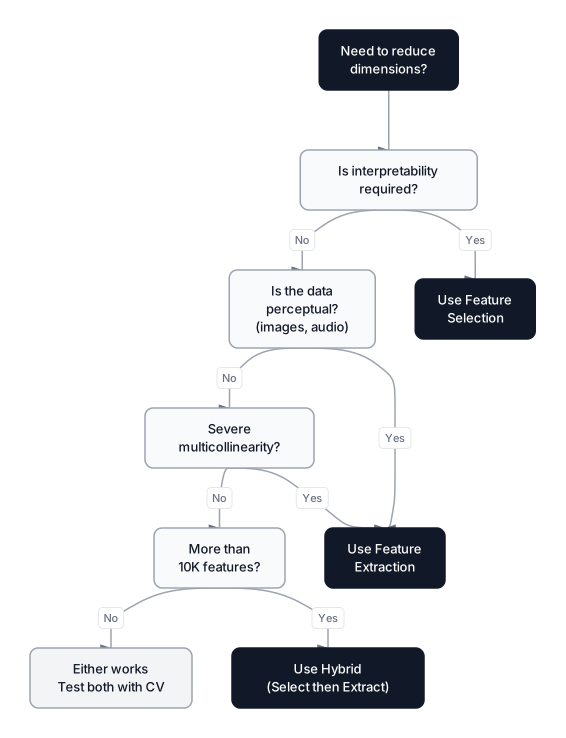 Click to expandDecision guide for choosing between feature selection and feature extraction
The Hybrid Approach: Select First, Then Extract
In production ML pipelines, the best results often come from combining both strategies in sequence. First use cheap filter methods to remove obvious garbage (constant columns, highly correlated duplicates), then apply PCA to compress the remaining signal.
Expected Output:
Pipeline Comparison (5-fold CV accuracy):
  Baseline (30 features):            0.9789
  PCA only (30 -> 5 components):     0.9702
  Hybrid (30 -> 20 -> 5 components): 0.9684
The hybrid pipeline (select 20 features, then compress to 5 components) achieves comparable accuracy to PCA alone. On this clean dataset the difference is small, but on real-world datasets with thousands of noisy features the selection step dramatically reduces computation time for the PCA step. When your feature matrix has 50,000 columns, cutting it to 5,000 before PCA can turn a 10-minute computation into a 6-second one.
Key Insight: The funnel pattern (filter garbage out, then compress signal) is the standard approach in production pipelines at companies dealing with wide data. The selection step handles the easy wins cheaply; the extraction step handles the subtle correlations precisely.
 Click to expandHybrid funnel approach showing selection filtering followed by extraction compression
Production Considerations
Computational complexity. Filter selection is per feature. PCA is for the covariance matrix plus for eigendecomposition. For datasets where $d > 10,000$, use sklearn.decomposition.TruncatedSVD (which skips the full eigendecomposition) or incremental PCA (IncrementalPCA), which processes data in batches.
Memory. PCA computes a covariance matrix. With 100,000 features, that's 80 GB of RAM for float64. TruncatedSVD and IncrementalPCA avoid this by never materializing the full matrix.
Storing transformations. Feature selection just stores a boolean mask. PCA stores the full components matrix. In a microservice architecture, the PCA object can be several megabytes for wide datasets, which matters if you're loading it per request.
Data leakage. Both selection and extraction must be fit on training data only. Fitting SelectKBest or PCA on the full dataset before splitting leaks test information into the transform. Always use sklearn.pipeline.Pipeline to prevent this, as shown in the hybrid example above.
Selection or Extraction: A Practical Rule
Feature selection and feature extraction solve the same problem through opposite philosophies. Selection says "most of these columns are noise, let's find the signal and discard the rest." Extraction says "the signal is spread across everything, let's compress it into fewer dimensions."
For interpretable models in regulated settings, feature selection is the clear winner. The LASSO and regularization family gives you simultaneous model training and feature selection. For compression-heavy tasks like image processing or visualization, PCA and its non-linear cousins (UMAP, autoencoders) deliver maximum information retention in minimum dimensions.
In practice, the best pipelines use both. Filter out the garbage cheaply, then compress the remaining signal with PCA or a learned embedding. That funnel approach gives you the speed of selection and the compression power of extraction without forcing a binary choice.
Frequently Asked Interview Questions
Q: What is the fundamental difference between feature selection and feature extraction?
Feature selection keeps a subset of the original features unchanged and discards the rest. Feature extraction creates entirely new variables by mathematically combining originals. Selection preserves interpretability; extraction maximizes information compression. A selected feature like "worst radius" is still directly measurable, while an extracted component like "PC1" is a weighted blend of all original features.
Q: Why should you standardize features before applying PCA?
PCA maximizes variance along principal components. Without standardization, features measured in larger units (e.g., area in square microns vs. smoothness as a decimal) dominate the variance simply because of their scale. Standardizing to mean-zero, unit-variance ensures PCA captures informational variance rather than scale artifacts.
Q: How does LASSO perform feature selection during training?
The L1 penalty term adds a cost proportional to the absolute value of each coefficient. During optimization, features whose predictive contribution doesn't justify this penalty get their coefficients driven to exactly zero. The result is a sparse model where only relevant features have non-zero coefficients, effectively selecting them as a byproduct of training.
Q: When would you prefer RFE over SelectKBest?
RFE evaluates features in the context of the model and in combination with other features. SelectKBest scores each feature independently using a univariate statistical test. If feature interactions matter (which they usually do), RFE tends to find better subsets. The trade-off is computational: RFE requires fitting the model many times, while SelectKBest runs a single pass.
Q: A stakeholder wants to understand which variables drive your model's predictions, but your current pipeline uses PCA. What do you do?
You have two practical options. First, examine the PCA loadings matrix to identify which original features contribute most to the important components, then present those to the stakeholder. Second, replace PCA with a feature selection method (LASSO or RFE) so the model uses original features directly. The second approach is cleaner for regulatory settings where "PC1 loading of 0.26 on concave points" isn't an acceptable explanation.
Q: Can feature extraction ever improve accuracy beyond what the original features achieve?
Yes, particularly when the signal is spread across many correlated features. PCA can denoise data by discarding low-variance components that capture measurement noise rather than true signal. In our breast cancer example, 10 PCA components (capturing 95% of variance) matched the full 30-feature accuracy, and denoised variants can occasionally surpass it on unseen data.
Q: What is the curse of dimensionality and how do both approaches address it?
As dimensions increase, data becomes exponentially sparse, and distance metrics lose discriminative power. Feature selection addresses this by reducing the number of dimensions directly (keeping only informative features). Feature extraction addresses it by projecting data onto a lower-dimensional manifold where distances are more meaningful. Both approaches restore the data density that algorithms need to generalize properly.
Q: You have a dataset with 50,000 features and limited compute. What dimensionality reduction strategy would you use?
Start with cheap filter methods: variance threshold to remove constants, then correlation filtering to eliminate redundant pairs. This might cut you to 10,000 features at negligible cost. Then apply TruncatedSVD (not full PCA, which would need a 50,000 x 50,000 covariance matrix) to compress to a manageable number of components. This hybrid funnel approach handles scale that neither pure selection nor pure extraction could manage alone.
Hands-On Practice
The "Curse of Dimensionality" head-on by comparing two fundamental strategies for handling high-dimensional data: Feature Selection and Feature Extraction. Using a specialized Wine Analysis dataset that contains real chemical markers mixed with redundant, derived, and noisy features, you will learn exactly when to discard features (Selection) versus when to compress them (Extraction). We will implement Variance Thresholding and Recursive Feature Elimination (RFE) for selection, and Principal Component Analysis (PCA) for extraction, allowing you to see the mathematical and practical differences between "making a salad" and "blending a smoothie."
Dataset: Wine Analysis (High-Dimensional) Wine chemical analysis with 27 features (13 original + 9 derived + 5 noise) and 3 cultivar classes. PCA: 2 components=45%, 5=64%, 10=83% variance. Noise features have near-zero importance. Perfect for dimensionality reduction, feature selection, and regularization.
Experiment by increasing n_components in the PCA step to 5 or 10; you will likely see the accuracy match the baseline as explained variance increases towards 80%. Conversely, try changing the RFE n_features_to_select to just 2 and observe how selection performance compares to the 2-component PCA smoothie. This comparison reveals the trade-off: PCA is often better at purely compressing information for performance, while RFE is superior when you need to explain exactly which variables drive the model's decisions.