
UN Convenes Global Dialogue on AI Governance
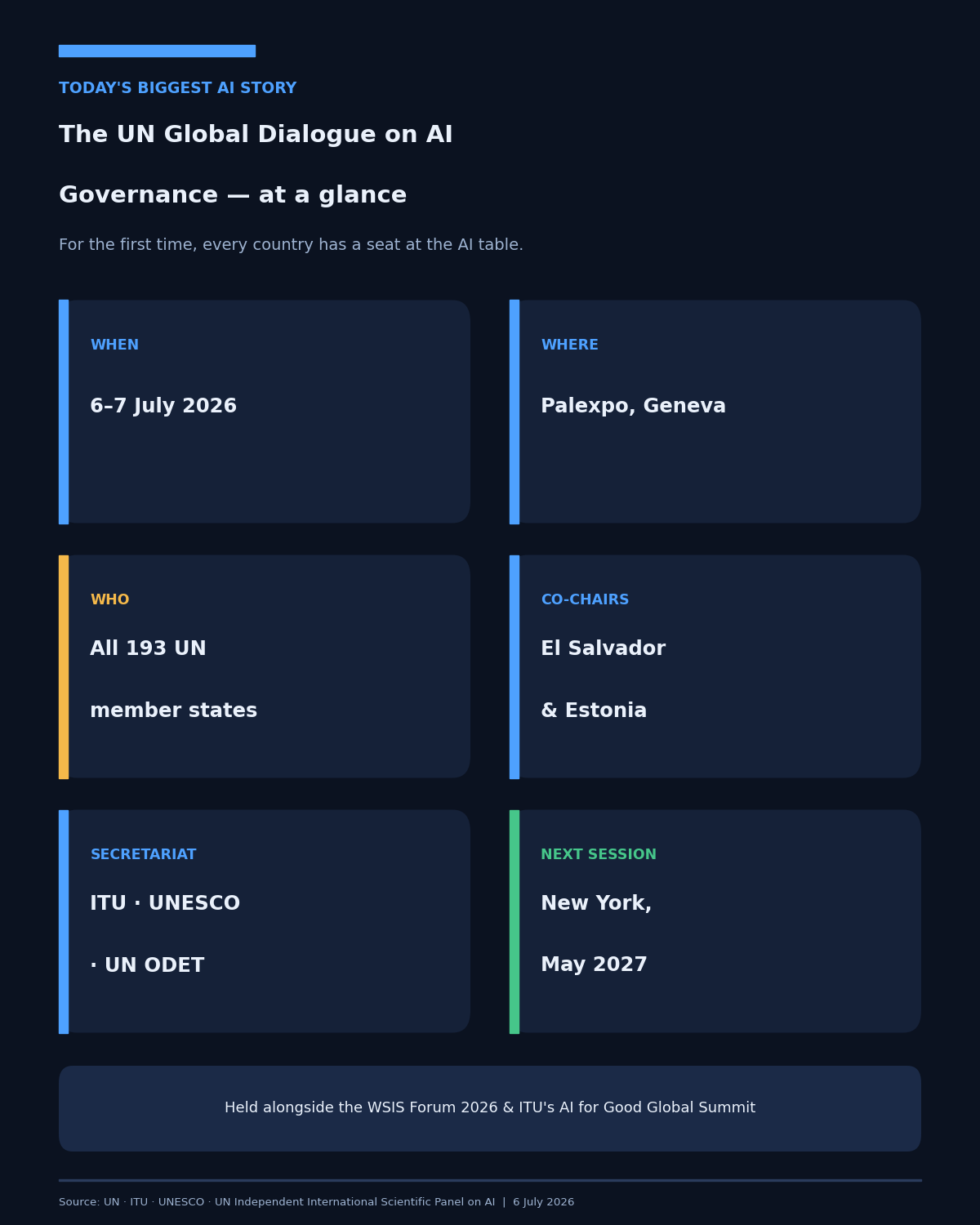
The United Nations' first Global Dialogue on AI Governance is scheduled for July 6-7, 2026 in Geneva, giving all 193 UN member states and outside stakeholders a formal venue for AI-governance coordination. The official UN and UNESCO pages say the meeting will cover international cooperation, best practices, safety, interoperability, and capacity-building, with the Independent International Scientific Panel on AI presenting its preliminary assessment. For practitioners, the near-term effect is not a new rule but a policy signal: model evaluation, documentation, procurement requirements, and cross-border compliance may start converging around UN-backed language if governments use the forum as a reference point.
The practitioner value of the UN dialogue is not that it immediately creates binding AI rules. It is that it gives governments, technical experts, companies, and civil society a shared venue for language that may later appear in procurement, evaluation, and compliance requirements. For teams deploying AI across borders, that makes the forum worth watching even before it produces formal standards.
What happened
The official UN Global Dialogue page says the first Global Dialogue on AI Governance will be held on July 6 and 7, 2026 in Geneva, with a second session planned for New York in May 2027. UNESCO describes the event as a two-day session with a high-level segment, thematic sessions, and side events, and says the Independent International Scientific Panel on AI will present its preliminary report during the event. The UN page says the Dialogue was established by the General Assembly and gives every country a seat at the table alongside private-sector, academic, technical, and civil-society stakeholders.
Timeline
The UN released the preliminary scientific assessment that will inform the first Global Dialogue on AI Governance.
The first session is scheduled to open at Palexpo in Geneva.
The first session is scheduled to close after high-level, thematic, and side-event programming.
Policy context
The dialogue bundles three policy channels that matter to technical teams: a shared scientific assessment, discussion of governance interoperability, and capacity-building for countries with less AI infrastructure. If governments later refer to the same assessment or vocabulary, companies may see more consistent expectations around model documentation, testing evidence, risk classification, and vendor accountability.
For practitioners
The immediate action is monitoring, not compliance implementation. Data and ML leaders should track whether the panel publishes concrete methods, whether government buyers cite the dialogue in procurement language, and whether capacity-building programs fund open evaluation tools, datasets, or compute access. Those are the paths through which a diplomatic forum becomes operational work for model owners and platform teams.
What to watch
Watch for post-session communiques, scientific-panel methods appendices, and follow-up commitments before treating the dialogue as a rules milestone. The score should reflect that distinction: this is a major governance forum with broad participation, but its near-term technical impact depends on what governments and standards bodies do after Geneva.
Key Points
- 1The UN dialogue creates a shared venue for AI-governance language that could later shape procurement and compliance expectations.
- 2The scientific panel's preliminary assessment is the technical artifact most likely to influence evaluation and documentation norms.
- 3Practitioners should monitor follow-up methods, standards references, and capacity-building commitments before changing deployment controls.
Scoring Rationale
This is a major multilateral governance forum with broad participation and a linked scientific assessment, so it can influence future standards and procurement language. The near-term technical impact is still indirect because the July 6-7 session has not yet produced binding rules or concrete implementation requirements.
Sources
Public references used for this report.
View 6 more sources
- Artificial Intelligence: Governance, Science and Global Cooperationwebtv.un.org
- The science is here: UN chief welcomes first global AI assessmentnews.un.org
- The World Is Trying to Govern AI. The UN Wants In.cfr.org
- Global Dialogue on AI Governancesdg.iisd.org
- What the UN Global Dialogue on AI Governance Reveals About Global Power Shiftscsis.org
- The case for a global AI governance flooradalovelaceinstitute.org
Practice interview problems based on real data
1,625 SQL & Python problems across 15 industry datasets — the exact type of data you work with.
Try 250 free problems