UBTech unveils Cruzr Y1 logistics humanoid robot
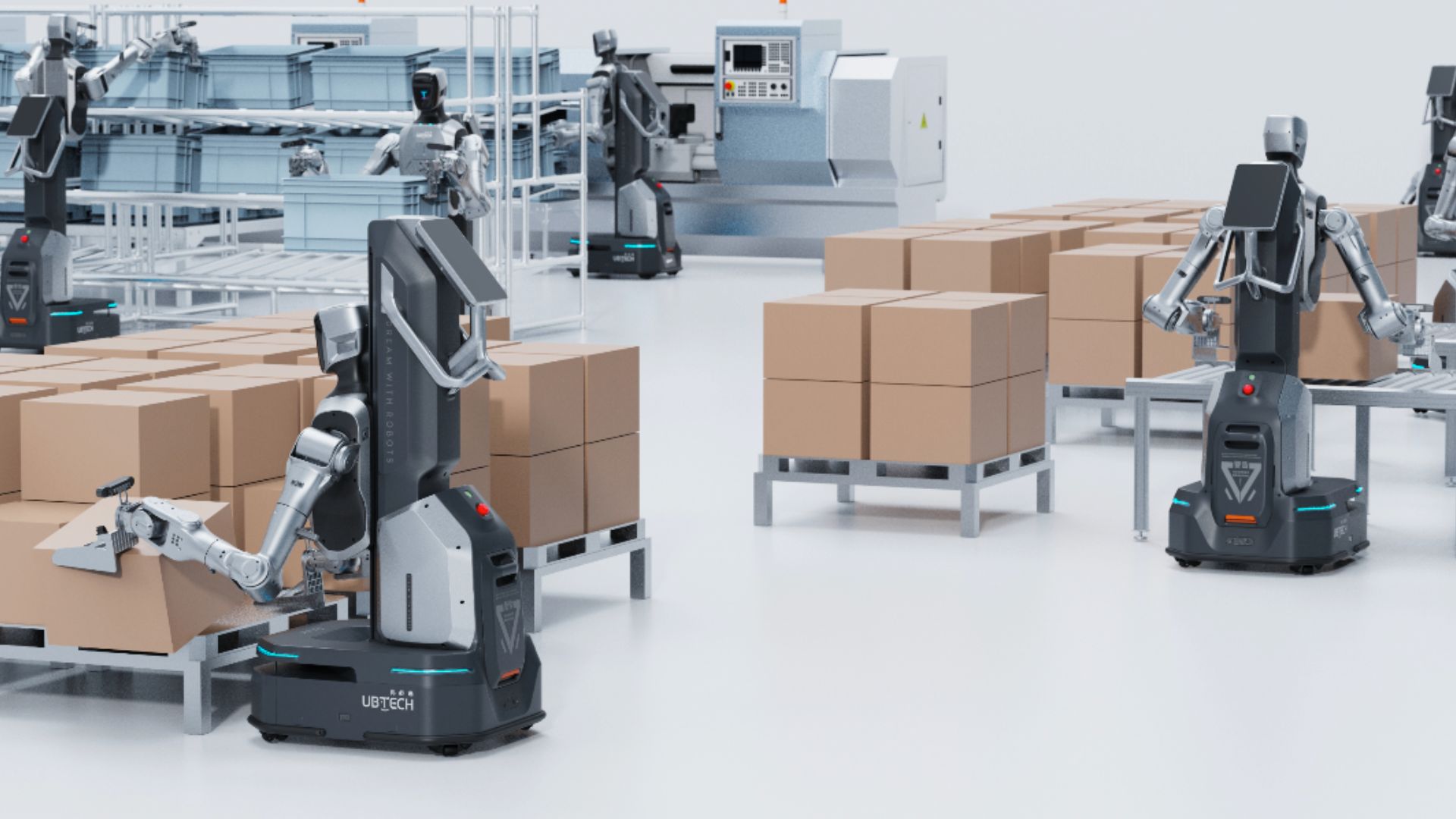
Chinese robotics firm UBTech unveiled the Cruzr Y1, a wheeled industrial humanoid robot for warehouse and factory box handling, at the OPPO Technology Launch and Supply Chain Expo on June 25, 2026, demonstrating live autonomous box unstacking and palletizing. The robot uses 360-degree omnidirectional wheels, dual torque-sensing arms, and a multi-sensor lidar/depth-camera system to adapt to shifting boxes and misaligned pallets, running on domestic Digua S100P/S600 chips with UBTech's ROSA software and a Vision-Language-Action model. It delivers 4+ hours of runtime with automatic charging and battery swapping. UBTech is opening SDKs and a multi-machine scheduling platform for factory integration, and has said it aims to ship roughly 5,000 industrial humanoids in 2026, up from 1,079 delivered in 2025.
For warehouse-automation and robotics-integration teams, the Cruzr Y1's most transferable detail isn't the hardware spec sheet, it's the buildout UBTech is shipping alongside it: SDKs, vision-recognition APIs, and a multi-machine scheduling platform meant to plug into existing factory infrastructure. That positions Cruzr Y1 less as a standalone robot purchase and more as a platform bet, which shifts the evaluation criteria from raw payload and battery life toward integration depth and vendor lock-in risk.
What happened
UBTech globally debuted the Cruzr Y1, a wheeled industrial humanoid built for loading, unloading, sorting, and palletizing, at the OPPO Technology Launch and Supply Chain Expo in China on June 25, 2026, where it demonstrated a full cycle of autonomous box unstacking and palletizing on site. The robot uses 3D vision and what UBTech calls embodied-intelligence decision-making to recognize and adapt to disordered environments, including shifting boxes and misaligned pallets, per Interesting Engineering and Gasgoo.
Technical context
The Cruzr Y1 trades bipedal legs for a wheeled base with 360-degree omnidirectional wheels and a vertical lifting mechanism, prioritizing stability and energy efficiency over terrain versatility. Its dual arms use harmonic joint modules with torque sensors for precise, payload-capable manipulation, and a multi-sensor array (lidar plus depth cameras on the head, wrists, and chassis) gives it 360-degree obstacle awareness for safe operation near workers. The system runs on domestic Digua S100P and S600 computing chips, UBTech's proprietary ROSA software platform, and a Vision-Language-Action model that links perception, decision-making, and motion control. A high-capacity lithium battery delivers more than four hours of continuous full-load operation, with automatic charging and rapid battery swapping for round-the-clock deployment.
Market context
UBTech is opening a full-stack developer ecosystem alongside the hardware: SDKs, vision-recognition APIs, motion-control interfaces, and a multi-machine scheduling platform designed to integrate with existing factory systems. The company has said it is targeting annual production of roughly 5,000 industrial humanoids in 2026, up sharply from 1,079 units delivered in 2025, as part of a broader humanoid push that also includes its new UWORLD consumer brand. Cruzr Y1 enters a fast-growing wheeled and bipedal industrial-humanoid segment that includes competitors in both China (Unitree, AgiBot, DEEP Robotics) and internationally (Boston Dynamics, Agility Robotics).
For practitioners
Teams evaluating industrial humanoids for logistics should weigh Cruzr Y1's wheeled-base tradeoff (stability and battery efficiency versus terrain flexibility) against their own facility layout, and treat SDK and scheduling-platform openness as the more durable differentiator than any single spec, since payload, battery life, and vision-stack numbers are converging across vendors. No independent benchmark of Cruzr Y1's claimed adaptability to disordered environments has been published yet; the June 25 demonstration was a controlled expo showcase, not a third-party evaluation.
What to watch
Watch for independent or customer-reported performance data beyond the expo demo, how quickly UBTech's SDK ecosystem attracts third-party integrators, and whether the company hits its 5,000-unit 2026 production target, which implies roughly a 4.6x increase over the 1,079 humanoids it delivered across its full product line in 2025.
Key Points
- 1UBTech unveiled the Cruzr Y1 wheeled industrial humanoid, demonstrating autonomous box unstacking and palletizing live at a June 25, 2026 expo in China.
- 2The robot pairs a wheeled base, torque-sensing arms, and a multi-sensor vision stack with an open SDK and factory-scheduling platform for integration.
- 3UBTech is targeting roughly 5,000 industrial humanoid shipments in 2026, a sharp ramp from 1,079 units delivered in 2025 across its product line.
Scoring Rationale
A well-corroborated industrial humanoid product launch with substantive technical detail (chips, software platform, sensor stack, live expo demo) from a major Chinese robotics firm, plus independent trade confirmation of UBTech's 2026 production target. Solid signal for warehouse-automation and robotics-integration practitioners, but remains a vendor product announcement without independent performance benchmarks.
Sources
Public references used for this report.
Practice with real Logistics & Shipping data
90 SQL & Python problems · 15 industry datasets
250 free problems · No credit card
See all Logistics & Shipping problems