Trust Wallet and Mesh Promote AI Agent Wallets at Consensus
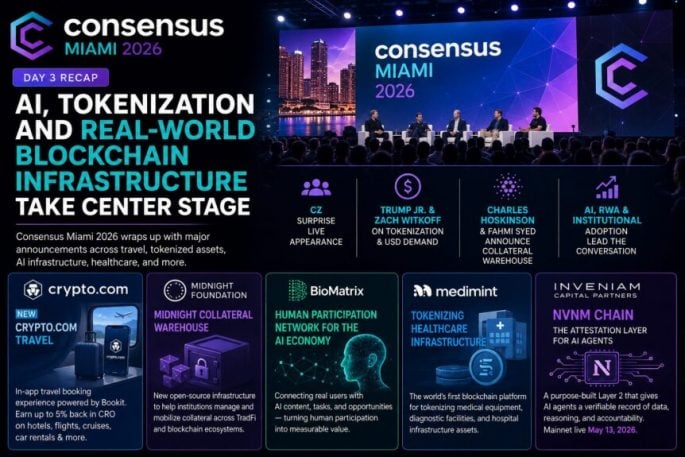
CryptoBriefing reports that executives from Trust Wallet and Mesh presented a vision for AI-powered wallets at Consensus Miami 2026, arguing AI agents could automate trading, payments, and self-custody tasks. CryptoBriefing says Trust Wallet CEO Felix Fan framed wallets as potentially the "new browser" for crypto, and that Mesh CTO Arjun Mukherjee emphasized infrastructure to let agents move money programmatically, citing a Mesh update published on May 1. CryptoBriefing also flags security and privacy concerns, citing a CryptoRank report dated April 13 and guides published by Cobo on May 7 about vulnerabilities in third-party AI integrations. The Consensus agenda lists a session titled "The Agent Wallet Is the New Browser" for May 7, with Mukherjee as a speaker, per CoinDesk's event pages.
What happened
CryptoBriefing reports that executives from Trust Wallet and Mesh presented a vision for AI-native crypto wallets at Consensus Miami 2026. According to CryptoBriefing, Trust Wallet CEO Felix Fan described AI agents as reshaping wallets and framed wallets as potentially the "new browser" for engaging with crypto. CryptoBriefing also reports that Mesh CTO Arjun Mukherjee focused on the infrastructure needed to let AI agents automate payments and programmatic transfers, citing a Mesh update published on May 1. CoinDesk's event listing shows a session titled "The Agent Wallet Is the New Browser" on May 7, with Mukherjee listed as a speaker.
Security and vendor-risk reporting
CryptoBriefing cites a CryptoRank report dated April 13 that identified vulnerabilities in third-party AI integration tools that could expose wallets, and notes guides published by Cobo on May 7 outlining security and privacy concerns tied to autonomous trading. These sources frame the risk vector as the connective tissue, APIs, plugins, and middleware, that let AI agents interact with on-chain infrastructure rather than the underlying ML models themselves, per CryptoBriefing.
Editorial analysis - technical context
Companies and projects pursuing agentic wallets will need to integrate three technical layers: secure key custody, deterministic transaction orchestration, and hardened middleware connecting agents to on-chain APIs. Industry-pattern observations show that middleware and plugin ecosystems expand attack surface faster than base cryptography, which is why third-party integration risk is the dominant security narrative in the sources cited. For practitioners, this pattern implies emphasis on verifiable transaction signing, granular agent permissions, and audit trails when evaluating agentic wallet designs.
Industry context
Public reporting frames the agentic-wallet pitch as part of broader efforts to apply AI agents to finance and payments, including corporate treasury use cases mentioned during Consensus panels, according to CryptoBriefing. Observed patterns in similar transitions indicate that enterprise finance teams and custodians will be early adopters when operational controls, compliance hooks, and auditability exist, while retail adoption follows once security and UX questions converge.
What to watch
Observers should track three signal types in coming months:
- •product releases or SDKs that expose agent permissioning models
- •third-party integration audits or exploit disclosures tied to wallet middleware
- •enterprise pilot announcements involving stablecoins and treasury automation
Reporting to date highlights middleware vulnerabilities and vendor guides as immediate guardrails to evaluate, per CryptoBriefing and CryptoRank.
For practitioners
The sources spotlight a core trade-off between automation and control. Industry-pattern observations suggest teams building agentic wallet systems prioritize explicit, machine-enforceable permission schemas and defend the middleware layer with zero-trust techniques and routine third-party audits. CryptoBriefing's coverage underscores that until integration tooling matures, security risk will likely dominate product discussions at industry events such as Consensus Miami.
Limitations in reporting
CryptoBriefing frames the vision and cites third-party reports and vendor guides; the coverage does not include direct technical whitepapers from Trust Wallet or Mesh exposing full designs, and CoinDesk's event page requires access for session recordings. If companies release formal specifications or SDKs, those primary documents will be needed to verify implementation claims.
Key Points
- 1Executives pitched AI agents that autonomously manage trades and payments, reframing wallets as potential user-facing platforms.
- 2Reporting highlights middleware and third-party integration as the primary security risk, not the underlying ML models.
- 3Enterprise treasury and stablecoin workflows are likely early focus areas, pending permissioning, auditability, and compliance controls.
Scoring Rationale
The story matters because agentic wallets change the developer and security surface that practitioners manage, but current coverage is vision-focused with limited technical specification. The combination of vendor pitches and third-party vulnerability reports makes this notable but not yet transformative.
Sources
Public references used for this report.
Practice with real FinTech & Trading data
90 SQL & Python problems · 15 industry datasets
250 free problems · No credit card
See all FinTech & Trading problems