Tiangong Ultra Sets Humanoid Sprint Record
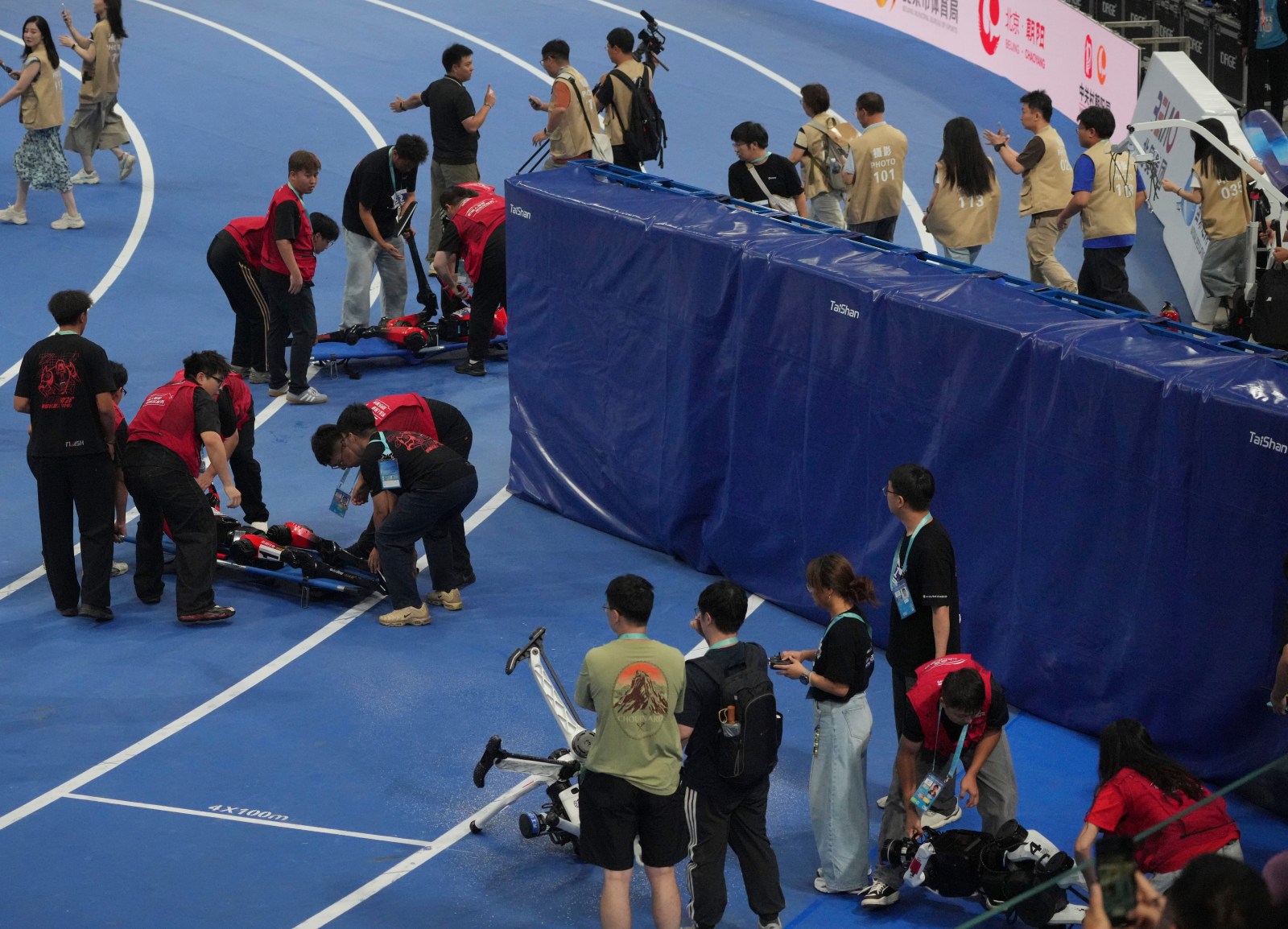
Tiangong Ultra ran the 100 meters in 8.86 seconds during a semifinal at the World Humanoid Robot Games in Beijing on Aug. 25, setting a new reported robot sprint mark. Daily News reported that the time improved on the robot's 9.39-second qualifying performance at the opening ceremony. The outlet noted that robot and human racing records are not directly comparable because the competitions operate under different physical conditions.
Tiangong Ultra ran the 100 meters in 8.86 seconds during a large-size semifinal at the second World Humanoid Robot Games in Beijing on Aug. 25, according to Daily News. The reported result surpassed the robot's own 9.39-second qualifying mark set at the opening ceremony.
Daily News reported that the Beijing event runs from Aug. 22 through Aug. 26 and includes more than 2,000 robots from 666 teams across 16 countries. Its 51 competitions span track events, football, table tennis, boxing, and tasks designed to simulate work in factories, restaurants, offices, and emergency settings.
Record comparison has limits
The 8.86-second time is numerically faster than Usain Bolt's 9.58-second human 100-meter world record from 2009. However, Daily News cautioned that robot and human competitions do not operate under the same physical conditions, so the result is not incorporated into human athletics records or a direct human-versus-robot comparison.
The outlet described the games as a venue intended to demonstrate and develop humanoid-robot capability. Tiangong Ultra was developed by the Beijing Humanoid Robot Innovation Center, which Daily News reported is supported by the Beijing municipal government.
For robotics practitioners, a sprint result is a narrow but visible systems test: it requires locomotion control, balance recovery, actuator performance, state estimation, and reliable operation under a high-speed dynamic load. Competition outcomes alone do not establish general-purpose mobility or workplace readiness. Across comparable robotics demonstrations, validation in unstructured environments, repeatability across hardware units, safety behavior, and energy consumption are separate engineering measures that determine whether a capability transfers beyond a controlled event.
Key Points
- 1Tiangong Ultra recorded 8.86 seconds over 100 meters, improving its reported 9.39-second qualifying result at the opening ceremony.
- 2The Beijing games brought together more than 2,000 robots across 51 events, creating a public benchmark venue for humanoid systems.
- 3Sprint demonstrations test dynamic locomotion, but industry evaluations typically require repeatability, safety, energy, and unstructured-environment performance data.
Scoring Rationale
The result is a notable public demonstration of high-speed humanoid locomotion and control, relevant to robotics engineers and embodied-AI researchers. The available reporting does not provide technical architecture, benchmarking methodology, or deployment evidence, limiting its immediate practical impact.
Sources
Public references used for this report.
Practice interview problems based on real data
1,625 SQL & Python problems across 15 industry datasets — the exact type of data you work with.
Try 250 free problems