
TensorWave Raises $350M to Challenge Nvidia's Dominance
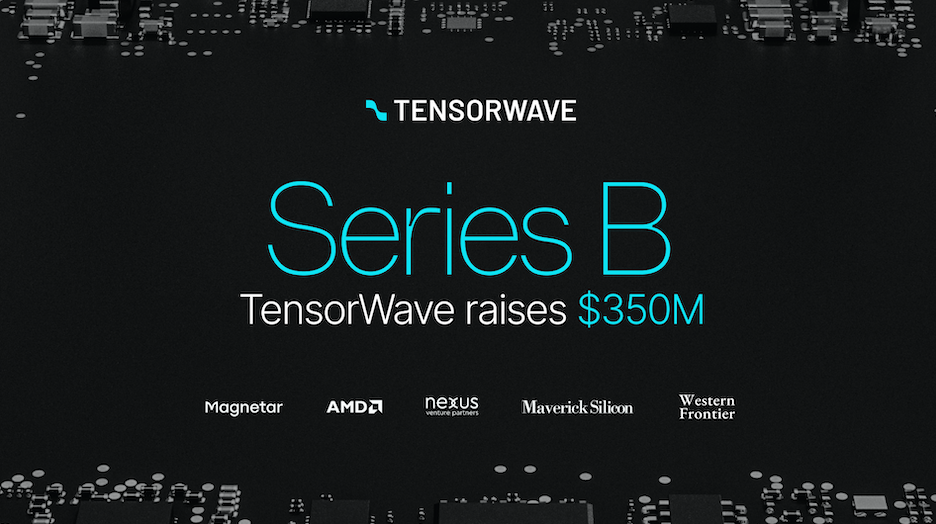
According to SiliconANGLE, cloud AI infrastructure startup TensorWave closed a $350 million funding round co-led by Magnetar and AMD Ventures, bringing its post-money valuation to $1.55 billion. SiliconANGLE and IndexBox report the Las Vegas company was founded in 2023 and operates three data centers in Arizona, Florida and Pennsylvania, each reportedly populated with 10,000 AMD Instinct processors and delivering capacity roughly equivalent to 14 megawatts apiece. SiliconANGLE quotes CEO Darrick Horton, via the Wall Street Journal, saying the company deliberately avoids Nvidia hardware to expand competition: "We wanted to figure out how we can solve problems for customers and restore competition to the market." IndexBox (citing Yahoo Finance) reports a prior roughly $100 million raise that valued the company at about $400 million. This is a notable capital infusion aimed at an AMD-only infrastructure play in a market dominated by Nvidia.
What happened
According to SiliconANGLE, TensorWave closed a $350 million financing round co-led by Magnetar and AMD Ventures, with participation from Maverick Silicon, Nexus Venture Partners and Western Frontier, valuing the company at $1.55 billion. SiliconANGLE reports TensorWave was founded in 2023 and operates three data centers in Arizona, Florida and Pennsylvania, each said to contain 10,000 AMD Instinct processors and to deliver computing capacity roughly equivalent to 14 megawatts. IndexBox, citing Yahoo Finance, reports the company raised about $100 million roughly a year ago at a valuation near $400 million. SiliconANGLE quotes CEO Darrick Horton (via the Wall Street Journal) saying the company refuses Nvidia hardware to restore competition: "We wanted to figure out how we can solve problems for customers and restore competition to the market. I don't like buying things from monopolies. You don't have a lot of leverage."
Editorial analysis - technical context
Industry-pattern observations: providers that attempt an AMD-only stack confront software and ecosystem gaps relative to the dominant Nvidia CUDA+cuDNN ecosystem. Companies pursuing alternative accelerators typically need to invest in software abstraction layers, scheduler integration, and workload portability to attract customers running frameworks optimized for Nvidia GPUs. SiliconANGLE notes TensorWave has worked closely with AMD to improve the ROCm software platform and says it is now "pretty much plug-and-play" for inference workloads, per Horton.
Context and significance
public coverage frames TensorWave's raise as part of a broader push to diversify AI compute beyond Nvidia. While Nvidia GPUs remain the de facto standard for many large-scale training workloads, investors and some customers have expressed interest in suppliers and architectures that reduce single-vendor exposure. A $350 million Series B at a $1.55 billion valuation signals material investor conviction in an AMD-centric infrastructure approach, but broad adoption hinges on software portability and customer willingness to run performance-critical workloads off the dominant stack. SiliconANGLE notes Horton wants to scale to 2 gigawatts of capacity within a year.
What to watch
Observed patterns in similar transitions: monitor metrics such as customer win rates for workloads sensitive to GPU ecosystem optimizations, announcements of software compatibility or runtime support for mainstream ML frameworks, and any benchmarks comparing AMD Instinct performance on representative enterprise training and inference workloads. Also watch for follow-on funding or partnerships that address software-stack gaps.
Key Points
- 1TensorWave raised $350M at a $1.55B valuation to build AMD-only AI data centers, signaling investor interest in Nvidia alternatives.
- 2An AMD-exclusive stack faces ecosystem challenges because many ML frameworks and optimizations target Nvidia's CUDA ecosystem.
- 3Practitioners and buyers will watch software portability, benchmark parity, and orchestration features before shifting large-scale workloads.
Scoring Rationale
A sizable Series B and a billionaire-plus valuation for an AMD-only infrastructure provider is notable for practitioners because it could diversify supply options. The story is important but not industry-shaking until software and benchmark parity are demonstrated.
Sources
Public references used for this report.
Practice interview problems based on real data
1,625 SQL & Python problems across 15 industry datasets — the exact type of data you work with.
Try 250 free problems