Tech Executives Deploy AI Clones for Work
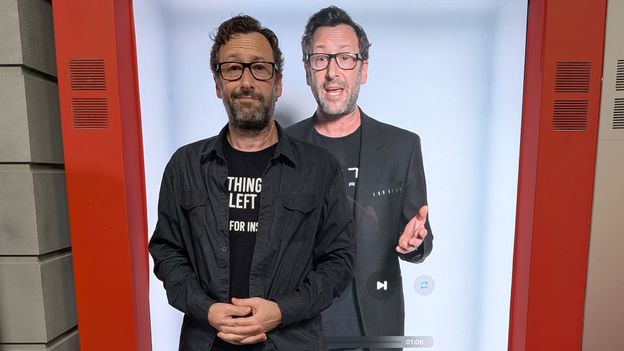
David Nussbaum, Proto Hologram's founder and executive chairman, used an interactive AI holographic clone at trade shows, according to a BBC report published August 11, 2026. The BBC, Axios, and Fast Company Middle East describe a broader executive-avatar trend while highlighting accuracy, privacy, authenticity, and workplace-trust risks in early deployments.
BBC reports that David Nussbaum, founder and executive chairman of Proto Hologram, has deployed an interactive AI-powered holographic clone of himself at trade shows. The avatar, trained on video recordings of Nussbaum speaking, uses an in-built camera to perceive visitors and can answer questions about Nussbaum and Proto Hologram's business.
Nussbaum told the BBC that the virtual assistant can sell, explain the company's technology in hundreds of languages, generate solutions, and appear where he cannot or does not want to be. BBC reporting also describes Proto deployments in which customer clones direct travelers at US airports in 140 languages, museum avatars teach visitors about history, and the company is testing AI versions of store clerks.
A growing executive-avatar use case
The use of executive replicas extends beyond holographic displays. Axios reported in June 2025 that executives were using platforms such as Delphi and Tavus to create text, voice, and video agents from their writing, interviews, speeches, and meetings. The report named LinkedIn co-founder Reid Hoffman, Zoom CEO Eric Yuan, and Khosla Ventures managing director Keith Rabois among executives who had created AI replicas.
Axios also reported that Otter CEO Sam Liang had asked whether a "Sam Bot" could attend meetings for him. The company's Meeting Avatar was a prototype at the time, according to Axios, with a proposed capability to answer questions, participate in discussions, record meetings, and produce notes and summaries.
Fast Company Middle East separately reported that Meta was building a photorealistic, AI-powered 3D avatar of CEO Mark Zuckerberg for employee interaction, citing the Financial Times. The publication reported that the avatar would be trained on Zuckerberg's image, mannerisms, tone, speaking style, and public statements. It also noted that Meta had not responded to its request for comment.
Accuracy and disclosure remain central risks
The available reporting documents practical benefits, but it also identifies unresolved reliability and trust questions. Axios described an interaction with Delphi co-founder and CEO Dara Ladjevardian's chatbot in which the bot said chats were inaccessible to Ladjevardian, while Ladjevardian told Axios that he could access them and attributed the response to a probable bug.
That example matters because executive avatars combine several high-risk properties in one interface: an authoritative identity, potentially sensitive source material, and generative responses that may be delivered in a familiar voice or visual likeness. In comparable enterprise deployments, clear disclosure of whether an interaction is with a human or an agent, defined access controls, and auditability of agent outputs are common governance concerns.
The workforce dimension is also unsettled. Axios reported that some executive clones have been used for investor calls, employee discussions about company culture, and video meetings. When digital doubles move from scripted content into live conversation, organizations commonly face harder questions about who is accountable for an inaccurate statement, what information the system can access, and how employees should treat its responses.
For ML and product teams, the reporting points to a distinction between a polished avatar layer and dependable agent behavior. A realistic face, voice, and multilingual delivery can improve reach, but those features do not establish factual accuracy, privacy guarantees, or authority to act. The strongest early evaluation criteria are therefore likely to be task-bounded performance, traceable source grounding, permissioning, and explicit human escalation paths.
Key Points
- 1Proto Hologram's executive avatar illustrates how AI clones can extend a founder's presence across trade shows, languages, and customer-facing settings.
- 2Axios documented a chatbot privacy error, showing that identity replication does not remove familiar generative AI accuracy and data-governance risks.
- 3As executive avatars enter meetings and internal communications, comparable deployments commonly require disclosure, source grounding, access controls, and accountable human oversight.
Scoring Rationale
Executive AI clones are an emerging enterprise interface rather than a foundational model or platform release. The story is relevant to practitioners because it combines multimodal generation, agent behavior, identity, privacy, and governance risks in customer-facing and internal workflows.
Sources
Public references used for this report.
Practice interview problems based on real data
1,625 SQL & Python problems across 15 industry datasets — the exact type of data you work with.
Try 250 free problems