Tairex Launches Virtual Consultation Room for Clinical Training
Tairex, a spin-off incubated at Tsinghua Universitys Institute for AI Industry Research, launched the Virtual Consultation Room on its Tairex Agent Hospital platform. The feature is open to doctors and medical students and supports simulated consultations across 21 clinical departments and diagnosis for more than 1,000 disease types via large-scale AI Patient Agents and AI Doctor Agents. The environment supports personalized AI Doctor Avatars, end-to-end clinical workflows, and full-cycle patient management across pre-service, in-service, and post-service stages. Backed by Tsinghua AIR, Tairex has completed an angel round of about RMB 100 million and positions this release as the next step in commercializing agent-based virtual hospitals for training, capacity scaling, and deployable telemedicine services.
What happened
Wuxi Tairex Technology Co. Ltd., an incubated spin-off of Tsinghua Universitys Institute for AI Industry Research, launched the Virtual Consultation Room as part of its Tairex Agent Hospital platform. The feature is available to doctors and medical students and is designed for simulated clinical training, clinical reasoning testing, and the development of deployable digital clinical capabilities. The platform reports support for diagnosis across more than 1,000 disease types and operation across 21 clinical departments, and Tairex has secured angel funding near RMB 100 million.
Technical details
The Tairex Agent Hospital architecture implements a fully agentized virtual hospital, where both patient and clinician roles are represented by large-language-model-driven agents. Key platform capabilities include:
- •Large-scale AI Patient Agents enabling realistic, repeatable case simulations
- •AI Doctor Agents and personalized AI Doctor Avatars that capture clinician decisions and evolve with usage
- •End-to-end clinical workflow support covering consultation, diagnosis, treatment planning, and follow-up management
- •Multi-department coverage with templates and reasoning pipelines for specialty-specific diagnostics
The system traces its origins to a 2024 Agent Hospital paper from Professor Liu Yangs team and follows a 2025 Tsinghua inauguration of the AI Agent Hospital prototype. The current release emphasizes simulation scale, reproducible clinical reasoning, and tooling for clinicians to author and refine avatar behavior.
Platform capabilities and integrations
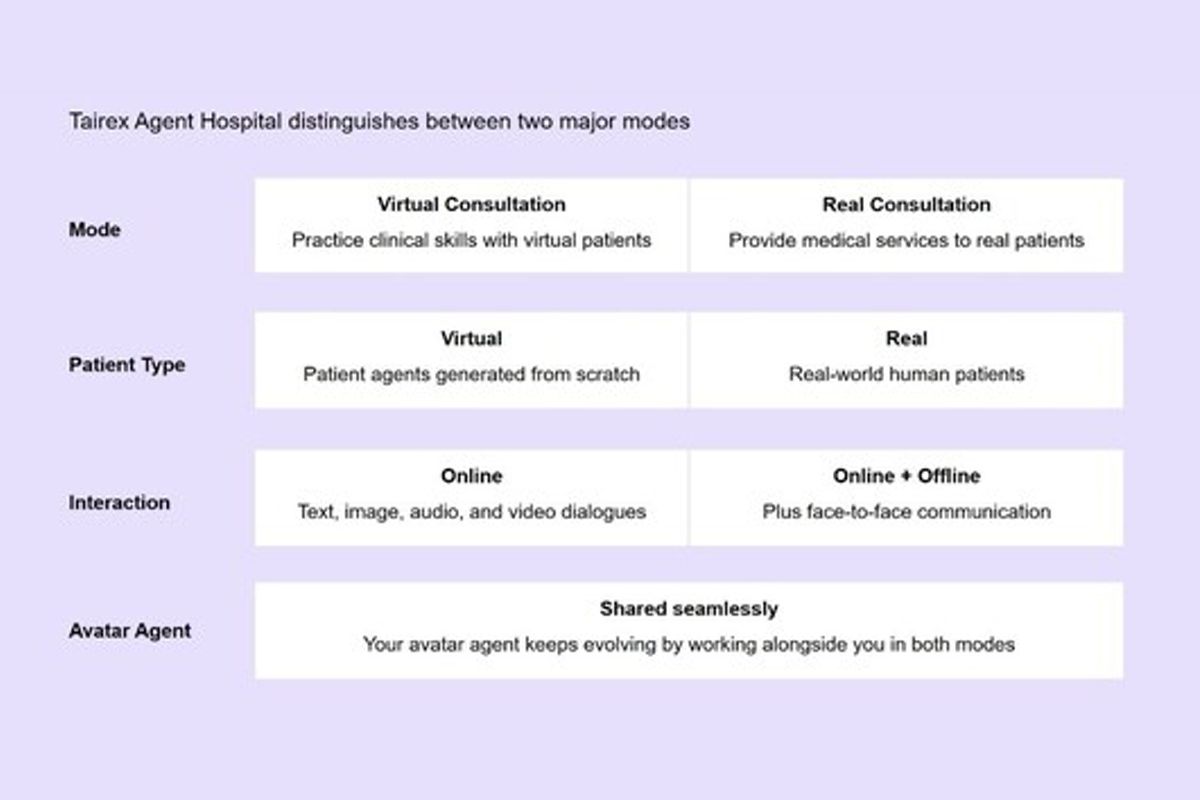
Practitioners should note the emphasis on two interaction modes: simulated training with AI patients and clinician-avatar co-evolution during real or supervised consultations. The platform promises a digital audit trail of diagnostic decisions, which supports quality assurance and training analytics. Early pilots at Tsinghua focused on general practice, ophthalmology, radiology, and respiratory medicine, indicating the platform is built to incorporate multimodal inputs such as images and structured clinical data when needed.
Context and significance
Agent-based virtual hospitals are a growing pattern in applied clinical AI because they let institutions standardize training, scale expertise replication, and stress-test AI reasoning across many edge cases without patient risk. Tairexs academic pedigree at Tsinghua AIR gives it access to research-grade modeling and clinical partnerships, accelerating translation from lab prototypes to commercial deployments. The reported support for more than 1,000 disease types and multi-department coverage positions Tairex closer to operational pilots than many boutique medical chatbots, but adoption will depend on validation, regulatory acceptance, and integration with hospital IT systems like EHRs.
Regulatory and risk considerations
The platforms promise of automated diagnosis and treatment planning raises clinical governance questions: how decisions are logged, how clinician oversight is enforced, and how liability is apportioned when AI Doctor Avatars contribute to care recommendations. The presence of a structured audit trail helps, but hospitals will require formal validation, dataset provenance, and alignment with local medical device or telemedicine regulations before wide deployment.
What to watch
Monitor validation studies, hospital pilot announcements, and any published evaluation comparing Tairex Agent Hospital reasoning against clinician benchmarks. Also watch for integrations with electronic health records and regulatory filings in China and regions targeted for expansion.
Bottom line
This launch marks a pragmatic commercialization step for agent-based virtual hospitals, offering a scalable training and deployment environment backed by strong institutional research. For ML engineers and clinical informaticists, the platform is worth evaluating for simulation-driven model evaluation, human-in-the-loop training workflows, and operationalized clinician-AI avatar co-development.
Key Points
- 1Tairex opened a Virtual Consultation Room on Tairex Agent Hospital to enable scalable simulated clinical training and avatar-driven care replication.
- 2Platform supports 21 clinical departments and diagnosis across 1,000+ disease types, enabling large-scale scenario coverage for training and validation.
- 3Academic backing and RMB 100 million angel funding accelerate commercialization, but regulatory validation and EHR integration remain critical adoption barriers.
Scoring Rationale
This is a notable commercialization milestone for agent-based virtual hospitals, backed by Tsinghuas AIR and meaningful funding. It introduces practical training and deployment tooling, but lacks disclosed clinical validation and faces regulatory integration hurdles, so its immediate operational impact is moderate.
Sources
Public references used for this report.
Practice with real Health & Insurance data
90 SQL & Python problems · 15 industry datasets
250 free problems · No credit card
See all Health & Insurance problems