Sugon Tops IO500, Showcases AI Infrastructure in Europe
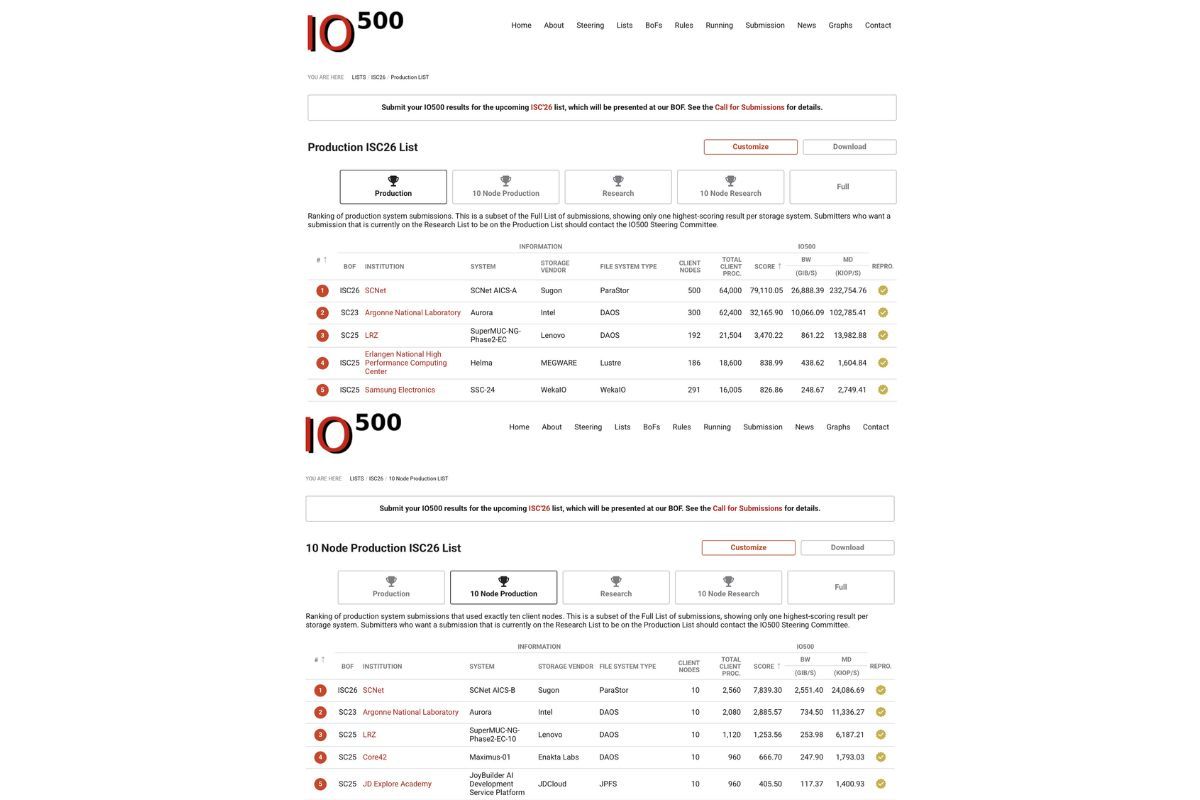
For practitioners building or evaluating large AI training clusters: independently confirmed IO500 benchmark data shows Sugon's ParaStor F9000 scoring 79,110 on the ISC26 production list - more than 2.4x the second-ranked system, Argonne National Lab's Aurora (32,165), per io500.org. Per PR Newswire, Sugon showcased its AI and advanced computing portfolio at ISC High Performance 2026 in Hamburg. The ParaStor F9000 all-flash distributed storage topped both the IO500 Production SC26 List and the 10 Node Production SC26 List; the full-production submission was filed under institution SCNet (500 client nodes, 64,000 total client processes). IO500 production lists rank only systems deployed in real operational environments meeting redundancy and usage criteria. StorageNewsletter and trade outlets corroborate the result. Independent customer benchmarks and published run artifacts would further validate operational claims at scale.
Practitioner perspective
The IO500 production list, which restricts entries to systems deployed under real operational conditions with redundancy requirements, is a more operationally meaningful benchmark than the research category. For AI infrastructure teams: a 79,110 IO500 score with 26,888 GiB/s bandwidth and 232,754 kIOP/s metadata throughput, confirmed by io500.org - the independent benchmark organization - points to a system capable of sustaining high parallel I/O across large GPU clusters. The 2.4x score gap over the second-ranked entry (Argonne National Lab's Aurora, using Intel DAOS at 32,165) is substantial. Procurement teams should still seek published run configuration details and independent customer references before drawing architecture conclusions.
What happened
Per PR Newswire and StorageNewsletter, Sugon showcased its AI and advanced computing portfolio at ISC High Performance 2026 in Hamburg on June 24, 2026. The presentation covered AI supernodes, AI superclusters, the ParaStor F9000 high-performance storage system, RDMA networking, liquid-cooled data center solutions, servers, workstations, and computing services.
Per PR Newswire, Sugon's ParaStor F9000 distributed all-flash storage system achieved No. 1 on both the IO500 Production SC26 List and the 10 Node Production SC26 List. io500.org, the independent benchmark organization that maintains the IO500 list, lists the ISC26 production top entry under institution SCNet as the submitter, with Sugon as the storage vendor and ParaStor as the file system. The recorded score is 79,110.05, with 26,888.39 GiB/s bandwidth and 232,754.76 kIOP/s metadata operations per second, using 500 client nodes and 64,000 total client processes. The second-ranked production entry, Argonne National Laboratory's Aurora (Intel DAOS), scored 32,165.90 - making the Sugon-powered system's score 2.46x higher. Per PR Newswire and StorageNewsletter, the result builds on Sugon's prior IO500 track record, including a previous No. 1 finish in the 10-Node Challenge at SC22.
Technical context
IO500 production rankings emphasize sustained real-world throughput and metadata performance under operational constraints such as redundancy and workload mix. Teams running large training clusters commonly see aggregate throughput limited by storage latency and parallel I/O scalability rather than raw GPU compute. Vendors reporting production IO500 leadership typically pair software-defined distributed file systems with NVMe-oF or RDMA networking and all-flash hardware to improve both bandwidth and I/O consistency across nodes. The participation of a major national lab (Argonne) as second-ranked provides useful context: the gap between first and second here is atypically large by IO500 historical norms.
Implications for practitioners
- •For training cluster architects: a production-class all-flash distributed storage system with an IO500 lead of this magnitude can reduce variance in epoch times and improve effective GPU utilization when training on sharded datasets at scale. This is a general industry implication; the SCNet submission context means practitioners should verify how the system maps to their specific deployment architecture.
- •For infra procurement teams: liquid cooling and RDMA networking lower operational barriers for dense GPU racks. Seek published run artifacts (configuration details, SSD models, network topology) and independent customer case studies before finalizing procurement decisions.
What to watch
Observers should look for: published IO500 run details and questionnaire data for the SCNet submission (available at io500.org/questionnaires/view/803); independent customer case studies involving ParaStor F9000 at similar scales; and whether the claimed 10 Node Production SC26 List top ranking also appears in the official io500.org 10-node production tab. Per PR Newswire, Sugon was founded in 1996 and develops computing infrastructure for enterprises, research institutions, and public-sector organizations.
Key Points
- 1Independent IO500 data on io500.org confirms Sugon's ParaStor F9000 scored 79,110 on the ISC26 production list - over 2.4x the second-ranked entry (Argonne's Aurora).
- 2Production IO500 rankings cover systems deployed in real operational environments with redundancy criteria, making them a stronger signal than research-category benchmarks.
- 3Vendors often publicize IO500 wins at conferences; practitioners should seek run-configuration artifacts and independent customer benchmarks before equating scores with long-term operational outcomes.
Scoring Rationale
The No. 1 IO500 ISC26 production ranking is independently confirmed on io500.org with a score of 79,110 - more than 2.4x the second-ranked entry (Argonne Aurora). This is a credible and practically relevant HPC storage benchmark for AI training cluster evaluations. Score adjusted downward from 6.9: the story is predominantly vendor PR with limited third-party analysis beyond the benchmark listing itself.
Sources
Public references used for this report.
View 5 more sources
- Sugon Showcases in Europe, Tops the IO500 - PR Newswire APACen.prnasia.com
- Sugon Showcases in Europe, Tops the IO500kosmo.com.my
- 09:20 ETSugon Showcases in Europe, Tops the IO500 - Longbridgelongbridge.com
- Sugon Tops IO500 Storage Benchmarks as It Pitches AI ...finance.biggo.com
- Sugon Showcases in Europe, Tops the IO500 | PR Newswireworld.storm.mg
Practice interview problems based on real data
1,625 SQL & Python problems across 15 industry datasets — the exact type of data you work with.
Try 250 free problems