Specialized Press Misreads Local AI Performance Metrics
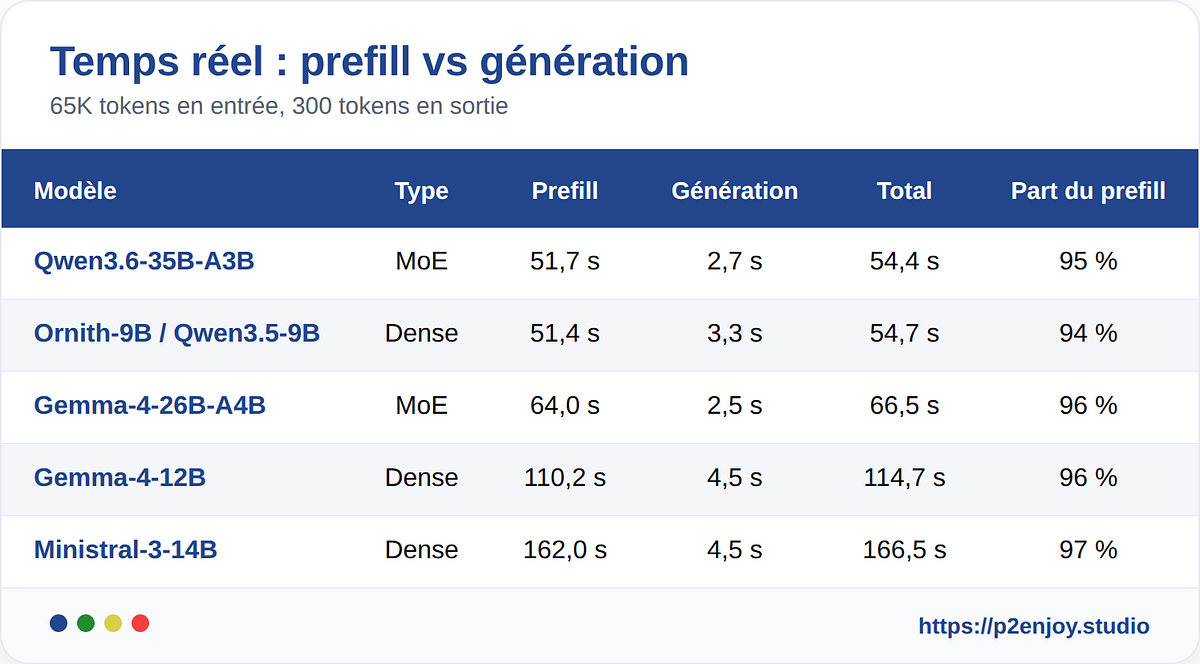
A July 2026 P2Enjoy post argues that local-AI rankings built around tg128, the time to generate 128 tokens, can mislead practitioners because long-context prefill often dominates real latency. The post's example focuses on agentic, RAG, coding and document workflows where prompts can reach 64K or 128K tokens before a short answer is generated. For practitioners, the safe takeaway is methodological: do not choose a local model from decode speed alone. Benchmark first-token latency, prompt processing, memory pressure, tool-call overhead and end-to-end wall-clock time on the actual context sizes your application will use.
The value here is not the blog's criticism of media coverage by itself; it is the benchmark-design warning. Local-model selection can go wrong when teams optimize for a visible decode-speed number while ignoring the prompt-processing work that happens before users see the first token.
What happened
P2Enjoy published a French-language analysis arguing that many local-AI performance comparisons overemphasize tg128, a 128-token generation metric. The post says that metric is useful for short demos but weak for professional workflows that load long documents, codebases, retrieval context or agent state before generating a comparatively short response.
Technical context
The post highlights long-context scenarios such as 64K or 128K tokens in and a few hundred tokens out. In those cases, prompt processing, first-token latency and memory behavior can dominate user-perceived speed, even when the model streams the final answer quickly once generation starts.
For practitioners
Teams evaluating local LLMs should run workload-shaped tests: cold and warm starts, realistic context length, retrieval overhead, tool calls, quantization settings, hardware memory limits and final wall-clock latency. Tokens-per-second is still useful, but only after the input path is measured.
What to watch
Because this item is essentially single-source commentary, treat it as a benchmark-methodology reminder rather than a settled market claim. The stronger evidence will come from reproducible benchmark suites that publish both prefill and decode measurements.
Key Points
- 1Decode speed alone can mislead model choice when long-context prefill dominates the actual user wait time.
- 2RAG, coding and agent workflows need benchmarks that include context size, first-token latency and tool overhead.
- 3This is single-source commentary, so practitioners should treat it as a test-design warning rather than market consensus.
Scoring Rationale
The item is useful for practitioners because it points to a real benchmarking pitfall in local LLM evaluation. It is single-source commentary rather than independently confirmed research or a product change, so the score is reduced to a solid but lower-impact level.
Sources
Public references used for this report.
Practice interview problems based on real data
1,625 SQL & Python problems across 15 industry datasets — the exact type of data you work with.
Try 250 free problems