Spark Mail Adds Mac CLI and Agent Skills
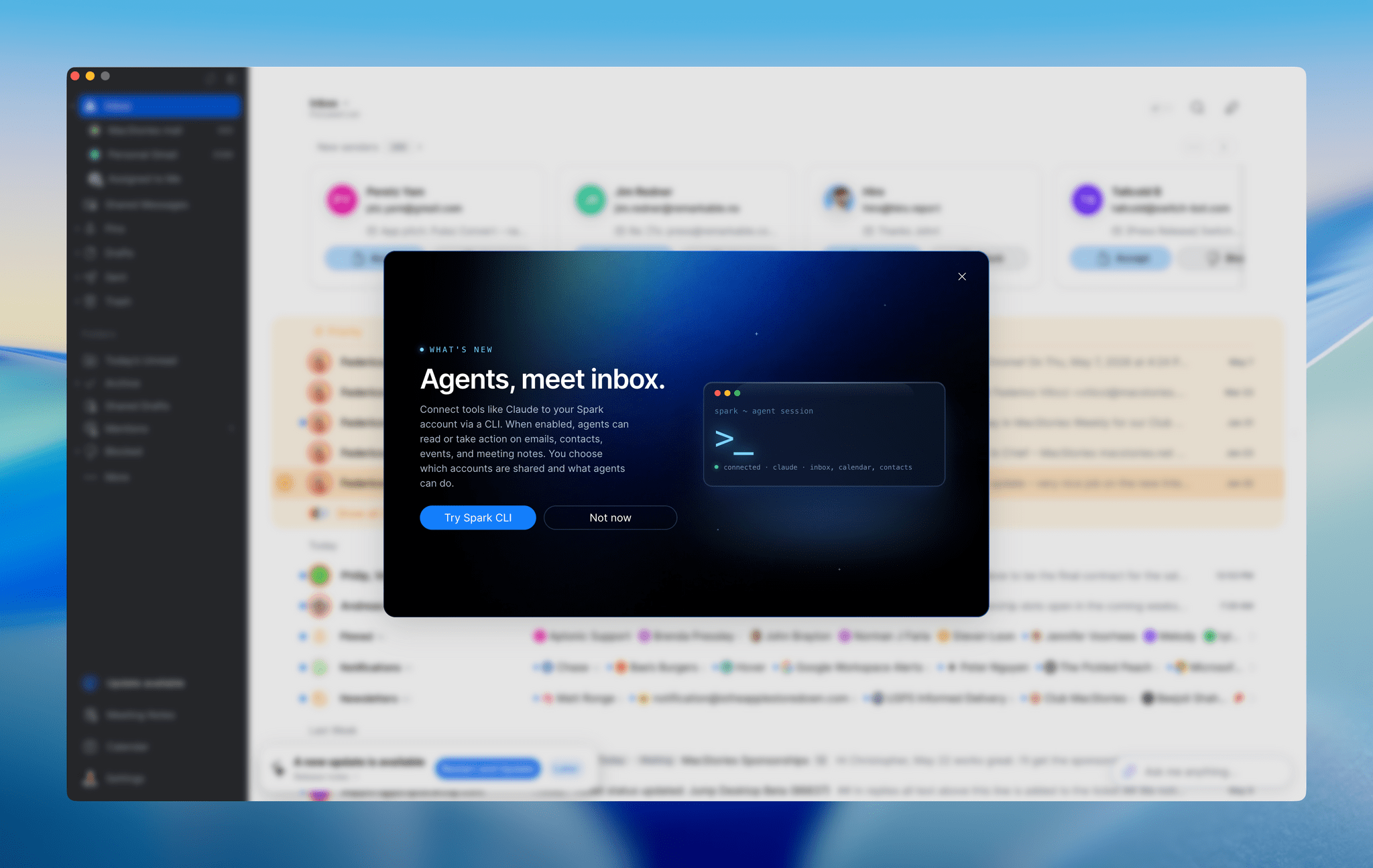
MacStories reports that Spark, the email app by Readdle, received a Mac command-line interface and a set of agentic skills that let agents such as Claude Code, Codex, and others access messages, calendar events, contacts, and meeting notes in read-only mode. MacStories says the features were expanded a few days later to add email triage actions and additional skills. The report highlights a local architecture that keeps message data on the Mac while making it available to agents, and contrasts Spark's approach with the cloud-based googleworkspace CLI, noting Spark's CLI acts as a remote control for the desktop app and requires Spark to be open to work. The author reports they found Spark's CLI easier to use than googleworkspace because it avoids Google Cloud project setup and OAuth.
What happened
MacStories reports that Spark, the email app from Readdle, was updated with a Mac command-line interface (CLI) and a set of agentic skills for Claude Code, Codex, and other agents, giving those agents read-only access to messages, calendar events, contacts, and meeting notes. MacStories also reports the feature set was extended a few days later with new abilities that add email triage actions and more skills. The article describes Spark's implementation as using a local architecture that keeps message data on the user's Mac while exposing capabilities to agents via the CLI.
Technical details
According to MacStories, the Spark CLI serves as a remote control for the desktop app rather than contacting Gmail servers directly; the piece contrasts this with the googleworkspace CLI, which is cloud-facing and requires a Google Cloud project and OAuth. The author reports that Spark's CLI requires the Spark app to be open to function. MacStories explains that local CLIs can reduce token usage for terminal agents because the agent only sees a command's text output rather than carrying full tool schemas the way some MCP servers do.
Editorial analysis - technical context
Local CLIs combined with agentic skills change the tradeoffs between privacy, latency, and cost for agent-enabled workflows. Industry-pattern observations: when tools expose functionality via a local CLI, they limit the data surface sent to remote models, which can reduce per-request token costs and simplify prompts for terminal-based agents. For practitioners, this pattern also shifts integration work away from cloud-based OAuth flows toward local interprocess communication or IPC patterns.
Industry context
MacStories frames this update as part of a broader trend of productivity apps adding CLIs to support agent workflows. Industry-pattern observations: multiple developer and productivity apps have added CLIs this year to support automation, scripting, and agent access, reflecting growing demand for programmable, terminal-first interfaces for LLM-driven assistants.
What to watch
Observers should track:
- •which agents and agent frameworks add native support for local CLIs like Spark's
- •whether local-CLI approaches spread to mobile or cross-device sync scenarios
- •how vendors handle authentication and access control for agentic skills exposed locally. For readers wanting hands-on experience, MacStories' testing notes that Spark's CLI avoids Google Cloud setup and OAuth friction compared with googleworkspace, but requires the desktop app to be running
Key Points
- 1Spark added a Mac CLI and agentic skills, enabling read-only agent access to email, calendar, contacts, and notes, per MacStories.
- 2Local-CLI architecture limits data sent to remote agents, reducing token exposure and avoiding complex OAuth setups, per MacStories' comparison.
- 3Industry-pattern observation: CLIs are trending as a lightweight integration path for terminal-based agents and automation workflows.
Scoring Rationale
This is a notable product update for practitioners integrating agents with local workflows: it demonstrates a practical local-CLI approach to agent access that reduces token exposure and OAuth friction. The change is useful but not paradigm-shifting, so it scores in the mid-high range for tooling relevance.
Practice with real Ad Tech data
90 SQL & Python problems · 15 industry datasets
250 free problems · No credit card
See all Ad Tech problems