SpaceXAI launches Grok 4.5, touts Opus-class performance
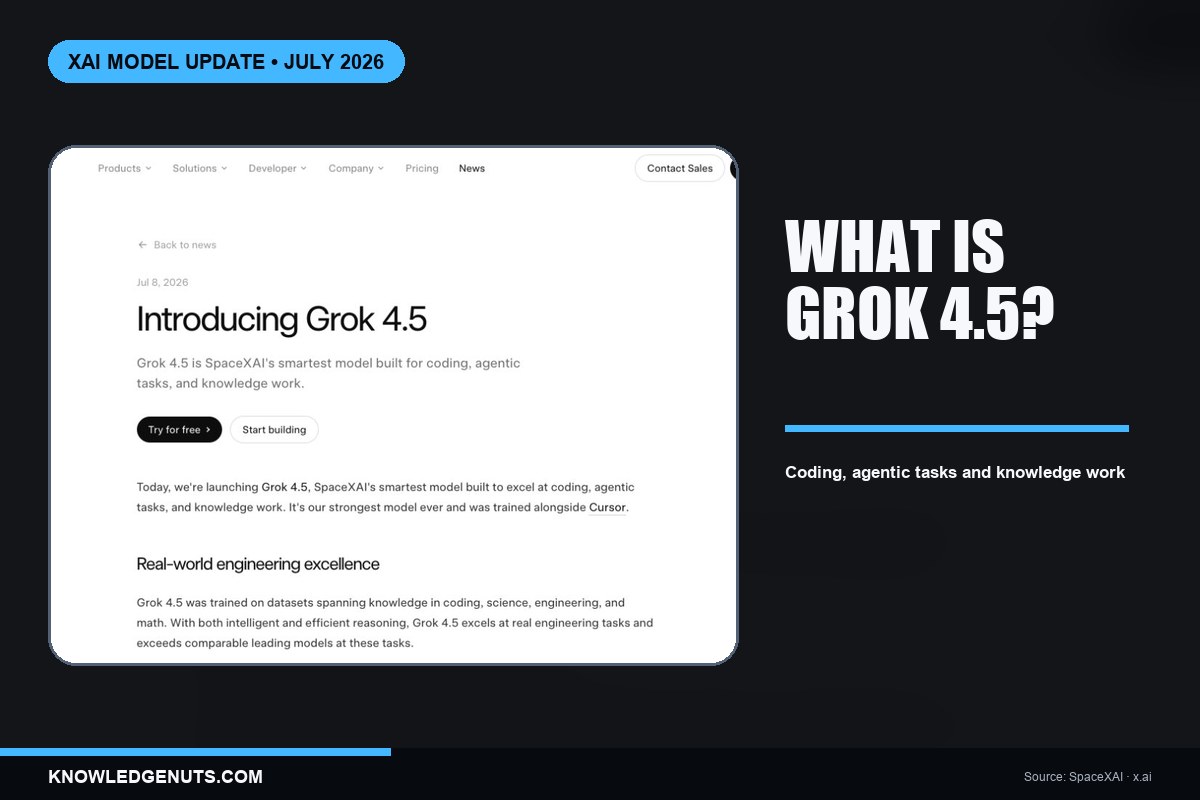
SpaceXAI launched Grok 4.5 on July 8, 2026, with public availability advertised for July 9 and official docs listing $2 per 1M input tokens and $6 per 1M output tokens. The practical question is not whether the model is "Opus-class," a claim still needing independent benchmarks, but whether its coding, tool-use, finance, and legal-workflow positioning can lower cost per completed task. Cursor says the release is built for long-running tool use, while Mashable and PYMNTS tie the rollout to Elon Musk's public cost and efficiency claims. Teams should benchmark latency, structured-output reliability, and real workload cost before moving assistants or agents onto it.
The useful reading of Grok 4.5 is cost-performance pressure, not the vendor comparison headline. If the model is materially cheaper for long-running tool use, teams will need routing tests that measure completed tasks, latency, and review effort rather than treating a frontier-label claim as enough evidence.
What happened
SpaceXAI's official release says Grok 4.5 is built for coding, agentic tasks, and knowledge work. The docs page lists API availability and pricing at $2 per 1M input tokens and $6 per 1M output tokens, while Mashable and PYMNTS report Elon Musk's public statement that the model would become available on July 9 and be "Opus-class" but faster, more token-efficient, and lower cost.
Technical context
The docs list support for Responses API, Chat Completions, function calling, web search, X search, and code execution. Cursor's launch post positions the model for difficult, long-running tasks across software engineering, data science, finance, and legal work, which makes tool reliability and trace quality as important as raw answer quality.
For practitioners
Treat the release as a new candidate in model-routing experiments. Run it against representative coding agents, data-analysis notebooks, and structured-output tasks, then compare cost per accepted result, latency variance, refusal behavior, and cleanup time against the models already in production.
What to watch
Independent benchmark results, real API rate limits, regional availability, and incident reports will matter more than the Opus-class label. The strongest signal will be whether teams can lower total workflow cost without losing tool-call accuracy or auditability.
Key Points
- 1Official docs make pricing and tool support testable, but Musk's Opus-class claim still needs independent workload benchmarks.
- 2Cursor positioning expands the model beyond chat into long-running coding, data, finance, and legal workflows.
- 3Teams should compare cost per completed task, latency, and structured-output reliability before routing agents to Grok 4.5.
Scoring Rationale
Grok 4.5 is a notable model release because it touches pricing, coding and agentic workflows, and model-vendor routing. The score stays at 7.1 because the official and secondary sources support the rollout, but independent benchmarks and production evidence remain limited.
Sources
Public references used for this report.
View 10 more sources
- Elon Musk says 'Opus-class' Grok 4.5 is about to launchmashable.com
- SpaceX Readies Expansion of Grok AI Modelpymnts.com
- Scoop: SpaceXAI launches new model, Grok 4.5axios.com
- SpaceXAI, Cursor Unveil Grok AI Model for Coding, Finance Tasksbloomberg.com
- New Name, New Grok: SpaceXAI Officially Ties Its Brand to Grokgizmodo.com
- XAI makes its rebrand to SpaceXAI complete with a new logobusinessinsider.com
- XAI makes its rebrand to SpaceXAI complete with a new logofinance.yahoo.com
- SpaceXAI's newest AI model Grok 4.5 dramatically undercuts Anthropic and OpenAI on pricesiliconangle.com
- SpaceXAI launches Grok 4.5, its first model with Cursorthenextweb.com
- SpaceX's Grok 4.5 launches at half the price of rivals — here's why that could rattle Anthropic and OpenAIventurebeat.com
Practice interview problems based on real data
1,625 SQL & Python problems across 15 industry datasets — the exact type of data you work with.
Try 250 free problems