South Korean startup records workers to train robots
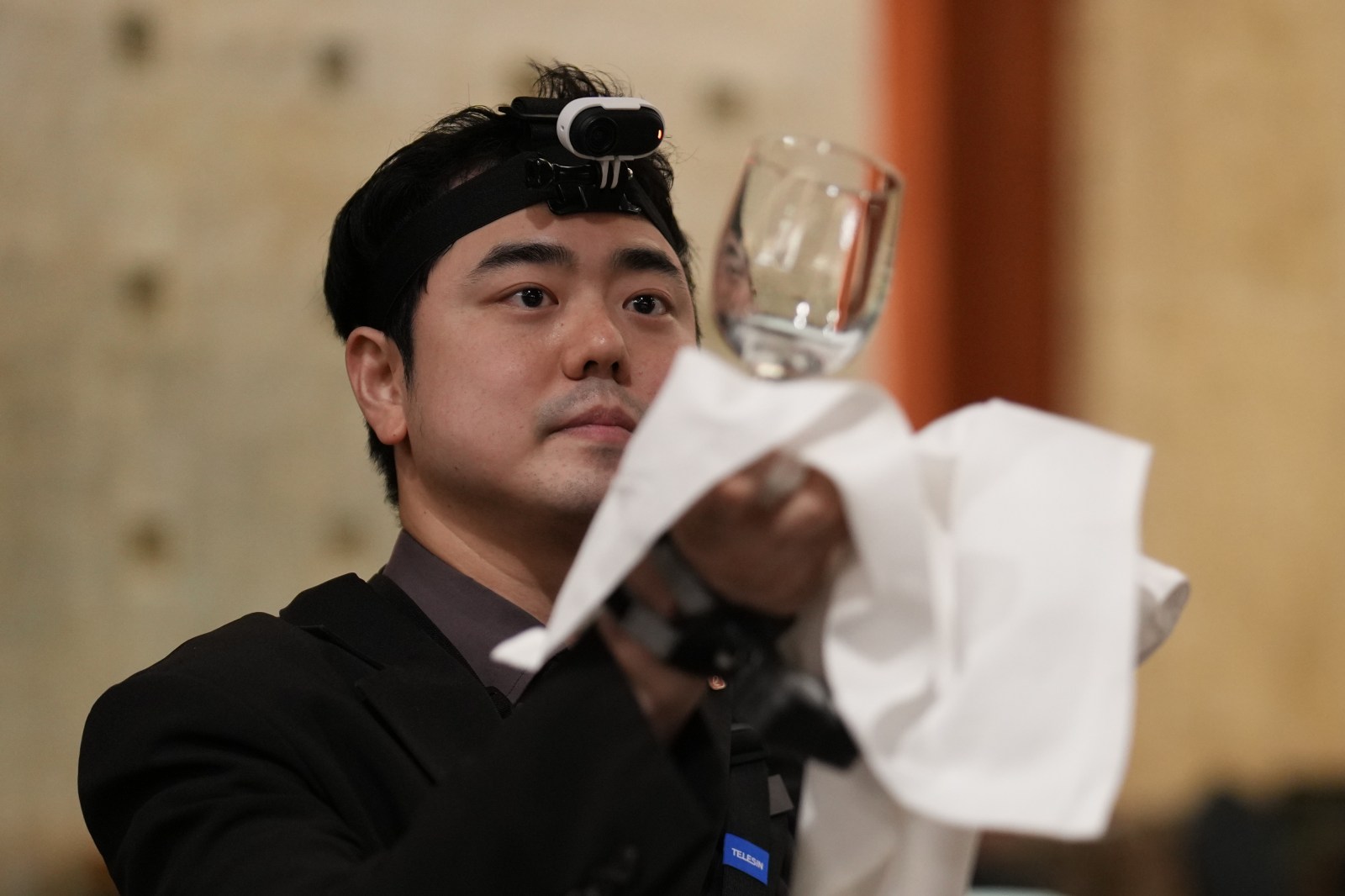
The Associated Press reports a South Korean startup is recording hotel and other workers with body cameras to capture their motions for training robot control systems. AP describes David Park, a worker at Lotte Hotel Seoul, wearing head, chest and hand cameras while folding a banquet napkin; those captured motions are fed into a database the reporting says is intended to teach robots similar tasks. The coverage frames the effort as an attempt to build the data and models the article calls "AI brains for robots."
What happened
The Associated Press reports a South Korean startup is collecting first-person video and motion data from workers to build a database for robot training. Per AP reporting, David Park, a nine-year employee at Lotte Hotel Seoul, wore head, chest and hand cameras while folding a banquet napkin; the captured motions are described in the article as being fed into a database meant to teach robots those tasks. The article frames the project as an effort to develop what it calls AI brains for robots.
Editorial analysis - technical context
Recording expert workers with body-worn cameras produces dense, task-focused footage that can support imitation learning and learning-from-demonstration approaches. Industry-pattern observations show such datasets are useful for training policies via behavior cloning, offline reinforcement learning, and hybrid sim-to-real pipelines. Practitioners should note that first-person video reduces some occlusion issues but typically still requires synchronization, pose estimation, and tool-state annotation before it is usable for control learning.
Industry context
Companies and labs increasingly seek real-world, human-centric datasets to accelerate robotic manipulation and service-robot deployments. Industry observers point out that collecting demonstrations in operational environments can shorten the gap between lab benchmarks and field performance, while also raising engineering challenges around data quality, annotation cost, and domain shift when deploying trained models on different hardware.
Technical caveats and challenges
Editorial analysis: Raw body-camera footage alone rarely yields production-ready control policies. Steps commonly required include multi-view reconstruction or sensor fusion, explicit labeling of object states and affordances, temporal alignment between hands and objects, and careful evaluation of safety-critical failure modes. Transfer to robot hardware commonly needs system identification and fine-tuning or real-world reinforcement learning.
What to watch
Follow whether the reporting names the startup, publishes datasets or benchmark tasks, or partners with robotics labs. Observers should watch for releases of annotated datasets, papers describing training pipelines, or demonstrations of robots generalizing from hotel or factory demonstrations to new contexts.
Key Points
- 1Recording expert workers with body cameras creates dense demonstration datasets that accelerate imitation learning for manipulation tasks.
- 2First-person footage reduces some visual ambiguity but still requires pose estimation, annotation, and sensor fusion before use in control models.
- 3Public datasets and reproducible pipelines from such projects materially benefit practitioners working on sim-to-real transfer and robot fine-tuning.
Scoring Rationale
The story highlights a practical, real-world approach to collecting demonstration data for robotic learning, which matters to practitioners working on manipulation and sim-to-real. It is notable but not frontier-changing, so it rates as a mid-tier industry application story.
Practice interview problems based on real data
1,625 SQL & Python problems across 15 industry datasets — the exact type of data you work with.
Try 250 free problems