South Korea Overtakes India in Global Market Capitalization
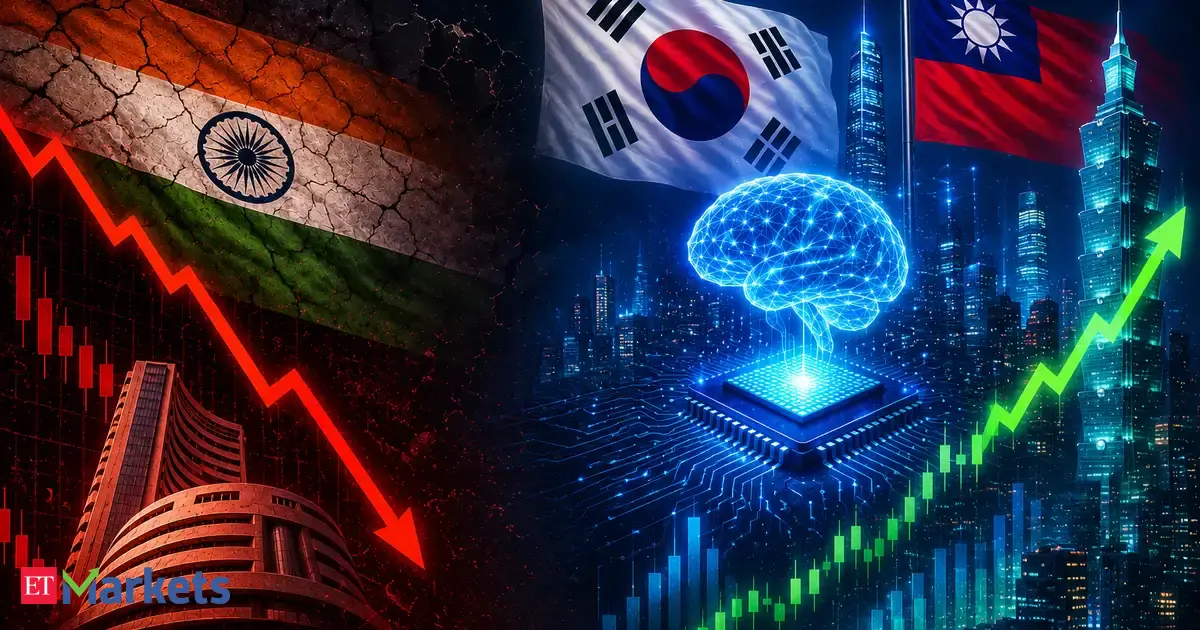
South Korea's stock market has overtaken India's to become the world's sixth largest, driven by a surge in AI-linked chipmakers, according to data compiled by Bloomberg. Bloomberg reports the total value of Korea-listed companies has climbed about 86% in 2026 to roughly $5 trillion, while India's has eased to about $4.8 trillion; Taiwan had passed India days earlier to take fifth. Samsung Electronics and SK Hynix, both newly above $1 trillion in market value on strong AI-memory demand, have powered the rally, and the Kospi has gained more than 100% this year. Reporting notes the two chipmakers account for roughly half the index. India, by contrast, has faced a weaker rupee and heavy foreign outflows and lacks large listed firms tied directly to the AI hardware supply chain.
What happened
South Korea's equity market has overtaken India's to become the world's sixth largest, according to data compiled by Bloomberg. Bloomberg reports that the combined value of Korea-listed companies has risen about 86% in 2026 to roughly $5 trillion, while India's has slipped to about $4.8 trillion; Taiwan had surpassed India days earlier to claim the fifth spot. The surge is attributed largely to semiconductor heavyweights Samsung Electronics and SK Hynix, both newly valued above $1 trillion on demand for AI memory, with the Kospi up more than 100% on the year and the two firms accounting for roughly half the index.
Editorial analysis - what is driving it
Memory and foundry suppliers benefit quickly when demand for high-bandwidth, high-capacity AI chips accelerates, and concentrated mega-cap re-rating can move an entire index. India, by contrast, has faced a weakening rupee, heavy foreign portfolio outflows, and a relative absence of large listed companies tied directly to the AI hardware supply chain. For practitioners, these capital flows shape where hardware-adjacent funding, liquidity, and public-company disclosure concentrate.
Context and significance
The reshuffle reflects a broader investor preference for markets that capture the hardware layer of the AI stack. Markets dominated by large semiconductor exporters can post rapid index-level gains when product cycles align with AI demand, while markets with fewer listed AI-supply-chain firms can underperform even amid strong domestic activity.
What to watch
- •Quarterly earnings and capital-expenditure guidance from leading memory and foundry firms.
- •Foreign portfolio flows into India and movements in the rupee.
- •Whether Korea's rally broadens beyond a few chipmakers, a key test of its durability.
Key Points
- 1Korea's market value rose about 86% in 2026 to roughly $5 trillion, overtaking India's roughly $4.8 trillion to rank sixth globally, per Bloomberg.
- 2Samsung Electronics and SK Hynix, both now above $1 trillion on AI-memory demand, drove a Kospi gain of more than 100% and make up about half the index.
- 3The shift shows how AI hardware demand concentrates equity gains in markets with large chip exporters, while markets lacking listed AI-infrastructure firms can lag.
Scoring Rationale
An AI-driven re-rating of Samsung and SK Hynix pushing Korea past India to the sixth-largest equity market is a meaningful signal of how AI hardware demand concentrates capital, verified against Bloomberg data. It is fundamentally a markets-and-capital-flows story rather than an AI development, which caps it in the lower-solid band despite the strong AI-semiconductor through-line.
Sources
Public references used for this report.
Practice interview problems based on real data
1,625 SQL & Python problems across 15 industry datasets — the exact type of data you work with.
Try 250 free problems