South Korea Ordains Humanoid Robot 'Gabi' as Monk
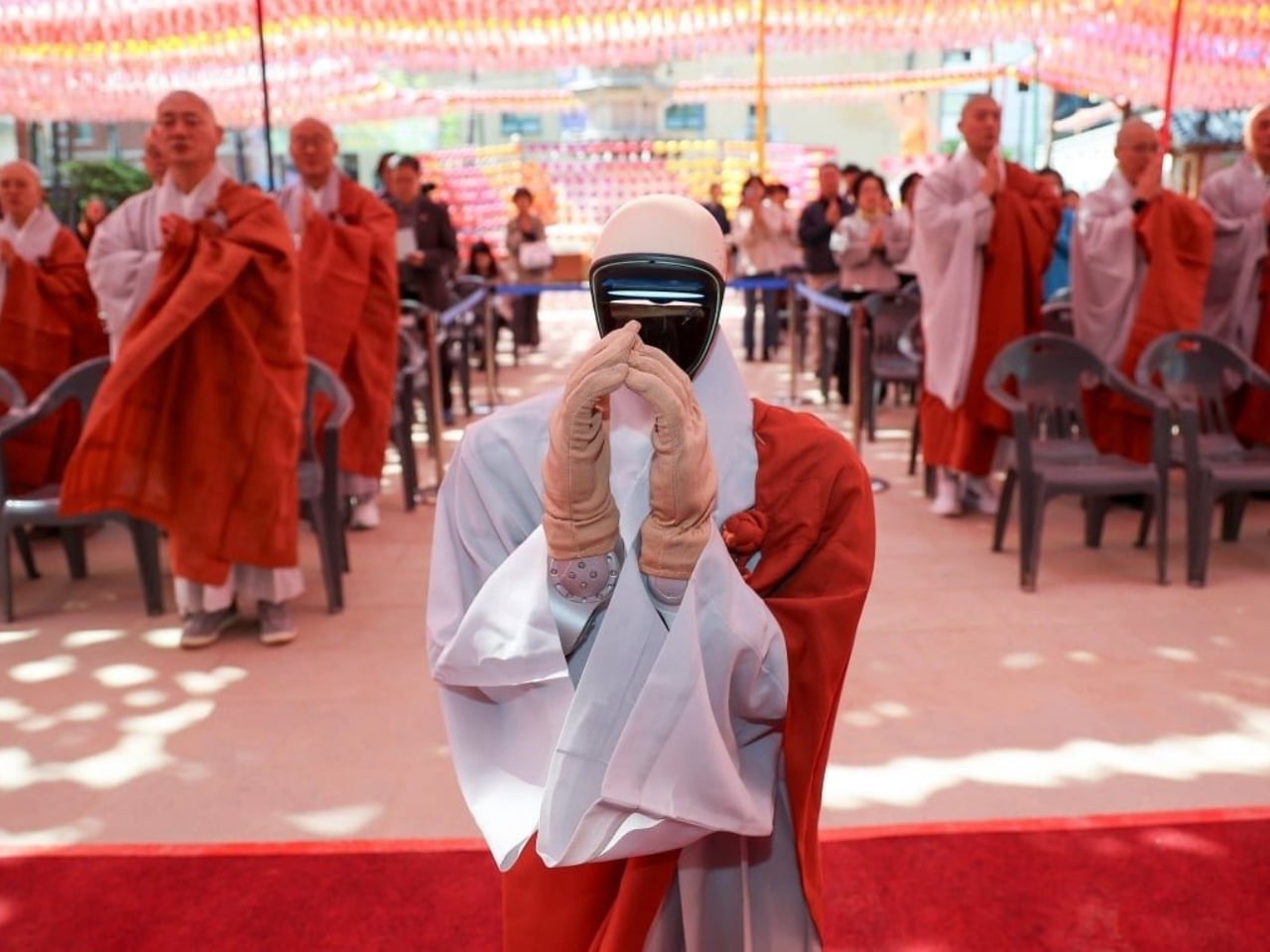
Multiple outlets report that a 130-centimeter humanoid robot named Gabi took part in a Buddhist ordination ritual at Seoul's Jogyesa Temple ahead of Buddha's birthday. Reporting varies: Mashable and several international outlets describe the event as an ordination in which the robot answered "Yes, I will devote myself," while IBTimes and the Jogye Order say the robot was accepted as a lay Buddhist practitioner rather than formally ordained as a monk (IBTimes cites the Jogye Order). Multiple sources identify the robot as based on Unitree Robotics' G1 humanoid platform and say the Jogye Order helped adapt the five precepts for a machine, with the rewrite informed by ChatGPT and Google's Gemini according to Mashable.
What happened
Multiple news outlets report that a humanoid robot named Gabi participated in a formal Buddhist refuge/ordination ritual at Jogyesa Temple in Seoul ahead of Buddha's birthday. Mashable describes the event as the robot being ordained and reports that the robot responded "Yes, I will devote myself" when asked to dedicate itself to Buddhism (Mashable). IBTimes, citing the Jogye Order, says the robot was not ordained as a monk but was formally accepted as a lay Buddhist practitioner and will serve as an honorary participant in the Lotus Lantern Festival (IBTimes).
Technical details
Reported coverage identifies Gabi as a roughly 130-centimeter humanoid based on Unitree Robotics' G1 platform, a compact humanoid design with multiple degrees of freedom that supports humanlike posture and motion (Yanko Design; IBTimes). Mashable and other outlets report that the event involved a machine-adapted version of the five Buddhist precepts, which Mashable says were rewritten for a non-human entity using ChatGPT and Gemini.
Editorial analysis: industry context
The public ritual sits at the intersection of robotics, religious practice, and cultural projection. Industry reporting frames the event as part of a broader Asian trend where temples and cultural institutions use humanoid robots for symbolic, educational, or festival roles; Japan previously hosted similar temple demonstrations (Yanko Design; IBTimes). For practitioners, the ceremony illustrates how off-the-shelf humanoid platforms are being repurposed for social and symbolic functions beyond narrow industrial or research settings.
Context and significance
Editorial analysis
The differing descriptions across outlets, some calling the event an ordination while others call it an honorary lay acceptance, highlight how symbolic meaning is negotiated between religious authorities, press narratives, and public reaction. The Jogye Order's participation, as reported by IBTimes, provides an institutional anchor for the ritual, while Mashable's reporting that ChatGPT and Gemini were used to adapt moral precepts underscores how foundation models are increasingly used as drafting tools for culturally sensitive text.
What to watch
For practitioners
observers should track how religious institutions document the role and limits of such machines (formal orders, vows, legal status), how platforms like Unitree position humanoids for public-facing roles, and whether temples publish the adapted precepts and technical details (sensor sets, autonomy levels, voice/interaction stacks) that were used during the ceremony. Public reaction on social media and commentary from religious scholars will shape whether similar demonstrations scale into repeated festival roles or remain one-off symbolic events.
Key Points
- 1Humanoid robot Gabi, reported at 130 cm, took part in a Seoul temple ritual, spotlighting robots in public religious performances.
- 2Reporting diverges: some outlets call it an ordination while the Jogye Order describes an honorary lay acceptance, showing contested symbolic meaning.
- 3Industry observers note repurposing of commercial humanoid platforms and foundation models for cultural roles raises ethical and documentation questions for practitioners.
Scoring Rationale
The story is culturally notable rather than technically novel. It illustrates public-facing uses of humanoid robots and foundation models, but it does not introduce a new model, algorithm, or infrastructure change that materially affects ML/DS practice.
Sources
Public references used for this report.
View 6 more sources
- Meet Gabi: South Korea's Humanoid Buddhist Robot Monk Emerges ...amp.ibtimes.sg
- South Korea’s Humanoid Robot Gabi Takes Vows as a Monk, Says “I Will Devote Myself”; Video Goes Viral | Watchthebridgechronicle.com
- "I Will Not Defy Humans, Namu Amitabha Avalokiteshvara"asiae.co.kr
- Robot monk Gabi takes vows in first-of-its-kind Seoul ritualmsn.com
- Robot becomes Buddhist monk in South Korea in symbolic temple ...cedarnews.net
- This $20 Pen Is The Reason I Quit My Notes Appyankodesign.com
Practice interview problems based on real data
1,625 SQL & Python problems across 15 industry datasets — the exact type of data you work with.
Try 250 free problems