Sony Ace Robot Beats Elite Table Tennis Players
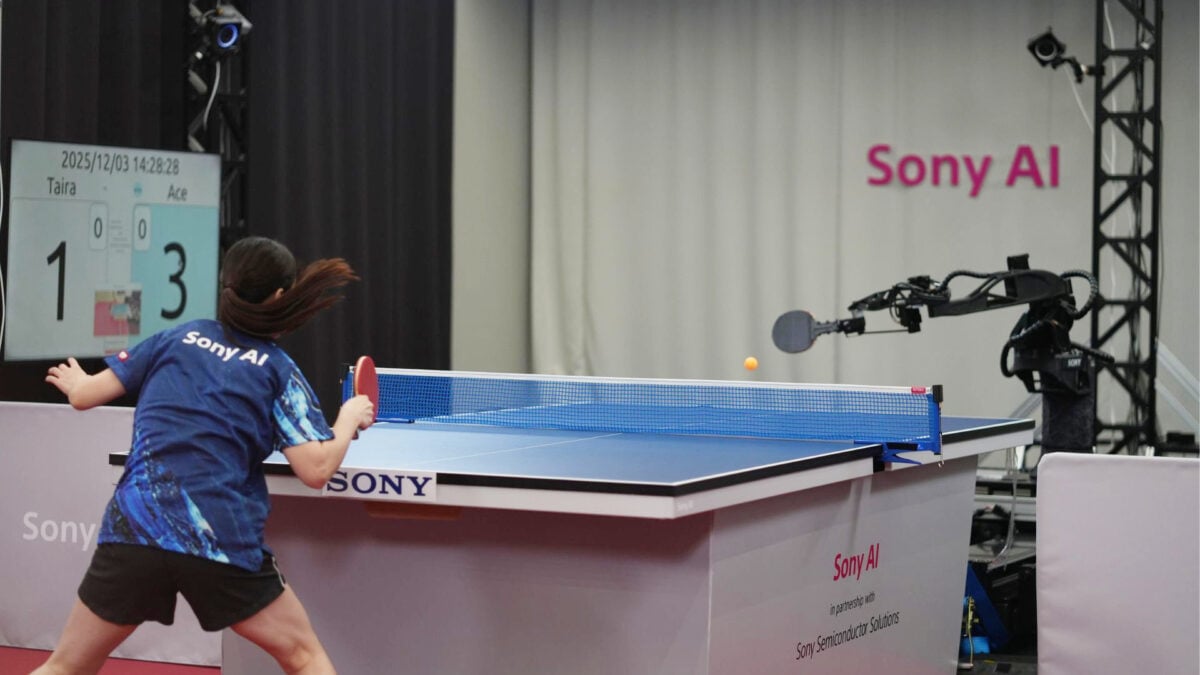
Sony's research teams have demonstrated Ace, a table-tennis robot that can match serves and outplay top professional players in controlled tests. The system builds on Sony's prior sports-AI and robotics work, combining high-speed vision sensors, proprietary pose-estimation, real-time object tracking, and low-latency arm control to perceive ball flight and return serves at human competitive speeds. The achievement is a milestone for real-time perception-action loops in dynamic physical tasks and signals practical use cases from training partners and broadcast augmentation to human-robot interaction research. Engineers should note the emphasis on predictive trajectory estimation, closed-loop control, and latency management as the core technical enablers.
What happened
Sony demonstrated Ace, a table-tennis robot capable of matching serves and beating elite human players in staged trials, marking a practical step forward for real-time, human-scale physical interaction. The result follows Sony's longer-running work in sports AI and robotic interaction from Sony Creative Center and Sony Computer Science Laboratories (Sony CSL).
Technical details
The system combines multiple sensing and control components to close the perception-to-action loop. Key elements include:
- •High-speed vision sensors and camera systems for ball detection and tracking
- •Proprietary pose-estimation and object-recognition pipelines to understand player posture and ball state
- •Predictive trajectory estimation and low-latency motor control to position robot arms and time returns
- •Integration of multi-body coordination concepts explored in the Parallel Ping-Pong research to maintain agency and hit accuracy
These components emphasize minimizing end-to-end latency and shifting part of the computation to explicit trajectory prediction so the robot can act proactively rather than purely reactively.
Context and significance
Sony has long prototyped sports-augmentation tech for broadcasting and analytics; this demonstration moves that stack from visualization toward physical interaction. For practitioners, this matters because it validates a system architecture that pairs computer vision, fast sensing hardware, and control algorithms to operate reliably in high-speed, adversarial human environments. The approach converges with broader trends in robotics: richer perception pipelines, model-based prediction for dynamic objects, and tighter integration of software and specialized sensors.
What to watch
Expect follow-on work on robustness (varied lighting, spin types, unpredictable human strategies), portability to different robot morphologies, and commercial applications such as automated training partners, live-broadcast overlays, and research platforms for human-robot interaction. Open questions remain around safety, regulatory constraints for human-robot sports, and how transferable the control stack is beyond table tennis.
Key Points
- 1Sony combined high-speed vision, pose-estimation, and predictive control to enable a robot to reliably match pro table-tennis serves.
- 2Minimizing perception-to-action latency and using trajectory prediction are the decisive engineering choices for dynamic, adversarial physical tasks.
- 3This advances practical robotics for sports training, broadcast augmentation, and human-robot interaction, but robustness and safety remain open challenges.
Scoring Rationale
This is a notable robotics milestone demonstrating real-time perception-action at human competitive speeds, directly relevant for practitioners building dynamic robotic systems. The result is important but not a foundational AI model breakthrough.
Sources
Public references used for this report.
Practice interview problems based on real data
1,625 SQL & Python problems across 15 industry datasets — the exact type of data you work with.
Try 250 free problems