Soft Exosuit Cut Walking Energy Use 13.9% in Small Test
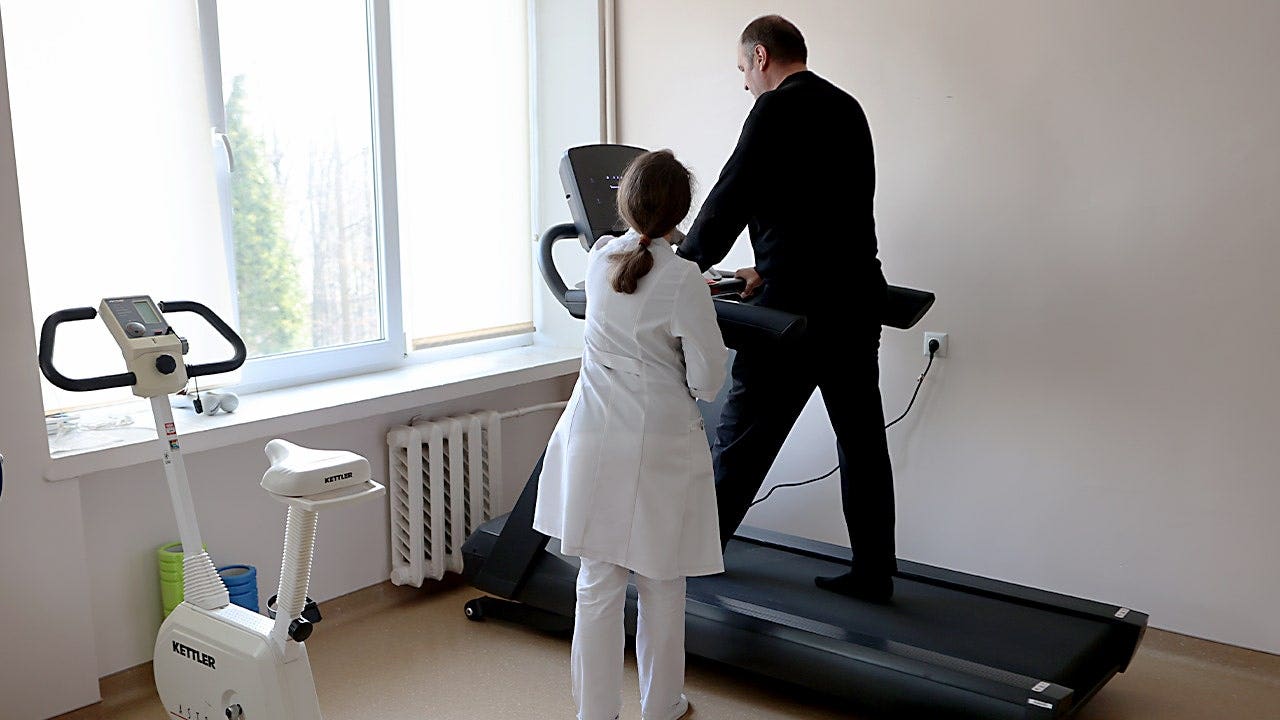
Researchers at Hebei University of Technology reported a motor-free soft hip exosuit that cut net metabolic rate by 13.9% in a treadmill study of six healthy adults walking at 4 km/h. The 4.2-pound prototype uses electrically driven fibrous dielectric-elastomer actuators instead of conventional motors; the early result does not establish clinical or real-world benefit.
Researchers at Hebei University of Technology reported a motor-free soft hip exosuit that reduced participants' net metabolic rate by an average of 13.9% compared with walking without the suit. The result came from six healthy adults walking at 4 km/h on a treadmill, so it is an early engineering result rather than evidence of clinical benefit.
The 4.2-pound prototype fits around the waist and thighs. Instead of conventional motors or pneumatic hardware at the assisted joint, it uses bundles of fibrous dielectric-elastomer actuators. These rubber-like fibers change shape under an electric field, and straps transfer their force to the hips and thighs.
What the experiment measured
The six participants walked under three conditions: without the exosuit, with the suit in passive mode and with electrically activated assistance. The researchers measured oxygen consumption and muscle activity while participants walked at a fixed speed.
IEEE Spectrum and Tech Xplore report that the active condition reduced energy use by 13.9% versus no suit. Muscle-activity measurements also fell, but the cohort was too small and narrow to support claims about older adults, people with mobility impairments or everyday use.
Why the actuator design matters
Soft exosuits usually still depend on rigid electric motors or pneumatic components. This design uses two bundles of ten thin actuator fibers, avoiding a motor and gearbox at the hip while retaining an onboard battery and electrical system.
The distinction is important: “motor-free” does not mean unpowered. The fibers are electrically activated, and IEEE Spectrum reports that dielectric-elastomer actuators typically require more than 1,000 volts. Current remains low, but any practical wearable would still need robust insulation, control and safety validation.
What remains unresolved
The retrieved reporting identifies several limits beyond the six-person treadmill test. Battery life constrains operating time, the control system does not yet adapt automatically to changing walking speed or terrain, and long-term reliability under sweat, temperature changes and prolonged movement remains unverified.
For wearable-robotics teams, the study shows that compliant fiber actuators can produce measurable hip assistance without conventional joint-mounted motors. It does not yet show that the suit improves daily mobility, prevents falls or provides safe assistance for a clinical population. Larger, more diverse and real-world studies are the next evidence threshold.
Key Points
- 1Six healthy adults walking at 4 km/h on a treadmill showed a 13.9% average reduction in net metabolic rate with active assistance versus no suit.
- 2The 4.2-pound prototype uses electrically driven fibrous dielectric-elastomer actuators instead of conventional hip-mounted motors or pneumatic systems.
- 3Battery life, adaptive control, high-voltage safety and real-world durability remain unresolved, and the study does not establish clinical benefit.
Scoring Rationale
The study reports a measurable metabolic benefit from a lightweight, motor-free wearable-robotics prototype, relevant to soft-actuation and human-robot interaction research. Its practitioner impact is limited by the six-person healthy-adult treadmill cohort and the absence of demonstrated clinical or real-world performance.
Sources
Public references used for this report.
Practice with real Ad Tech data
90 SQL & Python problems · 15 industry datasets
250 free problems · No credit card
See all Ad Tech problems