Robots Illuminate Limits and Insights into Human Sport
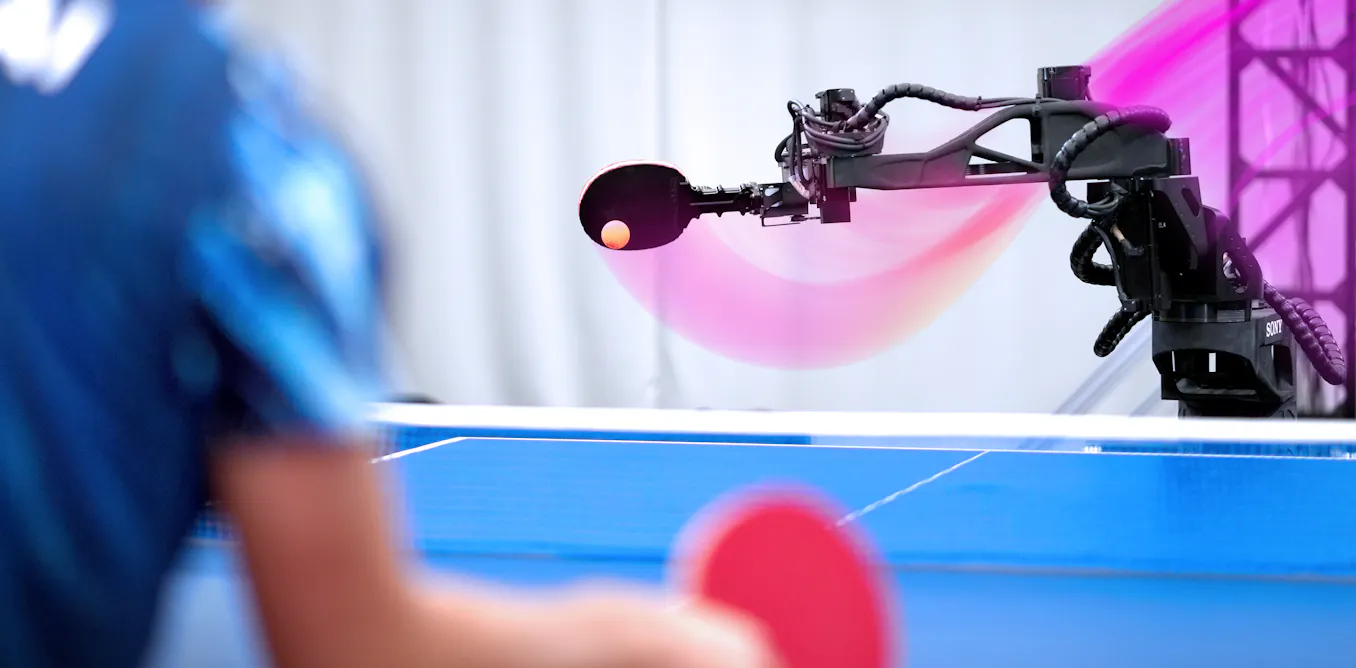
A humanoid robot recently ran a half-marathon, and an AI-powered robot played ping-pong, according to a piece in The Conversation by researchers at Queensland University of Technology. The authors, Professor Jonathan Roberts and Marc Portus, argue that sport robotics research is less about producing robot champions and more about using machines to study movement, perception-action coupling, and training processes. The Conversation article contrasts robot training, which relies on simulation, data and control algorithms, with human learning through practice, coaching and experience. For practitioners, the article frames sport robotics as a controlled laboratory that can generate repeatable, high-frequency data to inform biomechanics, wearable analytics and data-driven coaching.
What happened
A recent article in The Conversation by Professor Jonathan Roberts and Marc Portus of Queensland University of Technology reviews recent sport robotics milestones, noting that a humanoid robot ran a half-marathon and an AI-powered robot played ping-pong, events the authors describe as public milestones for the field. The piece states that sport robotics experiments emphasise machines learning to move, react and interact in dynamic, unpredictable environments, and that researchers commonly use simulation, large datasets and control algorithms to train robots.
Editorial analysis - technical context
Per the Conversation article, robots are typically trained in rich virtual environments that allow them to "practice" millions of times, supporting rapid iteration on perception, prediction and control. Industry-pattern observations: this workflow contrasts with human athlete training, which couples perception and action through embodied practice and coaching. For practitioners, the relevant technical takeaways are the emphasis on repeatability, high-rate sensor telemetry, and closed-loop control evaluation as tools that produce precisely measured datasets useful for modeling sensorimotor dynamics.
Industry context
Industry observers note that sport robotics sits at the intersection of robotics, biomechanics and sports science, where experiments can isolate variables that are hard to separate in human studies. For practitioners: datasets and methodologies from robot experiments can inform feature engineering for wearable sensors, help validate physics-based models, and supply ground truth for supervised or reinforcement-learning approaches applied to human movement analytics. The Conversation authors highlight that the research value lies in understanding human performance, not merely in creating entertaining robot demonstrations.
What to watch
- •Broader release of motion and sensor datasets derived from sport-robotics experiments, which would aid reproducible research.
- •Advances in sim-to-real transfer that reduce the gap between virtual training and real-world robot behaviour.
- •Cross-disciplinary projects that pair robotics labs with sport-science groups to translate robotic measurement techniques into athlete monitoring and coaching.
Editorial analysis
Overall, the Conversation piece positions sport robotics as a methodological platform that can produce controlled, high-resolution measurements; practitioners should watch for usable datasets and validated simulation pipelines that might be repurposed for human-performance modeling.
Key Points
- 1Sport robotics demonstrations highlight differences between simulation-driven robot training and embodied human learning, offering controlled variables for study.
- 2Sim-to-real workflows produce rapid iteration and repeatable trials, which can accelerate development of biomechanics models and sensor-fusion pipelines.
- 3Robotic experiments generate high-frequency, consistent telemetry that is valuable for training and validating data-driven athlete monitoring and wearable analytics.
Scoring Rationale
The story is notable for robotics and sports-science practitioners because it reframes public robot demos as research tools rather than endpoints. It matters to those building motion models, wearable analytics, and sim-to-real pipelines, but it is not a frontier-model release or major industry shift.
Practice interview problems based on real data
1,625 SQL & Python problems across 15 industry datasets — the exact type of data you work with.
Try 250 free problems