Qwen 3.8-27B Leads Local RTX 5090 Tests
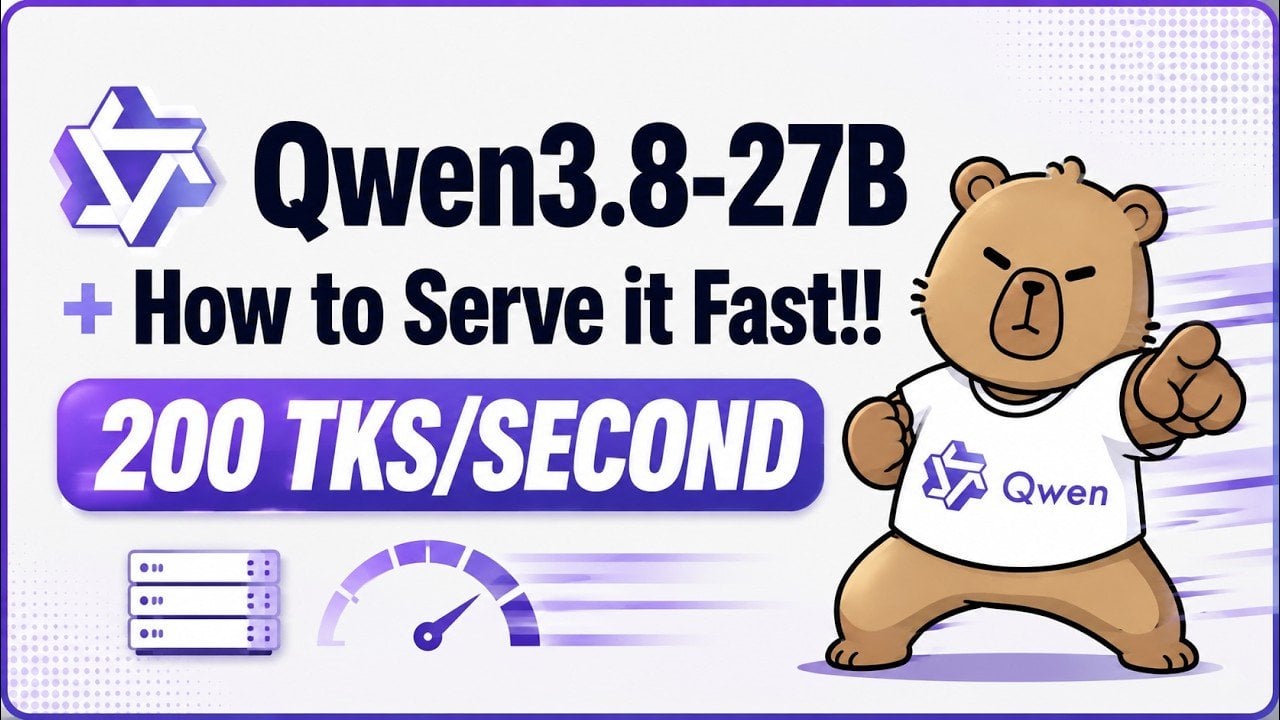
On August 15, KGPTalkie compared Qwen 3.8-27B, Nemotron 3.5 Lightning, and Meta Muse Glimmer on 16 code-checkable problems using one RTX 5090, measuring accuracy, speed, VRAM, and failure modes. Geeky Gadgets' August 20 overview says Qwen 3.8-27B outperformed Muse Glimmer in local tests and discusses FP8, NVFP4, and serving libraries.
KGPTalkie tested Qwen 3.8-27B, Nemotron 3.5 Lightning, and Meta Muse Glimmer on 16 hard, code-checkable problems on a single RTX 5090. The August 15 benchmark examined answer accuracy alongside generation speed, VRAM consumption, and failure behavior, an approach intended to distinguish incorrect answers from outputs cut off by generation-token limits.
Geeky Gadgets, in an August 20 overview of local serving options, characterizes Qwen 3.8-27B as outperforming Meta's Muse Glimmer in local tests. Its article focuses on serving and quantization methods, including FP8 and NVFP4.
What the local comparison measured
KGPTalkie's test design used problems whose answers could be checked by executing code, rather than by subjective reading. That matters for local-model evaluation because short, familiar programming prompts can cause similarly capable models to converge on a correct answer, masking differences in reliability on harder tasks.
The benchmark describes the three models as close in nominal size but technically distinct:
- •Nemotron 3.5 Lightning is a sparse mixture-of-experts model with 32.9 billion total parameters and a 1 million-token context window, according to KGPTalkie.
- •Muse Glimmer is a dense 27.9 billion-parameter model with a 6,656-wide embedding, and KGPTalkie reports that it does not expose a separate thinking field.
- •Qwen 3.8-27B is described by KGPTalkie as a dense model.
KGPTalkie reports that Nemotron used 25.4 GB of VRAM during its run, compared with roughly 17 GB for the other two models. That difference is operationally important for practitioners selecting a model for a single consumer GPU, where memory headroom affects context length, concurrency, and KV-cache capacity.
Serving and quantization tradeoffs
Geeky Gadgets highlights SGLang and vLLM as inference libraries relevant to Qwen deployment, and discusses FP8 and NVFP4 quantization. The original RSS description reports throughput of up to 200 tokens per second with SGLang and NVFP4, but that figure is configuration-dependent and should not be treated as a general performance result across hardware, prompts, or output lengths.
The source also warns that aggressive quantization can introduce over-compression risks and that available VRAM constrains local deployments. Across comparable local-model evaluations, token-per-second figures alone are an incomplete selection criterion: hardware fit, quantization quality, output-length controls, and task-specific correctness can materially change the usable result.
For teams evaluating open local models, the strongest part of the KGPTalkie methodology is its separation of failure categories. A response that is truncated because of a token cap requires a different intervention from a response that completes but fails verification. Logging finish reasons, token budgets, quantization settings, GPU memory use, and verifier outcomes can make those distinctions reproducible in internal model evaluations.
Key Points
- 1KGPTalkie compared three local models on 16 executable-check problems, pairing correctness measurements with speed, VRAM consumption, and failure analysis.
- 2Nemotron's reported 25.4 GB runtime footprint versus roughly 17 GB for the other two models illustrates how model architecture changes single-GPU deployment feasibility.
- 3Across comparable local deployments, throughput claims require accompanying details on quantization, context, output limits, hardware, and verified task quality.
Scoring Rationale
The comparison is relevant to practitioners deploying capable language models on a single high-end GPU, especially because it measures verifiable task outcomes and memory use. Its impact is limited by the small benchmark scope and the absence of a complete reproducible results table in the supplied reporting.
Sources
Public references used for this report.
Practice interview problems based on real data
1,625 SQL & Python problems across 15 industry datasets — the exact type of data you work with.
Try 250 free problems