Quandela Demonstrates Photonic QPU for Quantum Machine Learning
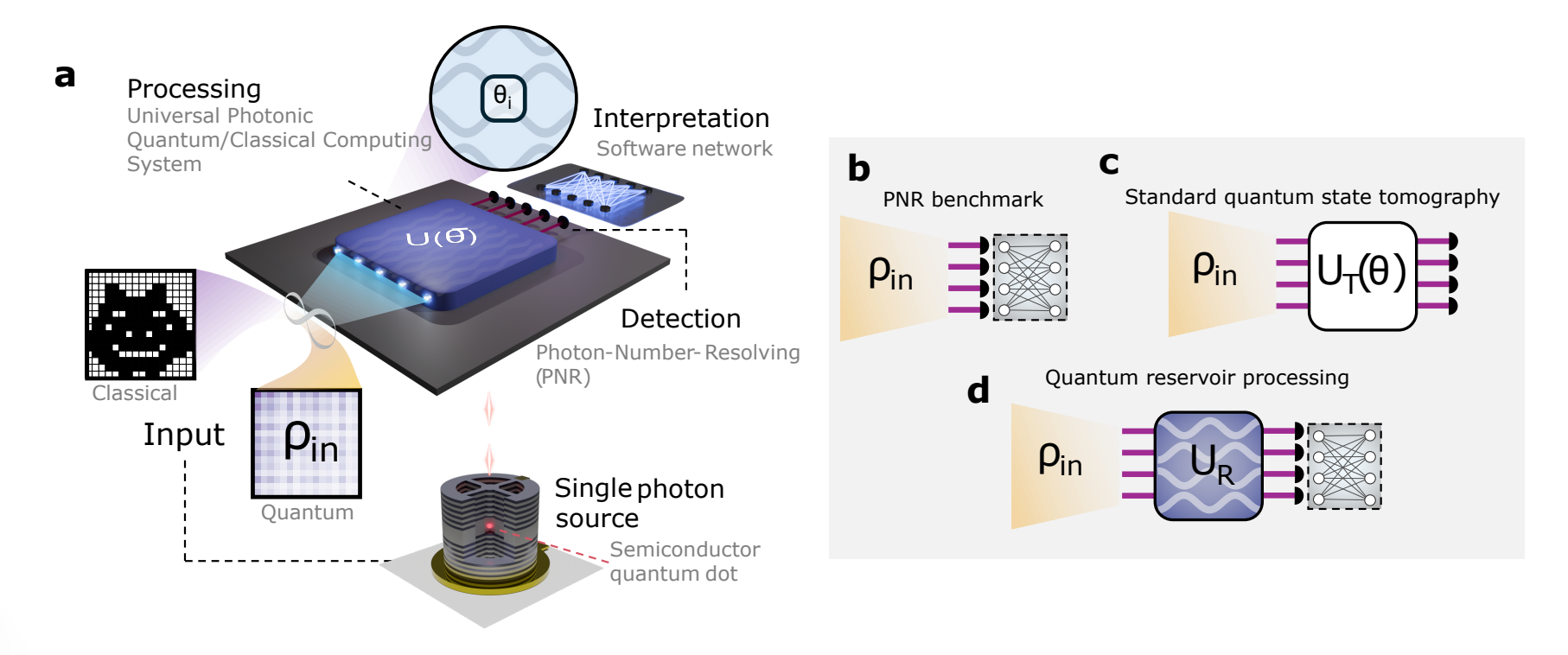
A research collaboration between Quandela, the Center for Theoretical Physics of the Polish Academy of Sciences, and the University of Warsaw has experimentally demonstrated a quantum reservoir processing (QRP) platform capable of both classical machine learning and quantum information tasks, supported by the EU Horizon Europe QUONDENSATE Pathfinder project. The system routes single photons from a semiconductor quantum dot through a 12-mode active demultiplexer into Quandela's Belenos QPU (24 modes), with photon-number-resolving (PNR) detectors at the output. A key result is single-basis quantum state tomography: the QRP protocol reconstructs two-mode density matrices using one fixed unitary transformation, achieving mean fidelity of 0.820 versus 0.747 for a standard PNR benchmark, while also extracting purity, von Neumann entropy, and entanglement negativity. A companion experiment on Quandela's legacy 12-mode Ascella QPU applied hardware-aware perturbation training for classical binary classification, reaching ~79.7% accuracy. The underlying preprint is arXiv:2605.10471 (May 2026), per Quantum Computing Report.
What happened
A Quandela-led research collaboration - also including researchers from the Center for Theoretical Physics of the Polish Academy of Sciences and the University of Warsaw - experimentally demonstrated a programmable silicon-photonic QPU performing quantum reservoir processing for machine learning and single-basis quantum tomography, supported by the EU Horizon Europe QUONDENSATE Pathfinder project. The system routed non-classical multimode single-photon states from a semiconductor quantum dot through a 12-mode active demultiplexer into Quandela's 24-mode Belenos QPU, with photon-number-resolving (PNR) detectors and an electronic correlator at the output, per Quantum Computing Report and arXiv:2605.10471.
Technical setup
The reservoir is a non-trainable universal Bell-Walmsley interferometer mesh on a silicon chip, comprising integrated optical waveguides, mode couplers, and thermo-optic phase shifters. Single photons traverse a programmable Mach-Zehnder interferometer array performing complex unitary transformations via quantum interference. A software ridge-regression readout layer then processes 15-element PNR coincidence probability feature vectors for classification and tomography.
Key results
The QRP protocol executed quantum state tomography in a single, fixed measurement basis - contrast to standard tomography, which requires an exponential number of different bases. Mean density-matrix reconstruction fidelity reached 0.820 versus 0.747 for a direct PNR benchmark that failed to resolve off-diagonal coherences. The system additionally extracted purity, von Neumann entropy, and entanglement negativity. Feature space requirements scale quadratically with mode count, supporting a path to 3-mode (45 independent parameters) and larger characterization. A companion experiment on Quandela's legacy 12-mode Ascella QPU used hardware-aware perturbation training - injecting random unitary noise at the chip's measured transpilation error amplitude during optimization - and reached approximately 79.7% binary classification accuracy, outperforming an ideal classical simulation in the coherent-state regime.
Industry context
Physical quantum reservoir computing maps nonlinear transformations natively in hardware, sidestepping barren-plateau optimization problems of parameterized quantum circuits. Photonic platforms operate at room temperature with native multi-mode interference, practical advantages over cryogenic alternatives for certain QML workloads. This is the first reported photonic QML system to successfully execute a quantum task (state tomography), not merely classical ML - that distinction is the paper's primary novelty claim.
What to watch
Reproducibility at larger mode counts, integration of higher-efficiency PNR detectors, and benchmarking against classical and other quantum hardware on standard QML tasks. The quadratic feature-space scaling result is the most concrete near-term indicator of practical scalability.
Key Points
- 1Single-basis QRP tomography on Quandela's Belenos QPU achieved 0.820 mean fidelity versus 0.747 for a direct PNR benchmark, recovering off-diagonal density matrix coherences the benchmark misses.
- 2Feature space requirements scale quadratically with mode count, providing a scalability roadmap from 2-mode (13 parameters) to 3-mode (45 parameters) and beyond.
- 3Hardware-aware perturbation training on the Ascella QPU - injecting noise matching the chip's measured error during optimization - reached ~79.7% classification accuracy, outperforming an ideal classical simulation.
Scoring Rationale
Experimental proof-of-concept for photonic quantum reservoir processing on Quandela's Belenos QPU, with verified fidelity improvement (0.820 vs 0.747) and quadratic scaling result. First reported photonic QML system to execute a quantum task (state tomography), not just classical ML. Notable for quantum ML and photonics practitioners but specialized scope; arXiv preprint with multi-institution authorship and EU project funding.
Sources
Public references used for this report.
Practice interview problems based on real data
1,625 SQL & Python problems across 15 industry datasets — the exact type of data you work with.
Try 250 free problems