PyCon US 2026 Typing Summit Recaps Typing Advances
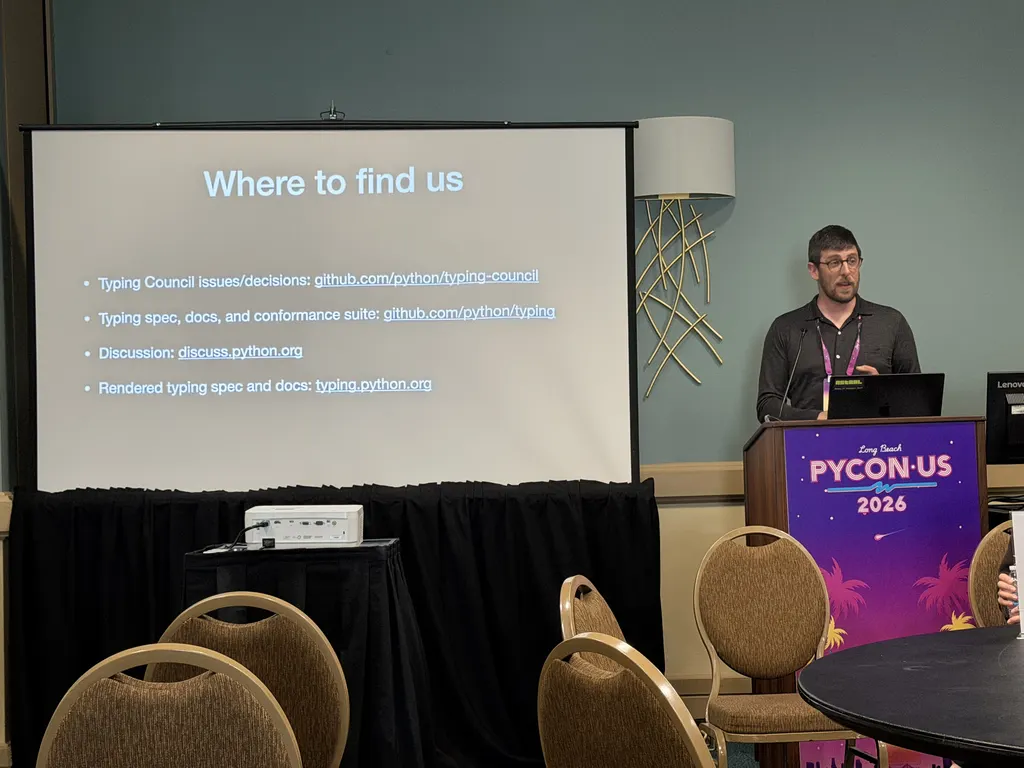
According to a recap posted on Bernat.tech, the PyCon US 2026 Typing Summit ran on May 14 in Long Beach and featured eight talks plus a Typing Council Q&A. The recap reports that Guido van Rossum argued the no-new-syntax rule is already broken in practice. Jelle Zijlstra proposed adding intersection and restricted-negation types with an inhabitation check, and Michael Sullivan (Vercel) presented a TypeScript-style type-manipulation system. The recap attributes a Pyrefly experiment by Conner Nilsen (Meta) showing success on a well-typed internal benchmark rising from 79.6% to 83.9%, with 21% fewer steps and 14% faster runs, while lightly typed benchmarks showed no clear benefit. The post also covers ty internals, a partial(choose, None) solver fix, tensor-shape types blocked by eager evaluation, and a Lean 4 formalization with mechanized proofs, which the author says AI assistants sped up. The event highlights practical intersections of typing research, typechecker tooling, and AI-assisted development workflows.
What happened
According to a recap on Bernat.tech, the PyCon US 2026 Typing Summit took place on May 14 in Long Beach, single-track with eight talks and a Typing Council Q&A. The recap reports that Guido van Rossum argued the longstanding no-new-syntax rule for Python is already broken in practice and urged weighing user pain against feature power. Jelle Zijlstra proposed adding intersection and restricted-negation types to the typing spec, with an inhabitation check as the core new rule. Michael Sullivan (Vercel) presented a type-manipulation system modelled on TypeScript conditional and mapped types. The recap describes ty internals, including ternary decision-diagram representation and a third solver strategy that fixes a canonical partial(choose, None) example many checkers get wrong, per the post.
Technical details
The recap attributes a Pyrefly experiment by Conner Nilsen (Meta) that evaluated AI coding agents with and without type-checker feedback. Reported metrics for a well-typed internal Meta benchmark moved success from 79.6% to 83.9%, with 21% fewer steps and 14% faster wall-clock runs, while experiments on lightly typed code over common libraries showed no measurable improvement, according to the Bernat.tech writeup. Avik Chaudhuri demoed tensor-shape types in Pyrefly, and the recap notes those are practically blocked by Python's eager evaluation of type parameters. Jia Chen presented a Lean 4 formalization (Featherweight Python) with mechanized soundness and decidability proofs; the recap says AI assistants compressed what used to take years into weeks.
Editorial analysis - technical context
Industry-pattern observations: proposals to add intersection and restricted-negation types plus an inhabitation check would increase expressivity but also change solver complexity and implementation surface for checkers. Observers building developer tools should note that TypeScript-style conditional/mapped type idioms are influencing Python tooling designs, as reported in Sullivan's talk. The reported gains for AI agents on well-typed benchmarks suggest that stronger static types can reduce search and error-repair work for agents in highly-typed codebases, while the lack of benefit on lightly-typed code highlights coverage as the primary limiter.
Context and significance
Editorial analysis: For practitioners, the session underscores two practical tensions in Python typing: the desire for more expressive type constructs versus the cost of solver complexity and runtime-evaluation interactions. The ty solver refinements and the partial(choose, None) example are concrete engineering fixes that tool maintainers will find relevant. The Lean 4 mechanization work signals growing uptake of formal methods in the Python-typing community, accelerated in part by AI-assisted proof development per the recap.
What to watch
Editorial analysis: Observers should track any formal PEP or Typing Council output following Zijlstra's proposal, adoption of TypeScript-style type-manipulation primitives in Python checkers, solver performance work addressing inhabitation checks, and follow-up publications on the Pyrefly AI-agent experiments to see benchmark details and reproducibility.
Key Points
- 1Reported proposals to add intersection and restricted-negation types increase expressivity but raise solver complexity and implementation cost.
- 2Bernat.tech reports Pyrefly agent experiments show stronger typing raised success from 79.6% to 83.9%, implying types can speed agent workflows when coverage is high.
- 3Mechanized Lean 4 proofs, reportedly accelerated by AI tools, indicate growing use of formal methods in Python typing research.
Scoring Rationale
The summit produced concrete technical proposals and experimental results that matter to tooling and type-system implementers. Reported AI-agent gains on well-typed code are directly relevant to developers of automated code tools. The story is notable within the typing and tooling niche but not industry-shaking.
Practice interview problems based on real data
1,625 SQL & Python problems across 15 industry datasets — the exact type of data you work with.
Try 250 free problems