Pudu Demonstrates Physical-Agent Architecture and D7 Robot at WAIC 2026
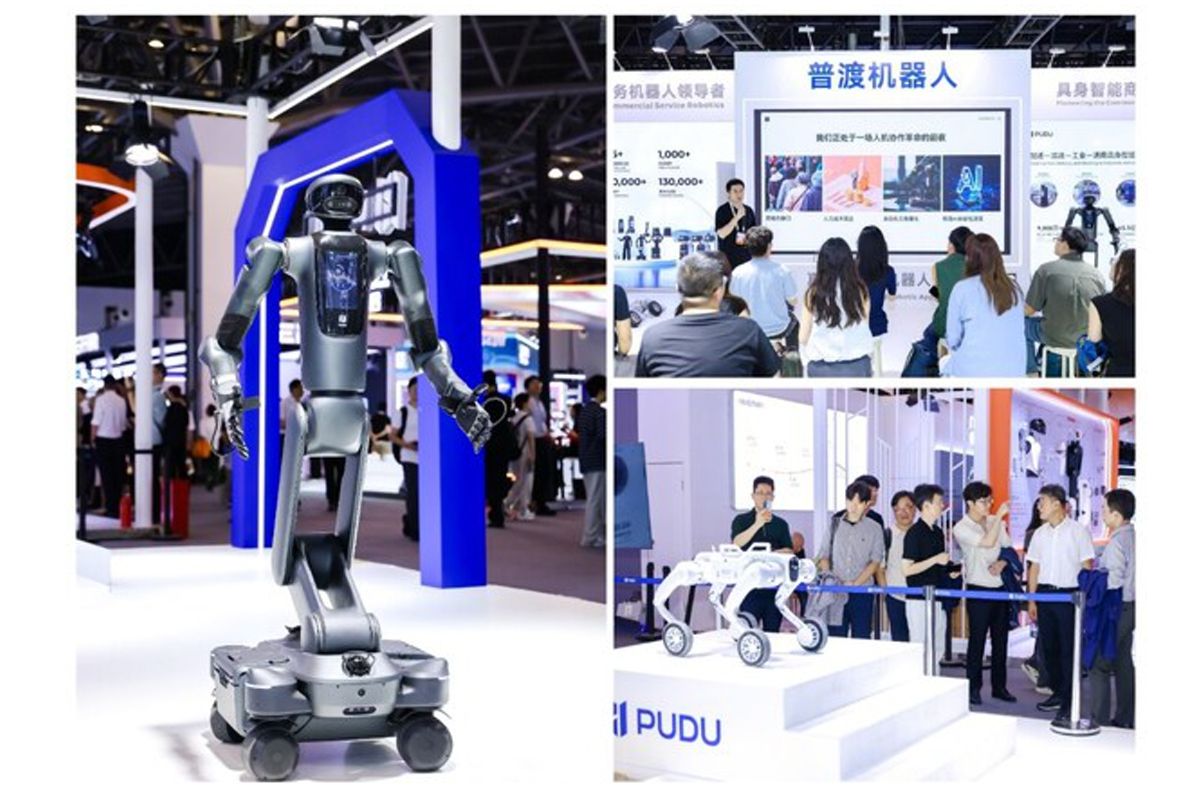
Pudu Robotics used its July 17 briefing at WAIC 2026 in Shanghai to present a three-layer Physical Agent architecture and give the PUDU D7 its first public offline showcase. The company says the semi-humanoid robot can handle payloads up to 14 kilograms and reach two meters, but it did not publish independent performance, deployment, or reliability results for the system.
Pudu Robotics presented its Physical Agent architecture at the World Artificial Intelligence Conference in Shanghai on July 17 and showed the PUDU D7 in public offline for the first time. The event was a technology briefing and demonstration, not evidence of a production deployment.
The company positions the system as a shared intelligence stack for robots with different physical forms. That approach reflects a broader theme at WAIC 2026: vendors are trying to reuse foundation models, control policies, and learned skills across specialized robots, semi-humanoids, and humanoids instead of building an isolated software stack for each machine.
What Pudu showed
Pudu described three layers. The embodiment layer covers the robot bodies. PuduAgent OS is the system layer for task understanding, planning, memory, and safety controls. The skill layer uses PuduFM, which the company says combines a physical vision-language model, a physics-intuition component, and action-expert modules.
The D7 was the hardware example at the briefing. Pudu describes it as an industrial semi-humanoid intended for material handling, high-reach picking, and warehouse logistics. The company lists a maximum payload of 14 kilograms and a working height of two meters. Those are vendor specifications; the announcement did not provide third-party test results, task-success rates, operating hours, or comparative benchmarks.
Why the shared architecture matters
A common model and software layer could reduce the engineering needed to transfer a capability from one robot form to another. In principle, experience gathered by delivery or cleaning robots could help train systems for industrial workflows, while a unified task and safety layer could make behavior more consistent across a fleet.
That is the architectural promise. Pudu did not disclose enough technical detail to assess how much training data, fine-tuning, or hardware-specific control work is still required for each embodiment.
What practitioners should watch
The useful next evidence will come from operations rather than conference demonstrations: sustained task completion, failure recovery, intervention rates, safety incidents, and performance across changing layouts. RobotToday’s broader WAIC analysis similarly identified long-duration reliability and post-deployment stability as unresolved industry tests.
For robotics and data teams, the event is best read as a platform direction plus a public hardware demonstration. It is not yet proof that cross-body skill transfer works reliably at production scale.
Key Points
- 1Pudu presented a three-layer Physical Agent architecture and gave the D7 its first public offline showcase at WAIC 2026 on July 17.
- 2The company lists a 14-kilogram payload and two-meter working height for the D7, but those specifications were not accompanied by independent performance results.
- 3The shared-stack approach aims to reuse intelligence across robot forms; production reliability, intervention rates, and cross-body transfer efficiency remain undisclosed.
Scoring Rationale
The event shows a concrete embodied-AI platform direction and a public industrial-robot demonstration, but the claims remain vendor-reported and lack deployment-scale reliability or benchmark evidence. The immediate practitioner impact is therefore moderate.
Sources
Primary source and supporting public references used for this report.
Practice interview problems based on real data
1,625 SQL & Python problems across 15 industry datasets — the exact type of data you work with.
Try 250 free problems