Private Capital Funds AI Infrastructure Buildout
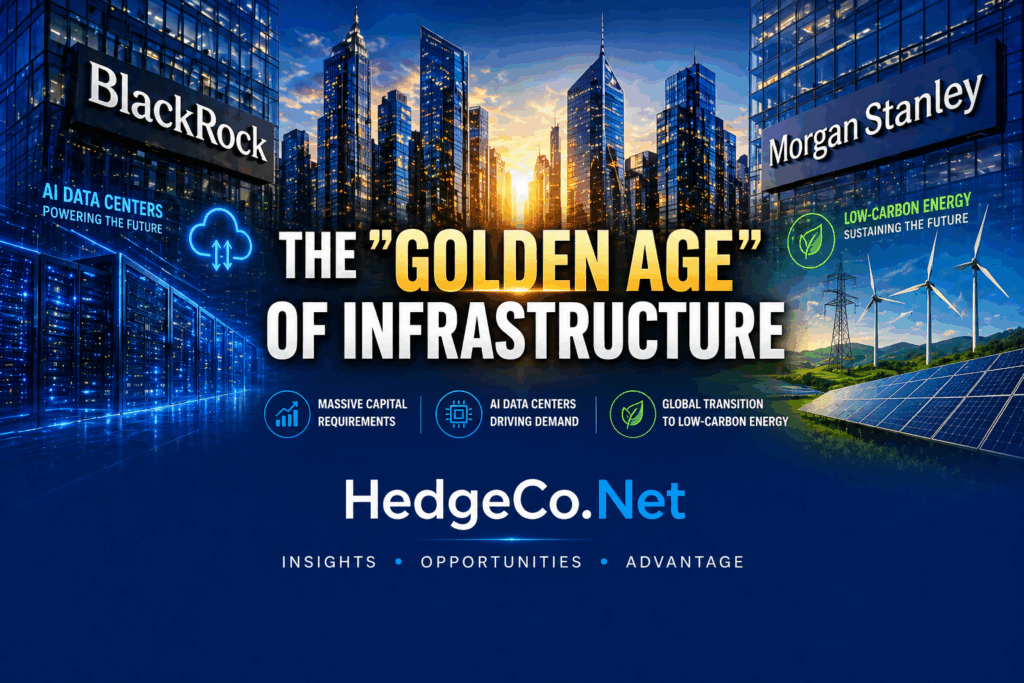
HedgeCo.Net reports that a new investment supercycle is emerging as private capital moves into infrastructure to support AI and the energy transition. According to HedgeCo.Net and quoted asset managers including BlackRock and Morgan Stanley, 2026 may mark a "golden age" for private infrastructure investing. The article describes converging demand drivers: an "insatiable" need for compute from AI adoption and large-scale investments in decarbonization, which together create multitrillion-dollar capital requirements over the next decade. HedgeCo.Net highlights that data centers alone could represent hundreds of billions in capital expenditures. For institutional investors and infrastructure operators, HedgeCo.Net frames this as a transformational opportunity across data centers, fiber and cloud networks, energy storage, and grid modernization.
What happened
HedgeCo.Net reports that a "powerful new investment supercycle" is taking shape in 2026 as private capital targets infrastructure linked to artificial intelligence and the energy transition. Per HedgeCo.Net and citing "leading asset managers including BlackRock and Morgan Stanley," the year may mark a "golden age" for private infrastructure investing. The article states that the combined capital need for AI compute, data centers, fiber networks, and low-carbon energy systems amounts to "trillions of dollars" over the next decade, and that data centers alone are expected to account for "hundreds of billions" in capital expenditures.
Editorial analysis - technical context
Context and significance
Editorial analysis
Observers following capital markets note that when public markets cannot absorb very large, long-duration projects, institutional private capital often steps in to provide patient funding. HedgeCo.Net positions this dynamic as expanding the investor universe for data center and energy projects beyond traditional strategic and hyperscale buyers. That broader capital base can accelerate buildout timelines, but it also changes project economics and contract design for operators and cloud customers.
What to watch
Industry context
The HedgeCo.Net framing connects two structural trends. First, the rapid deployment of AI across sectors is increasing demand for compute, colocation, cooling, and high-bandwidth connectivity. Second, global decarbonization efforts are driving large-scale spending on renewable generation, grid modernization, and energy storage. Companies building and operating physical infrastructure therefore face intersecting technical requirements: higher power density per rack, resilient and low-carbon electricity supply, and expanded fiber and interconnection capacity. For practitioners, that means growth in operational engineering needs around power distribution, thermal design, site selection, and energy procurement.
Key indicators to monitor include announced private infrastructure funds targeting data centers and energy assets, long-term power purchase agreements (PPAs) sized for high-density compute sites, and partnership models between hyperscalers, utilities, and private investors. Observers should also watch how financing structures address lifecycle risks such as technology obsolescence, power-cost variability, and permitting delays.
Key Points
- 1Private capital is entering infrastructure at scale because AI-driven compute and decarbonization together create multitrillion-dollar needs.
- 2Expanded private funding can accelerate data center and grid buildouts, shifting operational priorities toward power, cooling, and connectivity.
- 3Investors and operators will monitor PPAs, fund mandates, and contract structures that allocate long-duration technology and regulatory risks.
Scoring Rationale
The story links large-scale capital flows to AI infrastructure and the energy transition, a material shift for practitioners responsible for capacity planning, site engineering, and procurement. It is notable for industry strategy but not an immediate technical breakthrough.
Practice with real FinTech & Trading data
90 SQL & Python problems · 15 industry datasets
250 free problems · No credit card
See all FinTech & Trading problems