
Pegasus One Health launches SONG framework to predict AI agent scale
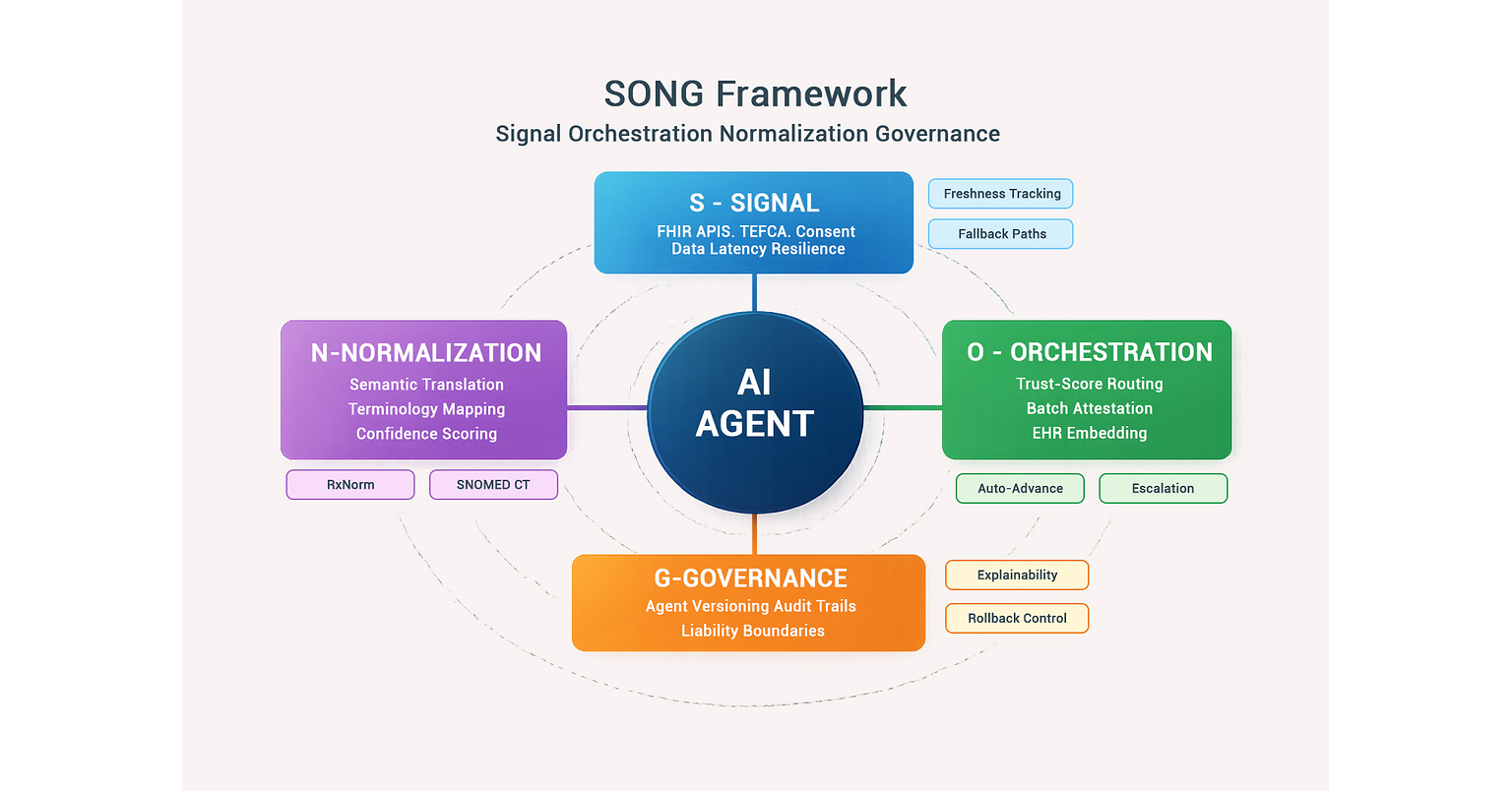
Pegasus One Health launched the SONG framework on July 7, 2026 to help healthcare organizations judge whether AI agents can scale from pilot to production. The company says SONG evaluates Signal, Orchestration, Normalization, and Governance, with checks for FHIR availability, TEFCA connectivity, workflow fit, semantic normalization, and audit trails. Because the launch is vendor-led, the 80% pilot-failure figure in the PRWeb release should be treated as Pegasus One's framing rather than a neutral benchmark. The useful takeaway for clinical AI teams is still practical: agent reliability depends on data access, routing, consent, and governance controls as much as model accuracy.
Healthcare AI agents fail in production when they cannot reach the right data, fit clinical workflows, or leave an auditable trail. SONG is a vendor framework, so its claims need attribution, but it points at a real deployment issue for clinical AI: integration quality often decides whether an agent survives contact with hospital operations.
What happened
Pegasus One Health announced the SONG diagnostic framework in a PRWeb release on July 7, 2026. The company says SONG stands for Signal, Orchestration, Normalization, and Governance, and is designed to predict whether healthcare AI agents will scale or stall. The release says the framework tests for data-source availability, FHIR readiness, TEFCA connectivity, latency, workflow fit, semantic normalization, versioned audit trails, and liability boundaries. Pegasus One also says an estimated 80% of healthcare AI pilots never reach production; because that figure comes from the vendor release, it should be used as directional context rather than a settled industry statistic.
Technical context
The framework's strongest idea is that model quality is only one layer of the production stack. A clinical agent that cannot retrieve current patient data, reconcile terms across EHR systems, route exceptions to humans, or preserve decision history will fail even with a capable language model. Those are data-engineering, interoperability, and governance constraints, not prompt-tuning details.
For practitioners
Teams evaluating clinical agents can turn SONG-like categories into concrete gates: prove source-system access, measure data latency, test workflow handoff, document semantic mapping, and verify audit logs before expanding a pilot. The framework is most useful as a checklist for Go/No-Go reviews, not as proof that a specific vendor implementation will work.
What to watch
Look for independent case studies, measurable deployment outcomes, and references from health systems using the framework. If Pegasus One publishes examples tied to reduced review burden, faster authorization, or better auditability, the story becomes more operationally meaningful than a framework launch.
Key Points
- 1Pegasus One Health launched SONG to assess whether healthcare AI agents have enough data and workflow readiness to scale.
- 2The framework usefully shifts attention from model accuracy to interoperability, semantic normalization, routing, and governance controls.
- 3Practitioners should treat vendor failure-rate claims cautiously while using the checklist idea for production readiness reviews.
Scoring Rationale
The event is useful for healthcare AI deployment practice because it emphasizes interoperability and governance gates for agents. The score is lowered modestly because the launch is vendor-led, evidence is mostly first-party, and no independent deployment outcome was verified in this run.
Sources
Public references used for this report.
Practice with real Health & Insurance data
90 SQL & Python problems · 15 industry datasets
250 free problems · No credit card
See all Health & Insurance problems


