OSI² ONE Is an Open-Source 50 mT MRI Project
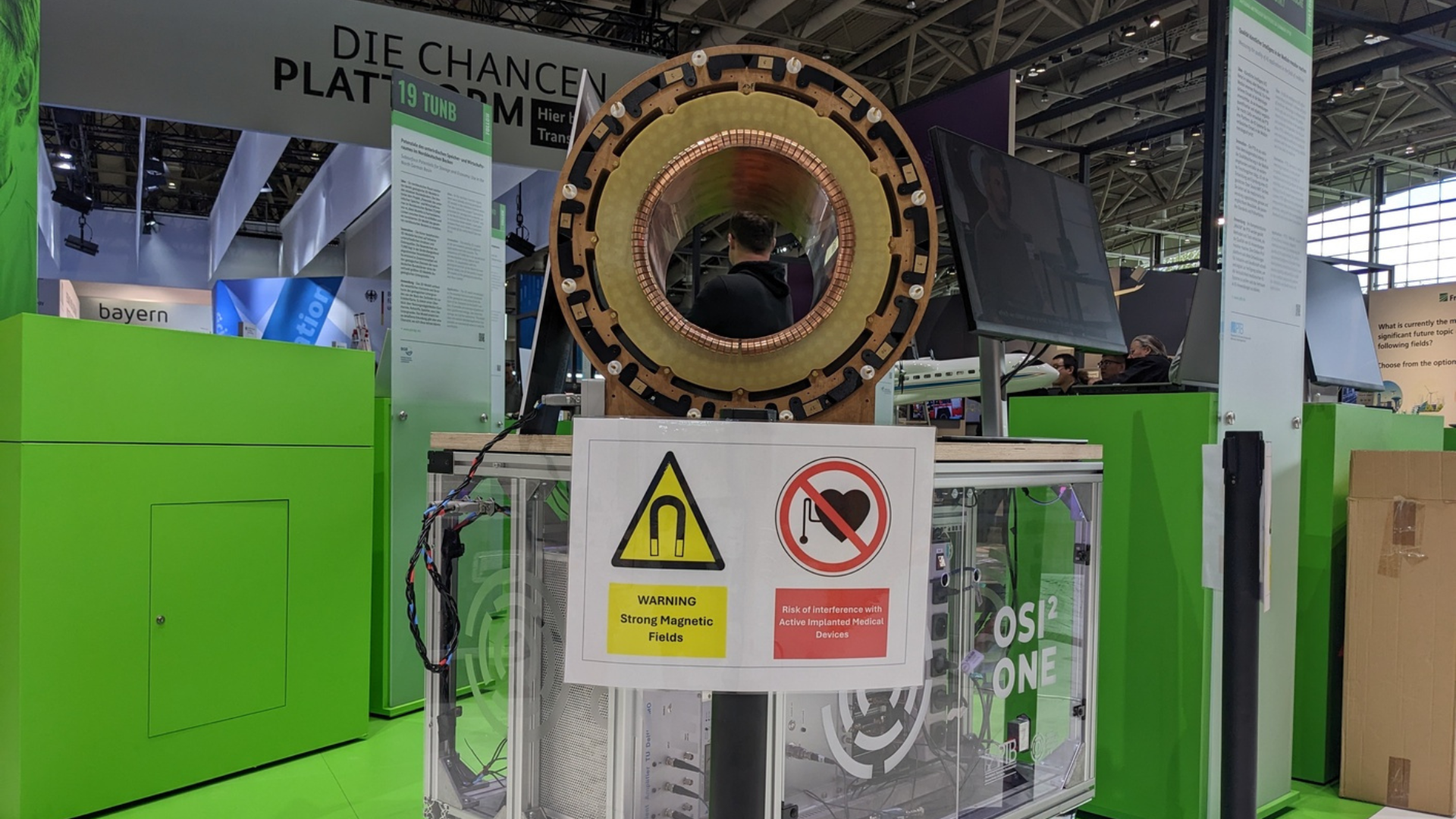
Open Source Imaging Initiative first presented OSI² ONE in January 2023, and the project remains an ongoing effort to build a modular, portable 50 mT MRI scanner from open hardware and software. Its current page lists €25,000–€60,000 in material cost, head-and-extremity imaging, a 150 kg weight and standard-outlet power. It is a research platform, not a newly launched whole-body clinical MRI.
Open Source Imaging Initiative first presented the OSI² ONE scanner on January 9, 2023, after showing an early prototype in 2022. A July 2026 Tom's Hardware report brought the project fresh attention, but it did not mark the launch of a new whole-body clinical MRI system.
The distinction matters because the project is narrower and more mature than a viral hardware headline can suggest. OSI² describes ONE as an ongoing, modular open-source low-field MRI effort intended to make scanner construction, research and education more accessible.
What OSI² ONE actually provides
The current project page lists a 50 mT permanent magnet, imaging for the head and extremities, approximately 1.5 × 1.5 × 5 mm spatial resolution, a weight of about 150 kg and operation from a standard 230 V, 16 A outlet. Estimated material cost varies by configuration from €25,000 to €60,000. Hardware is published under the CERN Open Hardware Licence, while most software uses GPL-3.0.
Those figures have changed as the project evolved. The January 2023 announcement estimated materials at roughly €20,000 and described three completed systems in Leiden, Berlin and Mbarara. It reported head and extremity imaging and a six-minute in-vivo head scan at 2 × 2 × 3 mm resolution. The announcement said the permanent magnet could be constructed with standard production tools including CNC equipment and a 3D printer; it did not say that the entire scanner was simply 3D-printed.
Research system, not clinical equivalence
Low-field MRI trades magnet strength and signal quality for lower cost, portability and simpler infrastructure. Open designs can improve reproducibility and let research groups adapt components, but the retrieved OSI² materials do not establish diagnostic equivalence to 1.5 T or 3 T hospital scanners.
The 2023 announcement said the team was still optimizing image quality and preparing documentation intended to support a future regulatory path. The July 2026 report discussed AI as a possible way to improve low-field images, but the retrieved OSI² pages did not publish a clinically validated AI reconstruction model for this system. Readers should therefore treat OSI² ONE as a promising open research platform whose clinical performance and regulatory status still require separate evidence.
Key Points
- 1OSI² first presented the ONE prototype in January 2023; July 2026 coverage revisited an ongoing project rather than announcing a new scanner.
- 2The current project specifies a portable 50 mT system for head and extremity imaging with estimated material cost of €25,000–€60,000.
- 3OSI² describes continuing optimization and regulatory-documentation work, not demonstrated equivalence to a full-size clinical MRI.
Scoring Rationale
OSI² ONE is notable as a modular open-hardware approach to lower-cost MRI research and education. Its immediate clinical and ML impact remains limited because the retrieved project materials describe a head-and-extremity research system, ongoing optimization and regulatory-documentation work rather than diagnostic equivalence or a validated AI reconstruction release.
Sources
Primary source and supporting public references used for this report.
Practice with real Health & Insurance data
90 SQL & Python problems · 15 industry datasets
250 free problems · No credit card
See all Health & Insurance problems