OpenAI model disproves Erd\u000151s planar unit distance conjecture
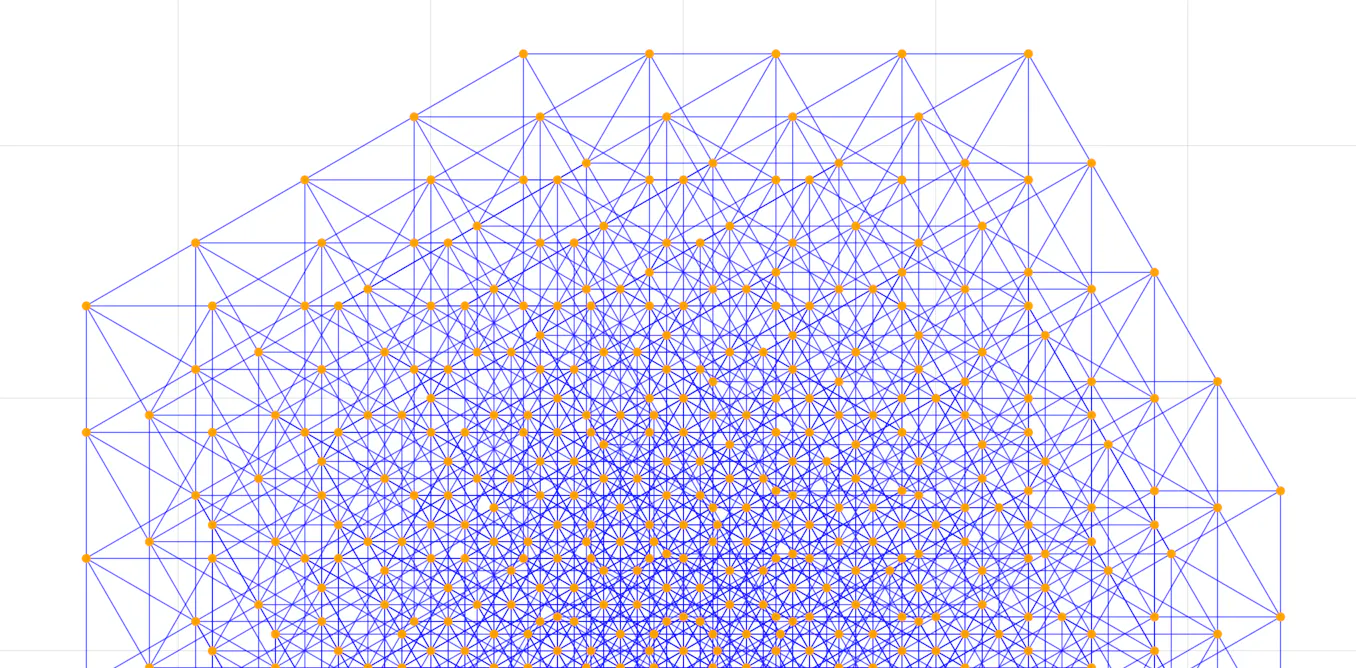
OpenAI announced in a May 20 blog post that an internal model produced a proof disproving the long-standing planar unit distance problem first posed by Paul Erd\u000151s in 1946 (OpenAI blog). According to OpenAI, the model generated an infinite family of planar point sets that give a polynomial improvement over the previously believed square-grid constructions; OpenAI wrote that external mathematicians have checked the proof and that a companion paper and a human-digested remarks document are available on arXiv (OpenAI, arXiv). Reporting in Nature and Phys.org summarises the announcement and notes that the finding followed a simple chatbot-style prompt and subsequent human review (Nature, Phys.org). Several independent mathematicians and blog commentators have posted reactions and digest versions of the proof (Gil Kalai blog, arXiv remark).
What happened
OpenAI wrote in a May 20 blog post that an internal OpenAI model produced a proof that disproves the planar unit distance problem, a conjecture posed by Paul Erd\u000151s in 1946 (OpenAI blog). Per OpenAI, the model constructed an infinite family of planar point sets that yield a polynomial improvement in the number of unit-distance pairs over the classical square-grid lower bound; OpenAI stated that external mathematicians have checked the argument and that a companion paper and a human-digested remarks note are available on arXiv (OpenAI blog; arXiv preprint, OpenAI remarks). Coverage in Nature and Phys.org reports the same basic sequence: an LLM-based interaction, extensive model-generated calculations, and follow-up human verification and writeups (Nature; Phys.org).
Editorial analysis - technical context
The published materials indicate the construction leverages higher-dimensional arithmetic analogues mapped back to planar arrangements; OpenAI's remarks and the arXiv companion provide the technical sketch and formalization (OpenAI remarks; arXiv). Industry-pattern observations: advanced LLMs that combine symbolic manipulations and long-form chain-of-thought can produce long, checkable mathematical artifacts; practitioners should view these outputs as machine-produced drafts that require human verification and formal checking before being accepted as proofs.
Context and significance
For decades the prevailing belief among combinatorial geometers was that rescaled square-grid constructions were essentially optimal; both OpenAI's release and independent writeups frame the result as overturning that expectation for the planar unit distance problem (OpenAI blog; arXiv; Nature). Industry context: this episode is one of the first widely publicised instances where a general-purpose reasoning model produced a solution to a prominent, nontrivial mathematical conjecture and where the community was able to verify and digest the argument rapidly.
What to watch
Observers will follow the peer-review and community vetting process around the arXiv papers and the human-digested remarks (arXiv; OpenAI remarks). Editorial analysis: researchers and toolmakers will monitor whether formal-verification tools (interactive theorem provers, computer algebra systems, mechanized proof checkers) are applied to convert the model-produced argument into a machine-checked formal proof, and whether similar workflows scale to other open problems. Also watch for detailed critiques or simplifications from domain experts, and for workshops or replication attempts documenting the model prompts, chain-of-reasoning artifacts, and the human steps needed to reach the published form (Gil Kalai blog; Marcus commentary).
Bottom line
The event combines a technical mathematical advance with a high-profile demonstration of LLM-assisted frontier research. The immediate claims and supporting documents are publicly available for scrutiny, and community verification and formalisation will determine how the result is integrated into the mathematical literature (OpenAI blog; arXiv; Nature).
Key Points
- 1An internal OpenAI model produced a counterexample family, showing LLMs can generate long, nontrivial mathematical constructions verified by humans.
- 2Human verification and arXiv remarks accompanied the release, underscoring that model outputs currently require expert digestion and formal checking.
- 3For practitioners: workflows that combine LLM drafts, symbolic tooling, and formal-verification pipelines will gain attention after this event.
Scoring Rationale
A general-purpose model producing a community-verified counterexample to an 80-year-old conjecture is a major milestone for AI reasoning and research assistance, with immediate relevance for researchers and toolmakers focused on formal verification and model-assisted discovery.
Sources
Public references used for this report.
View 5 more sources
- AI makes a major breakthrough in a math problem that had stumped experts for decadesphys.org
- AI cracks 80-year-old mathematics challenge — researchers are astonishednature.com
- OpenAI makes breakthrough on 80-year-old maths problemtheguardian.com
- Mathematicians stunned by AI's biggest breakthrough in mathematics yetnewscientist.com
- Amazing: Erdős’ Unit Distance Problem was Disproved! It was achieved by AI! | Combinatorics and moregilkalai.wordpress.com
Practice interview problems based on real data
1,625 SQL & Python problems across 15 industry datasets — the exact type of data you work with.
Try 250 free problems