OpenAI Disproves Erdos Planar Unit Distance Conjecture
OpenAI announced in a May 20 blog post that an internal general-purpose reasoning model produced a proof disproving Paul Erdos's planar unit distance conjecture, a problem first posed in 1946 (OpenAI blog). OpenAI said external mathematicians checked the proof and produced a companion paper explaining the argument (OpenAI blog). Coverage in Nature, Scientific American, The Guardian, and other outlets reports strong surprise from the mathematics community and highlights verification by researchers including Daniel Litt and comments solicited from Timothy Gowers (Nature; Scientific American; Guardian). For practitioners, the result illustrates that large reasoning models can search across literature and combine domains, while conceptual creativity in mathematics remains a human frontier.
What happened
OpenAI announced in a May 20 blog post that an internal general-purpose reasoning model had produced a proof that disproves the longstanding planar unit distance problem conjecture posed by Paul Erdos in 1946 (OpenAI blog). The blog post states that the model produced an infinite family of constructions that give a polynomial improvement over the previously assumed optimal grid-like arrangements, and that a group of external mathematicians checked the proof and authored a companion paper explaining the argument (OpenAI blog). Coverage in Nature, Scientific American, and The Guardian reports that mathematicians responded with astonishment and careful scrutiny, and that figures such as Daniel Litt and Timothy Gowers were consulted or quoted in post-publication commentary (Nature; Scientific American; Guardian).
Technical details
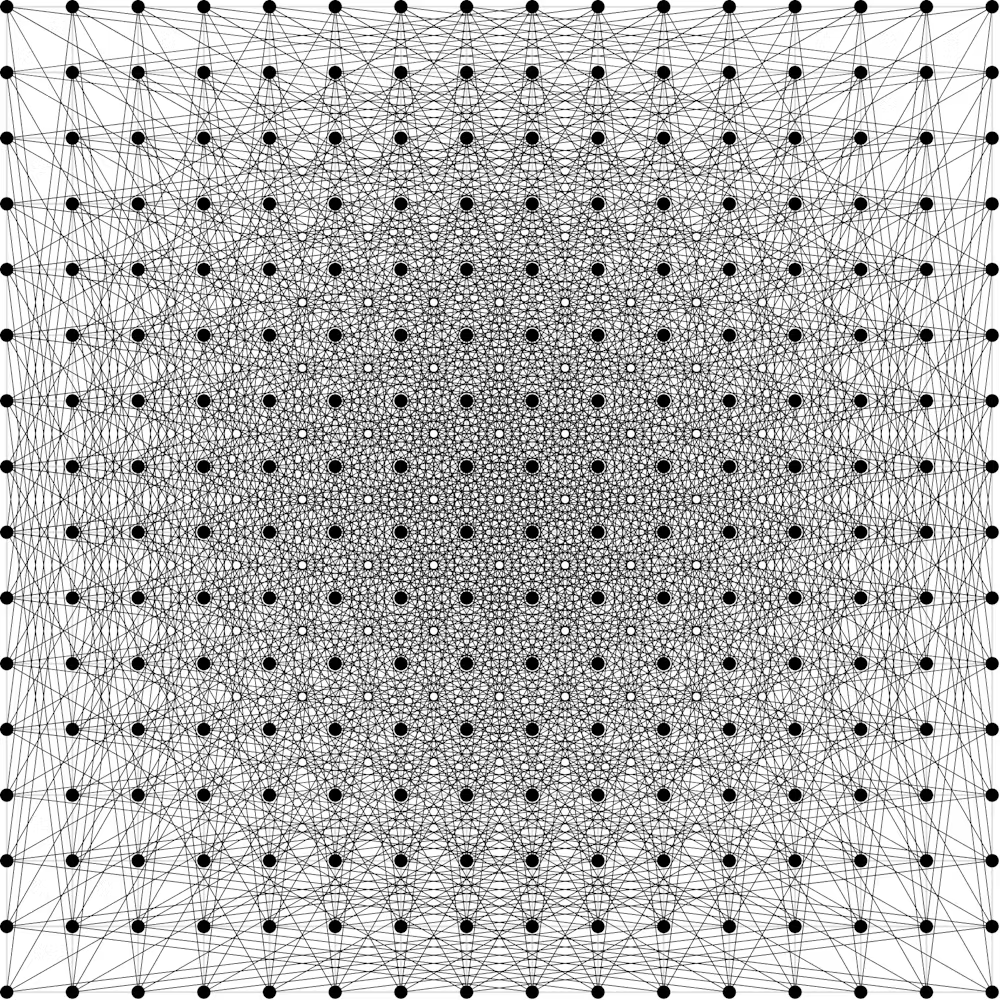
Per OpenAI's announcement, the result emerged from a general-purpose reasoning model rather than a system trained solely on mathematics or scaffolded with specialized proof search tools (OpenAI blog). OpenAI describes the model's workflow as breaking the problem into smaller steps and synthesizing constructions that combine techniques from multiple subfields of discrete geometry and combinatorics (OpenAI blog). External coverage notes that the construction yields a family of point arrangements that outperform classical square-grid constructions for arbitrarily large numbers of points, producing a polynomial improvement relative to Erdos's conjectured bound (OpenAI blog; Scientific American).
Editorial analysis - technical context
Contemporary large reasoning models excel at broad search, pattern matching across disparate literature, and enumerating candidate constructions. Observed patterns in comparable model outputs show they are especially effective when the solution can be framed as a sequence of combinatorial constructions or case analyses that the model can chain together. However, formal verification and human vetting remain essential: published accounts emphasise that mathematicians rechecked and clarified the machine-derived argument before community acceptance (Scientific American; Nature).
Context and significance
Industry context: Public reporting frames this event as a milestone because it is among the first high-profile instances where a general-purpose AI produced a mathematical result that passes expert-level scrutiny and yields genuinely new mathematics (OpenAI blog; Nature). Observers quoted in the coverage treat the result as different in quality from earlier AI-assisted proofs that primarily assembled known results or rediscovered existing literature, citing prior missteps that required human correction (Guardian). For mathematicians, the practical significance is twofold: the specific bound on the planar unit distance problem changes an 80-year-old assumption in discrete geometry, and the episode demonstrates a new workflow where model-generated conjectures and constructions enter the human peer-review loop.
What to watch
For practitioners and researchers, follow these indicators: whether the companion paper and subsequent peer-reviewed publications fully formalize the model-produced argument; whether independent teams reproduce or refine the construction; and whether other long-standing open problems yield to the same class of reasoning models. Industry context: Observers will also watch how journals and referees adapt reviewing practices for proofs originating from machine-generated arguments, and whether tool chains appear that combine model search with formal proof assistants for automated verification.
Caveats and open questions
Editorial analysis: While the event shows models can generate nontrivial, previously unknown constructions, it does not by itself demonstrate that models can autonomously originate broad conceptual leaps across all mathematical domains. Historical pattern: prior model claims in mathematics have sometimes relied on rediscovery of existing literature absorbed during training, and independent verification has been the critical filter for separating useful novelty from artifacts of training data (Guardian; Scientific American).
Bottom line
The reported result is a high-profile demonstration that general-purpose reasoning models can contribute substantive new theorems that survive expert scrutiny, but the broader implications for automated mathematical creativity and the validation pipeline remain active areas for the research and practitioner community (OpenAI blog; Nature; Scientific American).
Key Points
- 1OpenAI reports a model disproved Erdos's planar unit distance conjecture, with external mathematicians checking the proof.
- 2Models excel at cross-domain literature synthesis and chained reasoning, enabling constructive combinatorial outputs.
- 3Editorial analysis: Human verification and formalization remain the gating factors for accepting machine-generated mathematics.
Scoring Rationale
This is a major milestone: a general-purpose AI produced a previously unknown mathematical construction that external experts vetted. The result affects research workflows and verification practices for models in mathematical discovery.
Sources
Public references used for this report.
Practice interview problems based on real data
1,625 SQL & Python problems across 15 industry datasets — the exact type of data you work with.
Try 250 free problems