Open weights availability tightens, raising market risks
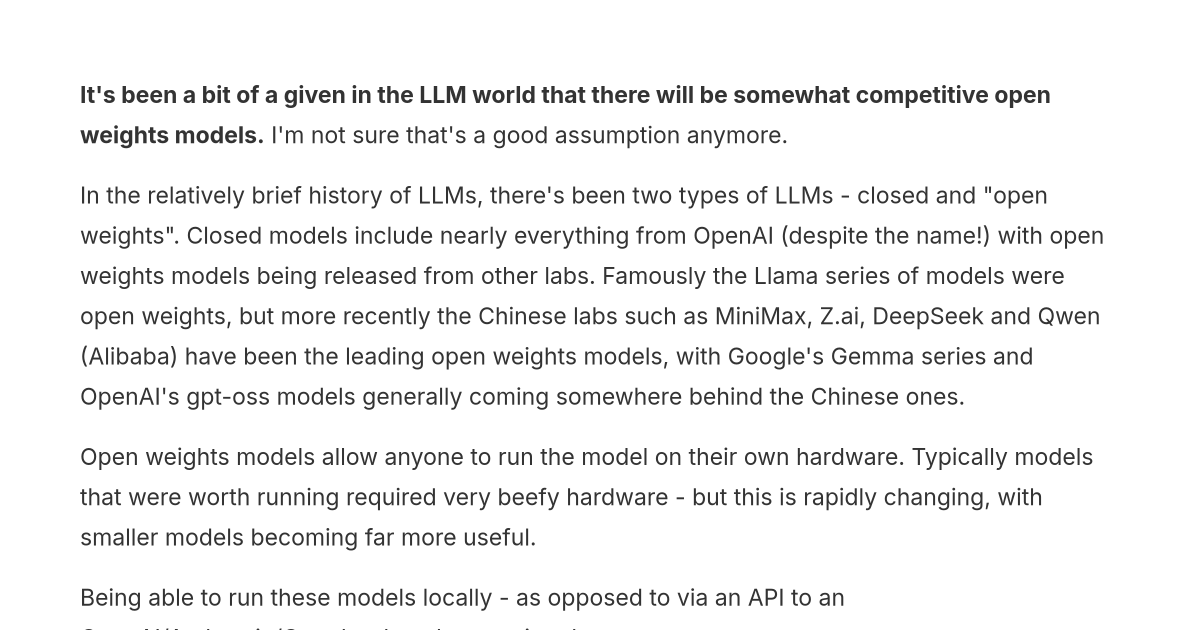
Martin Alderson writes that open weights large language models are "quietly closing up" and argues this trend risks leaving a small set of oligopolists extracting consumer surplus. Alderson traces the LLM history into closed and open-weights camps and names the Llama series and Chinese labs MiniMax, Z.ai, DeepSeek, and Alibaba's Qwen as recent open-weights leaders, with Google's Gemma and OpenAI's gpt-oss generally trailing, per his post. He lists three advantages of open weights-privacy/compliance, flexibility for fine-tuning and quantization, and cost-and claims hosted providers running open weights often charge under 10% of frontier API per-token costs. If open-weights availability continues to decline, practitioners who rely on self-hosting or low-cost hosted inference should watch for higher API dependence and upward pressure on inference pricing.
What happened
Martin Alderson writes that open weights models are "quietly closing up" and frames this as a risk to competition in the LLM market. Alderson provides a short history, distinguishing closed frontier models from open-weights releases and naming the Llama series and Chinese labs MiniMax, Z.ai, DeepSeek and Alibaba's Qwen as prominent open-weights examples, with Google's Gemma and OpenAI's gpt-oss generally behind them in his account. He identifies three practical advantages of open weights for users:
- •privacy and compliance (ability to run models on-premise),
- •flexibility for fine-tuning and hardware-specific quantization, and
- •dramatically lower running cost, noting hosted open-weights services often cost less than 10% per token compared with frontier APIs, according to his post.
Technical details
Editorial analysis - technical context: The practical value Alderson highlights-on-prem execution, fine-tuning, and quantization-are the same levers practitioners use today to reduce inference cost and control data flows. Availability of smaller, efficiently quantized models and maturation of inference stacks has lowered the hardware barrier for usable local or hosted open-weights deployment. Those trends make cost-sensitive production use cases viable outside of frontier API consumption.
Context and significance
Editorial analysis: From an industry-structure perspective, readily available open weights act as a competitive constraint on frontier API pricing and increase options for privacy-sensitive or cost-constrained deployments. If open-weights releases become rarer or more restricted, the balance between API-dominant frontier providers and self-hosted alternatives could shift, reducing contestability and increasing switching costs for organizations that prefer on-prem or low-cost inference.
What to watch
Editorial analysis: Observers and practitioners should monitor three indicators: licensing and redistribution terms attached to new model releases, the cadence of high-quality open-weights checkpoints from major labs (including non-US providers), and pricing/latency improvements from hosted open-weights inference vendors. Regulatory or procurement policies that prioritize on-prem capabilities will also influence how material these shifts become for enterprise adoption.
Key Points
- 1Open-weights models enable on-prem privacy, fine-tuning, and cheaper inference, giving practitioners alternative supply routes to frontier APIs.
- 2If high-quality open checkpoints decline, API providers face less price pressure and practitioners lose low-cost hosting options.
- 3Watch licenses, new open checkpoints, and hosted inference pricing as leading indicators of contestability in model supply.
Scoring Rationale
The availability of open weights directly affects cost, privacy, and deployability for practitioners; a decline materially increases dependence on frontier APIs and raises switching costs. The story is notable but not a single-vehicle paradigm shift.
Practice interview problems based on real data
1,625 SQL & Python problems across 15 industry datasets — the exact type of data you work with.
Try 250 free problems