Nvidia Uses Neural Texture Compression to Slash VRAM
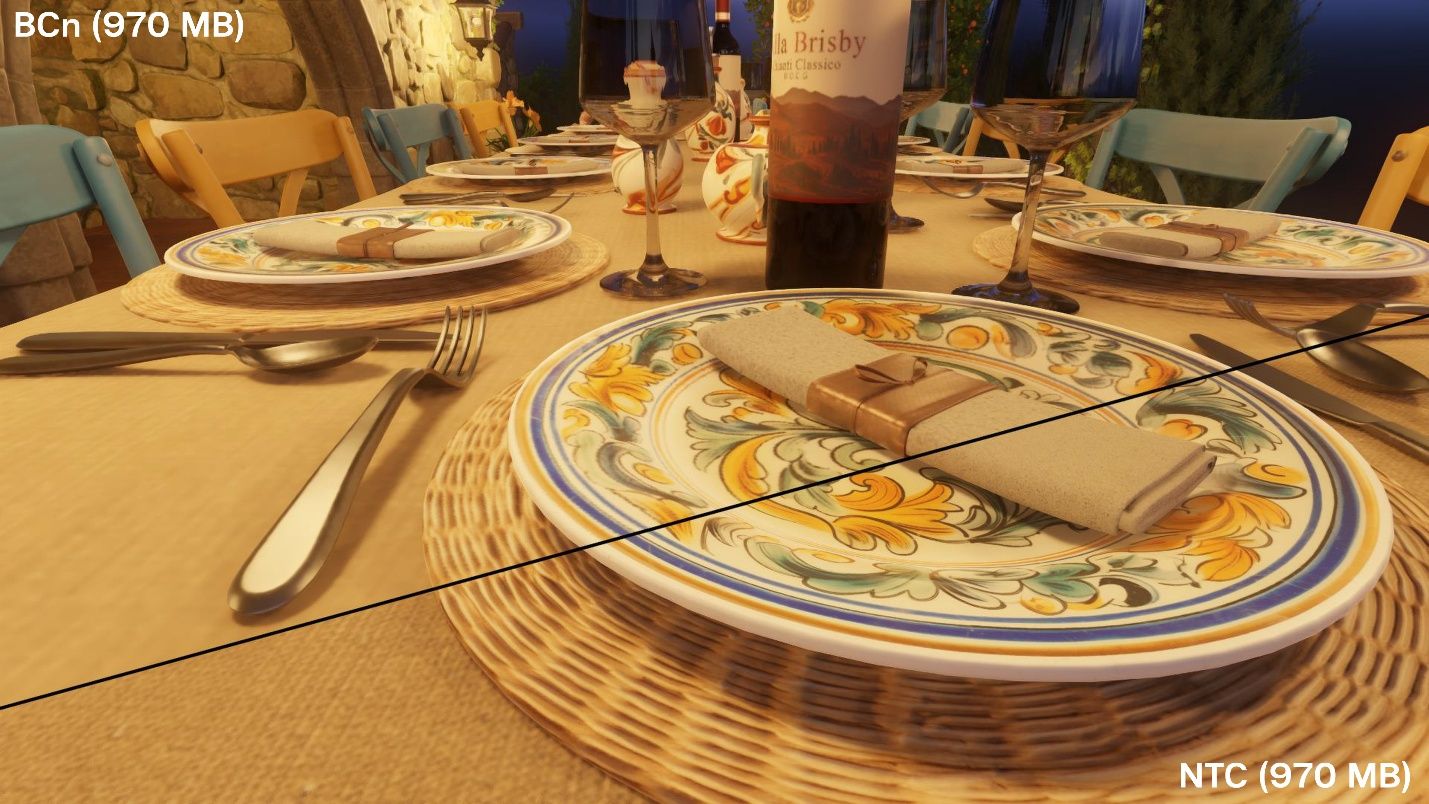
NVIDIA's Neural Texture Compression (NTC) converts textures into compact learned latents and reconstructs texels at runtime with a small GPU neural decoder, cutting VRAM use by up to 85% in demos. The technique is deterministic, uses positional encoding on UVs to restore high-frequency detail, and is trained by jointly optimizing a small MLP decoder and per-texture latent codes against reconstruction loss. Practical tests show large reductions, for example dropping a texture budget from 6.5 GB to 970 MB, enabling either much richer textures on the same hardware or enabling high-fidelity rendering on lower-VRAM devices like laptops. This alters memory-quality tradeoffs in real-time rendering and game deployment pipelines.
What happened
NVIDIA demonstrated Neural Texture Compression (NTC) at GTC 2026, showing reconstruction-based compression that can reduce texture VRAM footprints by as much as 85%, with example savings moving a 6.5 GB texture budget down to 970 MB. Senior DevTech Engineer Alexey Bekin explained NTC stores learned latents and reconstructs texels on demand with a small neural decoder running on the GPU, and the system is deterministic, producing the same output every frame.
Technical details
NTC separates storage from reconstruction. Textures are encoded into a compact latent texture where each texel is a feature vector rather than a final color. At runtime a lightweight MLP decoder consumes positional encoding of UV coordinates plus the latent code to produce final texels. Training is a standard neural optimization loop that jointly updates the decoder weights and per-texture latent codes to minimize reconstruction loss against the original asset. Key structural advantages include:
- •Higher compression ratios, fitting more texture data into the same VRAM budget
- •High channel-count support, enabling complex packed material maps
- •Quality-for-budget tradeoff, where the same VRAM can yield higher effective texture fidelity
Context and significance
This is a practical use of neural compression tailored to the real-time rendering pipeline. Because NTC is deterministic and designed for GPU execution, it sidesteps many concerns about runtime variability and generative artifacts. The approach aligns with broader trends of shifting storage costs into small inference compute, similar to neural compression in image and audio domains. For developers, NTC changes constraints: teams can either raise texture fidelity for a fixed VRAM cap or maintain quality while supporting lower-end GPUs and laptops.
What to watch
Developer tooling, encoder performance, integration into texture pipelines, and licensing will determine adoption. The real test will be third-party game/content integrations and runtime performance overhead on mobile-class GPUs.
Key Points
- 1NTC stores compact learned latents and decodes texels on demand, enabling deterministic reconstruction and much higher compression.
- 2Demonstrated VRAM reductions of about 85% (6.5 GB to 970 MB) let studios trade memory for lightweight GPU inference.
- 3Adoption depends on encoder/tooling, runtime decode cost on target GPUs, and quality controls for high-frequency texture detail.
Scoring Rationale
NTC offers a tangible, near-term improvement for real-time rendering memory constraints and could change deployment choices for games and visualization, making it notable for practitioners. It is not a paradigm-shifting AI breakthrough, but its practical impact on GPU memory usage and graphics pipelines warrants a solid, above-average score.
Sources
Public references used for this report.
Practice interview problems based on real data
1,625 SQL & Python problems across 15 industry datasets — the exact type of data you work with.
Try 250 free problems