NVIDIA Positions Vera CPU for Agentic AI Workloads
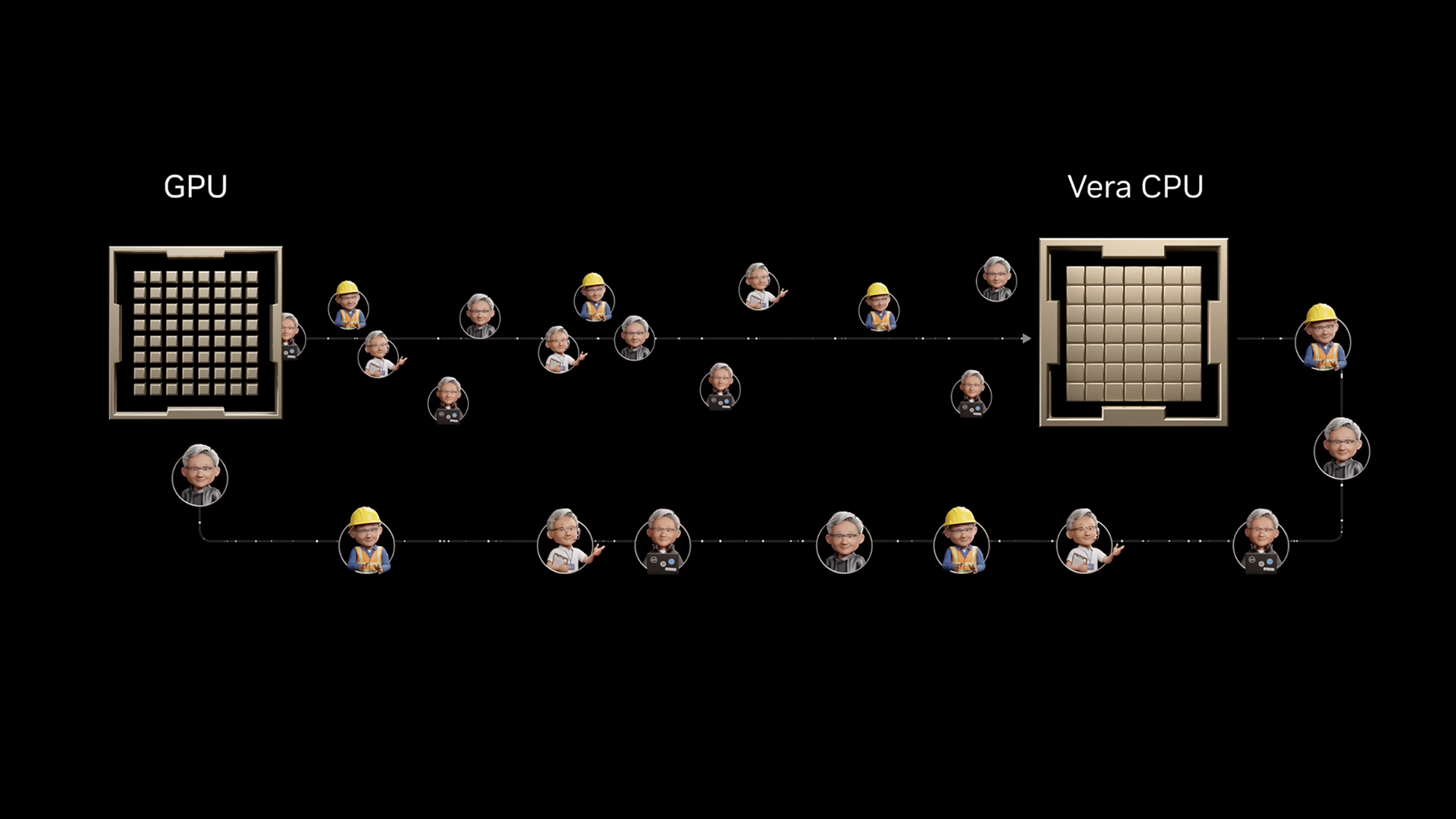
NVIDIA's July 7 update positioned NVIDIA Vera as a data-center CPU for agentic AI workloads where tool calls, retrieval, code execution, and sandbox startup sit on the request path. NVIDIA says Vera combines 88 Olympus cores, up to 1.2 TB/s of LPDDR5X memory bandwidth, and a monolithic mesh to keep per-core performance high under load. The company reports Vera delivered more than 1.8x sandbox performance versus x86 in loaded agentic workloads, while its Perplexity example completed a repository clone-and-test workflow about 1.5x faster and started concurrent sandboxes up to 1.9x faster. For practitioners, the signal is that agent infrastructure planning now extends beyond GPU selection into CPU latency, memory bandwidth, orchestration, and per-token system economics.
Agent systems do not spend all of their time inside the model. The repeated loop of tool call, CPU-side execution, retrieval, validation, and feedback makes host CPU latency part of inference economics, especially for coding agents, research agents, and reinforcement-learning environments that run many sequential steps. NVIDIA's Vera positioning is therefore best read as a systems argument, not just a chip-spec announcement.
What happened
NVIDIA's July 7 blog post positioned Vera as a data-center CPU for agentic AI workloads and cited Perplexity tests on a coding workflow involving repository cloning and test execution. NVIDIA also published a technical blog explaining why agentic and reinforcement-learning workloads make CPU execution part of the AI loop. The company says Vera uses 88 Olympus cores, up to 1.2 TB/s of LPDDR5X memory bandwidth, a monolithic compute die, and a fabric designed to sustain per-core performance under full load.
Technical context
The key claim is that CPU-bound work compounds as agents take more steps. NVIDIA says Vera delivers more than 1.8x sandbox performance versus x86 on loaded agentic workloads and describes lower memory latency, high memory bandwidth, and faster core-to-core movement as the design points. Those are vendor-reported benchmarks, so infrastructure teams should validate them against their own mix of Python, JavaScript, shell, retrieval, and database workloads before treating the numbers as procurement-grade evidence.
For practitioners
The practical takeaway is that high-volume agent stacks should measure more than GPU utilization. Sandbox startup time, CPU memory bandwidth, scheduler behavior, and data-plane latency can decide whether expensive accelerators sit idle while agents wait on tools or tests. NVIDIA's Rosa and Rigel roadmap also suggests CPU design will stay visible in AI infrastructure planning as inference moves from isolated chat requests toward persistent autonomous work.
What to watch
Watch for independent Vera benchmarks on real coding-agent, data-agent, and reinforcement-learning environments; cloud-provider availability details; and workload traces that show how much end-to-end latency shifts from GPU inference to CPU-side orchestration.
Key Points
- 1NVIDIA says Vera targets CPU-bound agent loops such as tool calls, code execution, retrieval, and validation work.
- 2Vendor-reported benchmarks claim faster loaded sandbox performance, but teams still need independent tests on their own agent workloads.
- 3The roadmap points infrastructure buyers toward CPU latency, memory bandwidth, and scheduler behavior as inference cost levers.
Scoring Rationale
This is a notable infrastructure signal because NVIDIA is tying CPU design directly to agentic AI latency and AI-factory utilization. It matters for teams sizing autonomous-agent systems, but the most important performance claims remain vendor-reported and need independent workload validation, keeping it below the major tier.
Sources
Public references used for this report.
View 6 more sources
- NVIDIA News Archivenvidianews.nvidia.com
- Perplexity to use Nvidia Vera CPU, company executive calls it a dead-on fittimesofindia.indiatimes.com
- Perplexity plans to use Nvidia Vera CPUstechinasia.com
- Perplexity says it plans to use Nvidia new CPUreuters.com
- Perplexity Picks Nvidia Vera Chip Over Intel and AMD After AI Speed Teststipranks.com
- Perplexity to Deploy Nvidia New Vera CPU as Chipmaker Targets AI Agent Workloadskalkine.com
Practice interview problems based on real data
1,625 SQL & Python problems across 15 industry datasets — the exact type of data you work with.
Try 250 free problems