NVIDIA Brings Isaac GR00T 1.7 to LeRobot
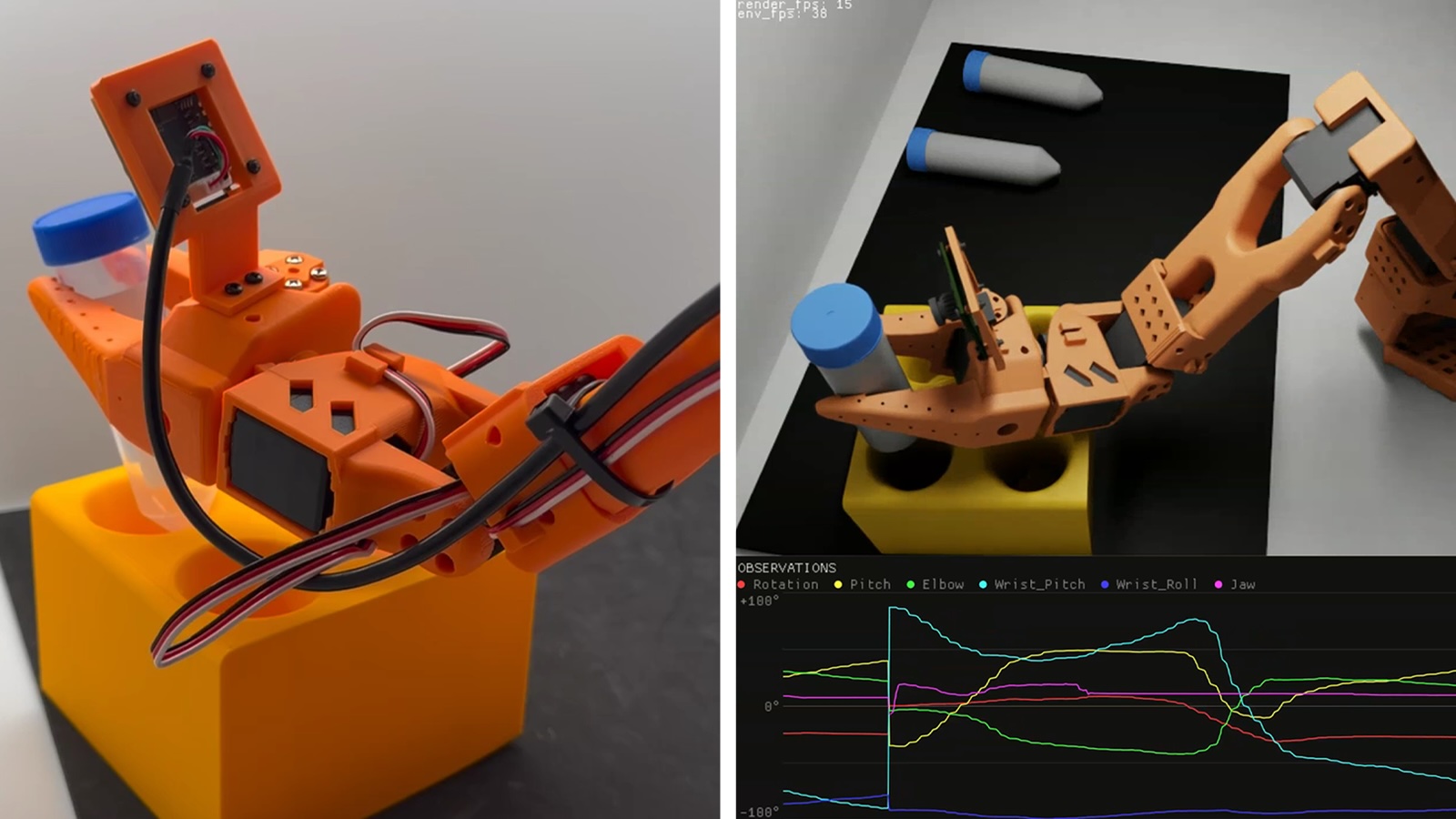
NVIDIA and Hugging Face made Isaac GR00T 1.7 and Isaac Teleop available through LeRobot in July 2026, giving robotics developers a shared open workflow for humanoid VLA model work. The release matters less as a standalone model update than as infrastructure for reproducible physical-AI experiments: teams can collect demonstrations, standardize datasets, fine-tune policies and test deployment paths inside one common library. NVIDIA says Cosmos 3 support is planned next, which would extend the same loop toward world-model-generated data and simulation. For practitioners, the near-term value is cleaner tooling around robot learning, not proof that general-purpose humanoids are solved.
The practical signal is that open robotics is starting to look more like the open model ecosystem: shared models matter, but shared data formats, teleoperation workflows and evaluation paths are what make experiments reproducible. NVIDIA and Hugging Face are trying to move humanoid-robot development away from one-off lab glue and toward a stack that more teams can inspect, adapt and compare.
What happened
NVIDIA said on July 6, 2026 that it is bringing Isaac GR00T 1.7, Isaac Teleop, datasets and robotics workflows to Hugging Face LeRobot, the open source robotics library. Hugging Face's NVIDIA-authored guide says GR00T 1.7 is now available on LeRobot, replaces N1.5 in that workflow, and is meant for training, fine-tuning and deploying vision-language-action policies for humanoid robots. NVIDIA also says Cosmos 3 integration is planned for future physical-AI workflows.
Technical context
The important architecture change is the workflow boundary. Isaac Teleop covers demonstration data collection, LeRobot provides a common robotics library and dataset/model workflow, and GR00T 1.7 supplies the humanoid VLA policy model. That combination gives teams a clearer path from demonstrations to policy tuning to deployment while keeping the artifacts closer to open robotics tooling instead of a closed vendor-only pipeline.
For practitioners
Robotics teams should treat this as a reproducibility and integration update, not a guarantee that a single foundation model will transfer cleanly to every embodiment. The useful work is to test whether LeRobot-formatted demonstrations, GR00T post-training and deployment scripts reduce the hidden engineering cost of comparing policies across tasks and hardware. Teams should still validate safety, sim-to-real transfer and dataset quality under their own robot constraints.
What to watch
The next proof point is whether researchers and commercial robotics teams publish comparable LeRobot workflows, benchmarks and failure cases around GR00T 1.7. Cosmos 3 support would be more consequential if it helps teams generate or augment training data in ways that survive real-world evaluation rather than only improving demos.
Key Points
- 1NVIDIA and Hugging Face put Isaac GR00T 1.7 and Isaac Teleop inside LeRobot workflows for open robotics development.
- 2The integration connects demonstration collection, dataset formatting, policy fine-tuning and deployment around a more reproducible humanoid VLA stack.
- 3Practitioners should validate sim-to-real transfer and hardware-specific safety before treating the shared workflow as production-ready.
Scoring Rationale
This is a notable infrastructure and open-robotics workflow update because it makes NVIDIA humanoid VLA tooling easier to reproduce inside Hugging Face LeRobot. The impact is below major platform-shift level until independent teams show durable benchmark or deployment gains across real robot embodiments.
Sources
Public references used for this report.
View 6 more sources
- NVIDIA Isaac GR00T N1.7 repositorygithub.com
- Robot AI Models Goes Open Sourceelectronicsforu.com
- NVIDIA and Hugging Face add robotics tools to LeRobotitbrief.asia
- NVIDIA Brings Robot Foundation Models to Hugging Face LeRobothyper.ai
- Nvidia and Hugging Face Bring New Models and Frameworks to LeRobot for Open Source Roboticstheaiinsider.tech
- Seeed reBot Arm integrates with LeRobot 0.6.0 and NVIDIA Isaac simulationseeedstudio.com
Practice interview problems based on real data
1,625 SQL & Python problems across 15 industry datasets — the exact type of data you work with.
Try 250 free problems