Mimic Robotics Unveils FLUX-mimic Video-Action Model
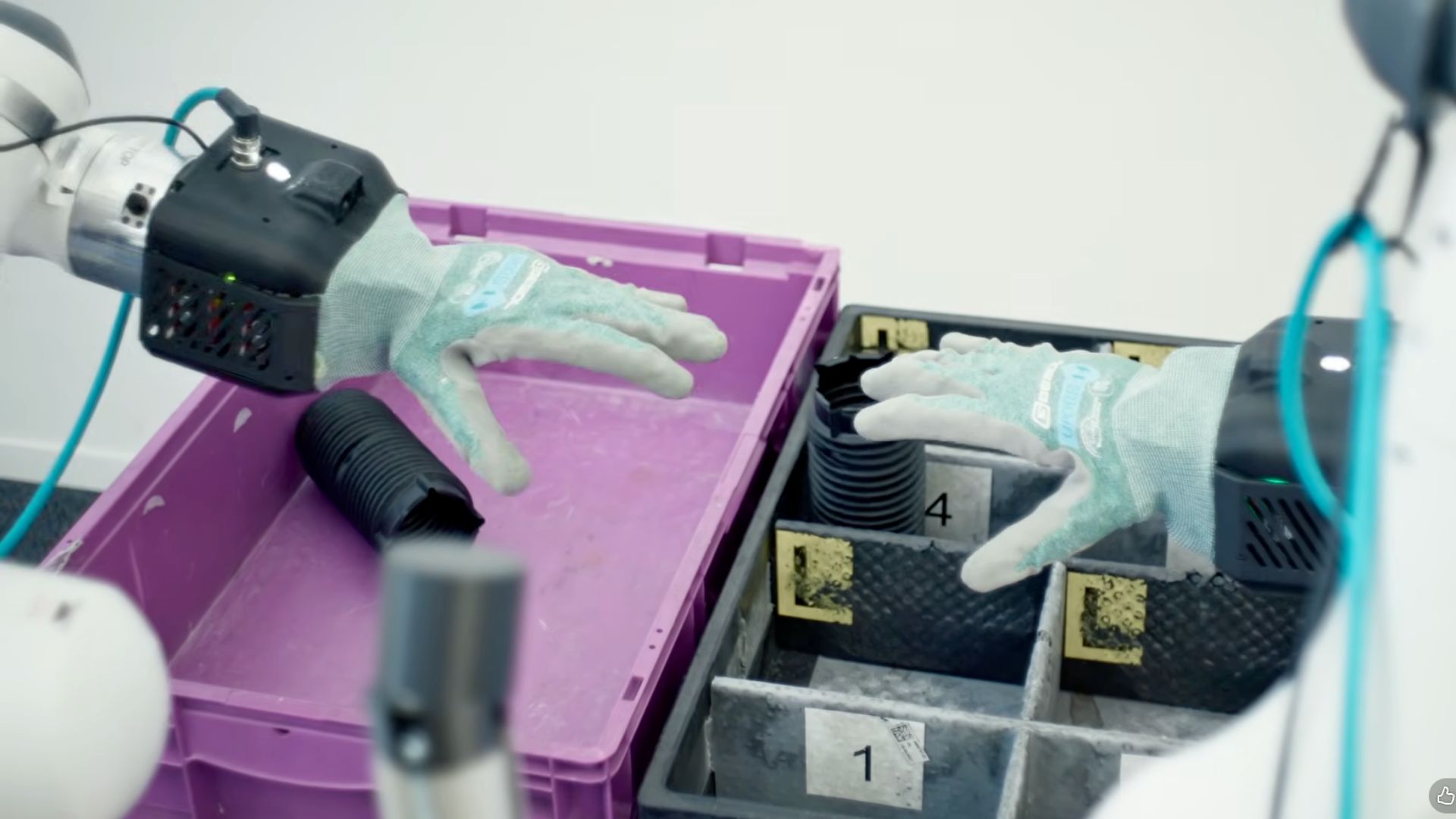
Mimic Robotics and Black Forest Labs unveiled FLUX-mimic on July 23, a video-action model for industrial manipulation built on FLUX 3. Mimic reports 95% success on a soft-body kitting test, versus 55% for an adapted pi0.5 and 70% for a task-trained baseline; those company-reported results and the claimed deployment gains still need independent validation.
Mimic Robotics and Black Forest Labs unveiled FLUX-mimic on July 23, combining the FLUX 3 multimodal foundation model with an action decoder for industrial robot control. The companies say the system is already being tested and deployed with Audi on manipulation tasks involving production parts and flexible materials.
From video prediction to robot actions
FLUX-mimic is a Video-Action Model: its backbone learns from video and other modalities, while a compact decoder turns the backbone's internal representation of a predicted future into robot actions. Mimic says the decoder reads latent features rather than generated pixels, so the system does not need to render a video rollout during inference.
The companies also report edge-deployment results. Mimic says FLUX-mimic runs locally on a single NVIDIA RTX 5090. Black Forest Labs reports less than 80 milliseconds for the backbone and 101 milliseconds for the complete robot system after the surrounding sensor, middleware, and action stack is included. These are vendor measurements, not independently reproduced latency tests.
What the reported evaluations show
Mimic reports 95% success on a real-robot soft-body kitting task without task-specific fine-tuning or post-training. Its announcement compares that result with 55% for an adapted pi0.5 model and 70% for a Flow Matching baseline heavily post-trained on the task. The company says success meant completing the multi-step kitting task correctly.
Black Forest Labs separately says its chart summarizes medians across 20 autonomous trials. In an interview with the Association for Advancing Automation, Mimic cofounder and CTO Elvis Nava said some new tasks can be learned with about 30 minutes of data. Rocking Robots reported the same claim against a comparison of 30 hours or more under earlier approaches, depending on task complexity.
Those figures add useful detail, but they remain company-reported. The public material does not establish independent replication, broad held-out generalization, or production reliability across factories and robot platforms.
What practitioners should validate
For robotics teams, the important question is not whether a video backbone can produce one strong demonstration, but whether the full control stack stays reliable under distribution shift. Evaluation should separate backbone quality from decoder training, report trial counts and failure modes, test unseen objects and layouts, and measure end-to-end latency after sensors, safety controls, and recovery behavior are included. FLUX-mimic is a concrete industrial test of the video-action approach, but its broader advantage will depend on reproducible results beyond the partners' own deployments.
Key Points
- 1FLUX-mimic combines the FLUX 3 multimodal backbone with an action decoder that converts latent video predictions into robot actions.
- 2Mimic reports 95% success on a soft-body kitting test and about 30 minutes of data for some tasks, but the results remain company-reported.
- 3Production evaluation should test held-out tasks, failure recovery, safety, and end-to-end latency rather than relying on demonstration efficiency alone.
Scoring Rationale
FLUX-mimic connects a scaled multimodal video model to real industrial robot control and includes concrete company-reported success and latency measurements from Audi-linked trials. The approach is materially relevant to data-efficient manipulation, but its impact remains provisional until independent evaluations establish generalization, reliability, and reproducibility.
Sources
Primary source and supporting public references used for this report.
Practice interview problems based on real data
1,625 SQL & Python problems across 15 industry datasets — the exact type of data you work with.
Try 250 free problems