
MacStories Releases Shortcuts Playground to Generate Shortcuts
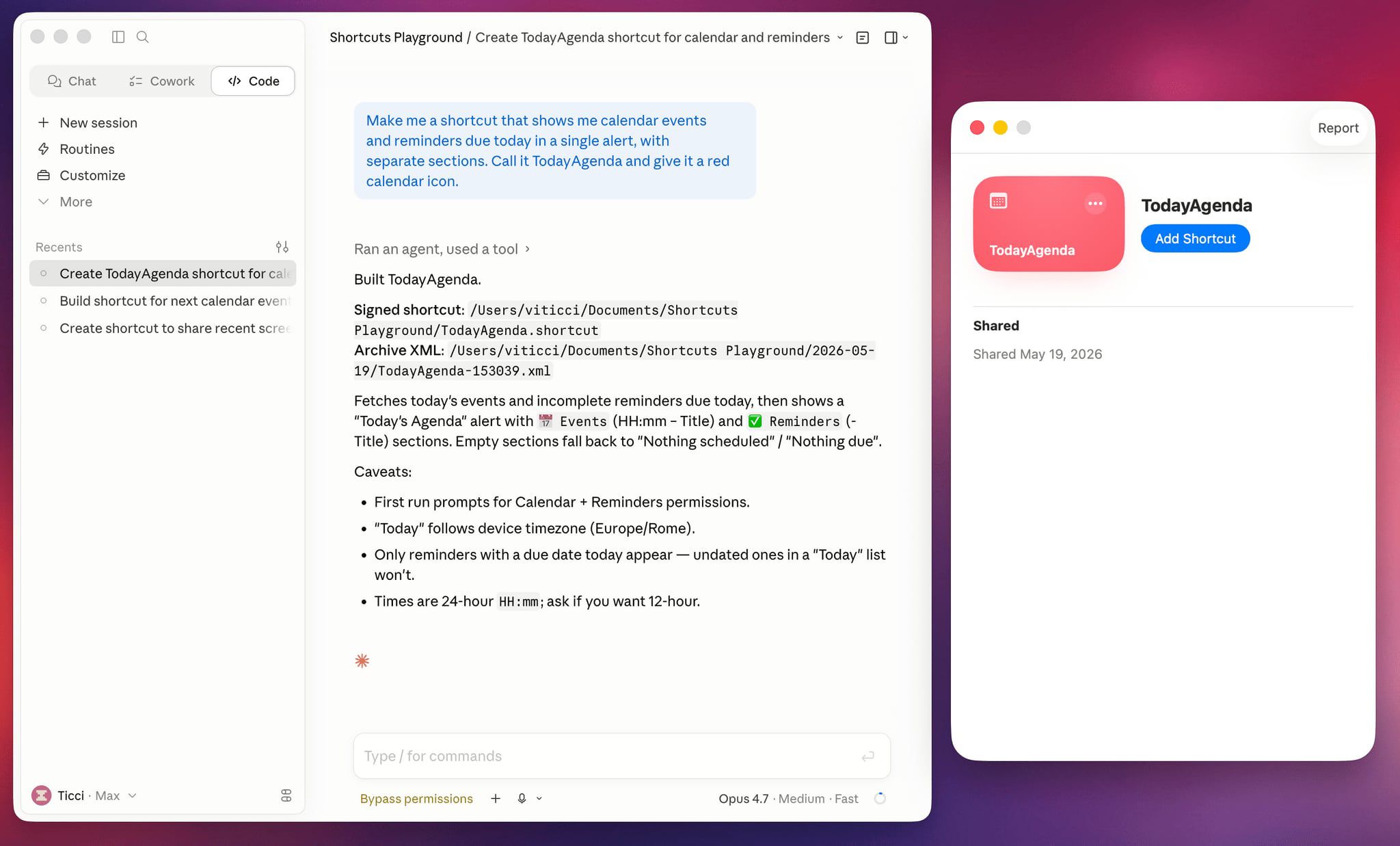
MacStories' Federico Viticci launched Shortcuts Playground, a free, open-source plugin that uses Claude Code or Codex to generate Apple Shortcuts from plain-English prompts, per MacStories and 9to5Mac. The tool returns a signed .shortcut file to Finder ready for import, and Viticci documents the project and publishes the code on GitHub, per MacStories. GadgetHacks reports the plugin pairs generation with a looping Python validator that iterates until the shortcut passes structural checks, which reduces broken imports. MacStories also offers a generative shortcut to Club MacStories+ and Premier members that can create and install shortcuts across devices, and Viticci published a redesigned archive with over 400 pre-built shortcuts; MacStories says 100 of those were generated by Shortcuts Playground, per MacStories and MacRumors. MacRumors notes Apple is rumored to add a natural-language shortcuts feature in iOS 27, placing this project in a larger ecosystem of Apple-focused automation tooling.
What happened
MacStories' Federico Viticci published Shortcuts Playground, a free, open-source plugin for Claude Code and Codex that generates Apple Shortcuts from plain-English prompts, according to the MacStories announcement and 9to5Mac. The plugin produces a signed .shortcut file and writes it to Finder so users can import it into the Shortcuts app, per MacStories and GadgetHacks. Viticci documented the implementation and posted the code on GitHub, per MacStories.
Technical details
GadgetHacks reports the notable architectural choice is pairing generation with a looping Python validator that keeps correcting output until it passes structural checks. Per GadgetHacks, that validator is what prevents many earlier tools from producing shortcuts that break on import. 9to5Mac and MacStories describe the workflow as: prompt in natural language, agent (either Claude Code or Codex) generates a shortcut, the validator iterates on errors, and a signed .shortcut is produced and saved to Finder.
What was released
Per MacStories and MacRumors, Viticci made Shortcuts Playground free and open source and provided detailed documentation. MacStories also published a generative shortcut version available to Club MacStories+ and Premier members that can create and install shortcuts on iPhone, iPad, or another Mac. MacStories debuted a redesigned shortcuts archive that includes more than 400 pre-built shortcuts; MacStories says 100 of those were generated and verified using Shortcuts Playground.
Industry context
Practical significance for practitioners
Limitations reported
Per MacStories and MacRumors, Viticci cautions that generated shortcuts are not guaranteed to be 100 percent accurate and users should review outputs. GadgetHacks and MacStories note the validator improves success rates but does not eliminate the need for human verification when shortcuts interact with device state, permissions, or third-party services.
What to watch
Editorial analysis
Combining model-driven generation with programmatic validators is an emerging pattern for producing executable artifacts reliably. Observers have seen similar approaches in other automation and code-generation tooling where a validation-and-repair loop reduces syntactic and structural errors compared with one-shot generation.
For developers and power users who author device automations, Shortcuts Playground demonstrates a concrete workflow to turn natural-language intents into importable, signed shortcut binaries. The architecture highlights a reproducible pattern: use a generative agent for the semantic mapping and a deterministic validator for structural correctness. That pattern can reduce manual debugging time when integrating model output with platform-specific file formats.
Observers should monitor three signals: adoption of validator-plus-generator architectures in other automation domains; whether the approach is adapted to on-device models as Apple expands Apple Intelligence in iOS 27 (MacRumors notes that Apple is rumored to add natural-language shortcut creation in iOS 27); and how the community extends the public repository with additional validators, templates, or integrations for third-party apps.
Summary
Shortcuts Playground is a pragmatic, open-source implementation that converts plain-English prompts into signed Apple Shortcuts using Claude Code or Codex, accompanied by a looping Python validator to improve import reliability, per MacStories, 9to5Mac, GadgetHacks, and MacRumors. The project is documented on GitHub and includes a member-only generative shortcut and a catalog of over 400 pre-built shortcuts; MacStories says 100 of those were generated by Shortcuts Playground, per MacStories and MacRumors.
Key Points
- 1Shortcuts Playground turns plain-English prompts into signed .shortcut files, reducing manual authoring for Apple Shortcuts.
- 2Pairing generation with a looping Python validator addresses a common failure mode where AI produces import-incompatible automations.
- 3Open-sourcing the plugin and publishing an archive of over 400 pre-built shortcuts accelerates community experimentation and template reuse.
Scoring Rationale
This is a notable tooling release that demonstrates a reliable pattern for turning natural-language prompts into executable automations. It matters to practitioners automating Apple platforms but is not a frontier-model release or platform-level shift.
Sources
Public references used for this report.
Practice interview problems based on real data
1,625 SQL & Python problems across 15 industry datasets — the exact type of data you work with.
Try 250 free problems


