k-Sparse Autoencoders Reveal Reasoning Model Features
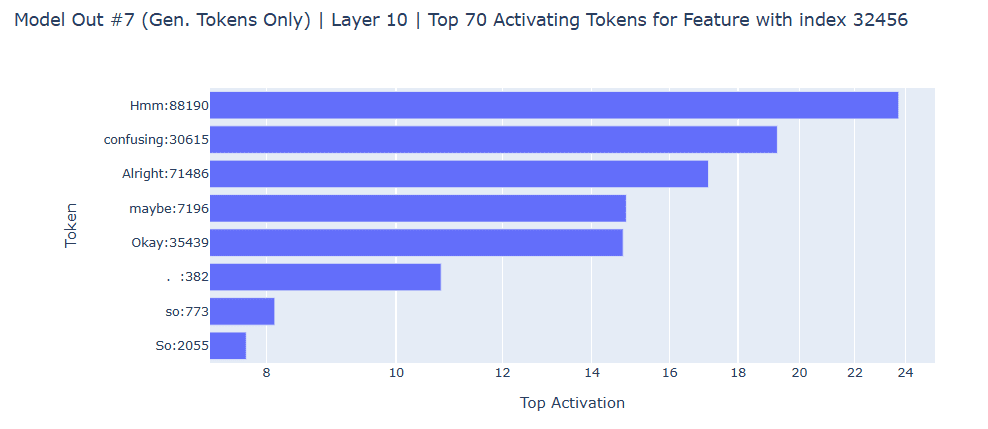
A LessWrong community project investigates whether k-sparse autoencoders (k-SAEs) can extract interpretable features from a small reasoning model. K-sparse autoencoders enforce sparsity by keeping only the k largest magnitude activations, making them a natural candidate for mechanistic interpretability. The project tests whether internal model activations correspond to identifiable thinking patterns or reasoning steps. Sparse autoencoders have seen growing application in LLM interpretability research - published work has found features associated with uncertainty and exploratory thinking in reasoning-focused models - but this project applies the method at small scale to probe accessibility and generalizability. Results are pending and the work is presented as an early-stage research probe rather than a completed study.
What it is
A LessWrong community post presents an early-stage project investigating whether k-sparse autoencoders (k-SAEs) can extract interpretable features from a small reasoning model. K-sparse autoencoders enforce sparsity by retaining only the k largest magnitude activations in the latent layer, producing sparser and more targeted feature decompositions than standard sparse autoencoders trained with an L1 penalty. The project focuses on finding evidence that internal activations correspond to recognizable "thinking patterns" or discrete reasoning steps.
Methodological context
Sparse autoencoders have become a central tool in mechanistic interpretability. OpenAI's scaling work (Gao et al., 2024) demonstrated that SAEs trained on GPT-4 residual stream activations recover monosemantic, interpretable features at scale. A peer-reviewed paper (arXiv 2503.18878) specifically applied sparse autoencoders to reasoning traces in large language models, reporting features that activate during uncertainty, reflection, and exploratory thinking. The LessWrong project aims to test similar ideas using the k-sparse variant on a smaller reasoning model, which lowers the compute barrier and may clarify whether such features generalize to smaller-scale reasoning architectures.
Limitations and status
The post is an early community project, not a completed or peer-reviewed study. The snippet indicates the work is framed as an investigation rather than a findings report, so claims about what the autoencoders actually reveal are not yet confirmed. The single-source LessWrong format means verification against primary experimental data is not currently possible.
Why practitioners should watch
If k-SAEs can reliably surface reasoning features in small models, the approach could become a lightweight diagnostic tool - practitioners could apply it to understand chain-of-thought structure, identify reasoning failure modes, or steer model behavior without requiring large-scale compute. The result, positive or negative, informs the broader question of whether sparse dictionary learning generalizes across model scale and architecture in reasoning-focused settings.
Key Points
- 1A LessWrong project probes whether k-sparse autoencoders can extract interpretable features from a small reasoning model's activations.
- 2K-SAEs enforce fixed sparsity (top-k activations only), a natural fit for identifying discrete reasoning steps in chain-of-thought models.
- 3Results are preliminary; success would suggest lightweight SAE-based probes can surface reasoning structure in models too small for large-scale interpretability pipelines.
Scoring Rationale
A single LessWrong community post describing an early-stage project probing k-sparse autoencoders on a small reasoning model. The methodological direction is relevant to mechanistic interpretability practitioners but the work is preliminary, not peer-reviewed, and does not yet report confirmed findings. Solid-tier score reflects genuine methodological interest without overstating incomplete community research.
Sources
Public references used for this report.
Practice interview problems based on real data
1,625 SQL & Python problems across 15 industry datasets — the exact type of data you work with.
Try 250 free problems