
Luckfox Releases Aura SBC with RV1126B NPU
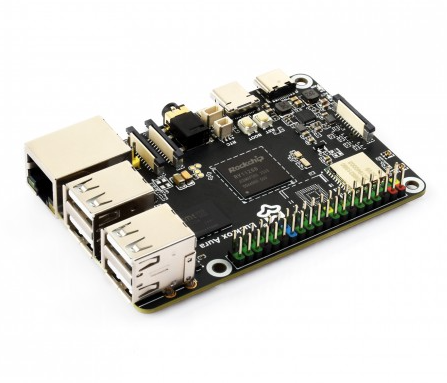
Luckfox has added the Aura, a compact Linux single-board computer built around the Rockchip RV1126B SoC, according to reseller product pages. The Waveshare product listing shows the board ships in multiple configurations and lists a price range of $48.99 - $147.99. Reseller and retail pages including Amazon and hubtronics describe the SoC as a quad-core Cortex-A53 at 1.6GHz with an integrated 3 TOPS NPU, hardware H.264/H.265 4K encode/decode, and dual 4-lane MIPI CSI camera interfaces. Product pages list options for 2GB/4GB LPDDR4X, optional eMMC up to 64GB, USB 3.0 OTG Type-C, Gigabit Ethernet with PoE module support, and Wi-Fi 6 plus Bluetooth 5.4. The board is offered with Linux images, per the listings.
What happened
Luckfox introduced the Aura, a Linux development single-board computer based on the Rockchip RV1126B system-on-chip, per reseller product pages including Waveshare and retail listings on Amazon and hubtronics. The Waveshare product page lists multiple SKUs and a price range of $48.99 - $147.99. Retail descriptions on Amazon and hubtronics list the SoC as a quad-core Cortex-A53 at 1.6GHz with an integrated 3 TOPS NPU, support for 4K H.264/H.265 hardware encode and decode, and dual 4-lane MIPI CSI camera interfaces.
Technical details
The product pages specify memory and storage options, with 2GB or 4GB LPDDR4X variants and optional eMMC up to 64GB, according to the Amazon and Waveshare listings. I/O and connectivity called out on the listings include USB 3.0 OTG Type-C, four USB 2.0 host ports, Gigabit Ethernet with optional PoE module support, and wireless connectivity listed as Wi-Fi 6 plus Bluetooth 5.4. The board is advertised with prebuilt Linux images and references to Buildroot/Debian on retail pages.
Editorial analysis
technical context: Edge-focused SoCs like the RV1126B, which pair Cortex-A cores with a modest NPU, are commonly used for on-device computer vision and lightweight inference at the edge. The 3 TOPS NPU positions the Aura for small neural networks such as object detection, classification, and optimized vision pipelines rather than large transformer workloads. Dual 4-lane MIPI CSI interfaces and an onboard AI-ISP make the board convenient for stereo camera rigs, multi-camera capture, or simultaneous RGB and depth/ISP streams.
Industry context:
Public listings and third-party retailers show a sustained market for compact Linux SBCs that blend general-purpose ARM compute with dedicated NPUs for vision tasks. Multiple vendors have released RV1126-based development kits and core boards on marketplaces, indicating the chip is popular for lower-power, cost-sensitive vision applications. The Aura's stated combination of 4K encode/decode, dual CSI, and Wi-Fi 6 places it in the product space targeted at prototyping cameras, robotics vision nodes, and networked inference gateways.
What to watch
Observers should look for official BSP and kernel support details from Luckfox or Rockchip, upstreaming status if any, and the availability of optimized inference runtimes or sample models. Shipping availability by SKU, final street pricing by configuration, and community resources or documentation will determine how practical the board is for rapid prototyping versus production evaluation.
Key Points
- 1Luckfox Aura is an RV1126B-based Linux SBC with a 3 TOPS NPU, targeting lightweight on-device vision workloads.
- 2Dual 4-lane MIPI CSI plus 4K encode/decode simplify multi-camera capture and streaming for edge CV prototypes.
- 3Multiple SKUs and a $48.99 - $147.99 price window, per reseller listings, make the board accessible for developers and evaluators.
Scoring Rationale
The Aura packages a capable, low-power vision SoC with a 3 TOPS NPU and dual CSI interfaces, making it a practical tool for edge computer vision prototyping. It is useful for practitioners but does not represent a new model or paradigm shift.
Sources
Public references used for this report.
View 3 more sources
- Luckfox Aura 2GB Ram + No eMMC High-Performance Linux Development Board, Rockchip RV1126B Quad-Core 1.6GHz Processor, 3 TOPS Computing Power, 4K Encoding And Decoding, Dual Band Wi-Fi 6 & BLE 5.4hubtronics.in
- Rockchip RV1126 AI Dev Kit: Open Source ARM Linux Board for Embedded Vision & Edge AIaliexpress.com
- Waveshare Luckfox Aura High-Performance Linux ... - Amazon.comamazon.com
Practice interview problems based on real data
1,625 SQL & Python problems across 15 industry datasets — the exact type of data you work with.
Try 250 free problems

