Literary Prize Winners Face AI Authorship Allegations
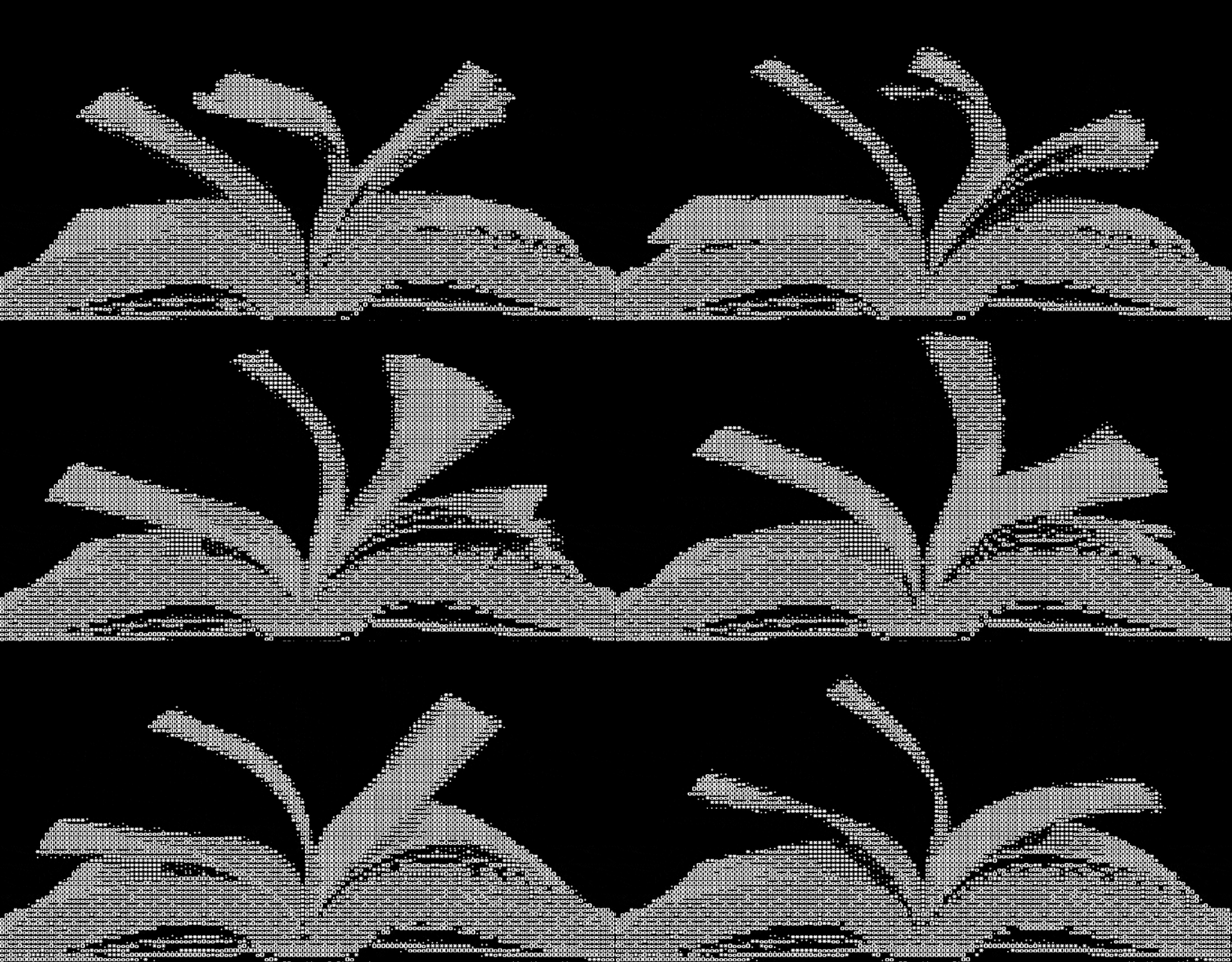
Multiple regional winners of the Commonwealth Short Story Prize have been accused online of submitting AI-generated fiction. Reporting by The Atlantic and New York Magazine's Book Gossip (via Vulture) identifies the Caribbean winner, "The Serpent in the Grove" by Jamir Nazir, published on Granta's site, as the focal point of the controversy; commenters ran the text through AI-detection platforms and flagged stylistic patterns they say resemble machine-generated prose. The Independent reports the prize received 7,806 entries this year and that each regional winner receives £2,500, with the overall winner announced on 30 June. Additional regional winners named in coverage, John Edward DeMicoli (Malta) and Sharon Aruparayil (India), have also been flagged by online sleuthing, according to The Atlantic. Coverage frames this episode as part of broader debates about authorship, detection tools, and editorial gatekeeping in publishing.
What happened
Multiple news outlets report a contentious episode in literary publishing after readers and online sleuths questioned the authorship of several winners in this year's Commonwealth Short Story Prize. The Caribbean regional winner, "The Serpent in the Grove" credited to Jamir Nazir, was published on Granta's website and attracted sustained online attention when readers highlighted repetitive metaphors and stylistic patterns that they said looked like machine-produced text, The Atlantic reported. Coverage in New York Magazine's Book Gossip (reposted at Vulture) notes that the prize committee described the story with "lyrical precision and haunting atmosphere." The Independent reports the competition received 7,806 entries this year and that regional winners receive £2,500, with the overall winner to be announced on 30 June.
The Atlantic and Vulture both report that commenters used third-party AI-detection platforms to flag passages; those tools labeled several stories, including entries attributed to John Edward DeMicoli (Malta) and Sharon Aruparayil (India), as likely machine-generated, according to The Atlantic.
Editorial analysis - technical context
Industry-pattern observations: Public-facing AI-detection tools are widely used by readers and journalists but have well-documented reliability issues. Detection platforms often rely on statistical signals such as token predictability and burstiness that can yield false positives for highly formulaic or intensely edited human writing. This makes simple binary outputs from those services hard to treat as conclusive evidence of nonhuman authorship.
Implications for practitioners
What to watch
Industry context
Observers will watch whether the Commonwealth Foundation or Granta publishes the results of any investigation and whether they adopt explicit disclosure rules for machine assistance in submissions. Practitioners will also track efforts to audit or standardize AI-detection benchmarks and any community-led protocols for provenance checks, such as signed-source workflows or submission metadata standards.
Closing note
Editorial analysis
The incident sits at the intersection of three trends affecting practitioners who curate and evaluate text: rapid improvements in generative models, the rise of forensic detection tools of uneven accuracy, and broader pressures on editorial workflows to process large submission volumes. For publishers and prize committees, the episode highlights provenance and verification challenges that are operational rather than purely philosophical: verifying authorship at scale collides with existing submission rules and limited investigative resources.
For editors, literary curators, and platform operators, this episode underscores trade-offs between automated screening and human review. Automated flags can prioritize cases for follow-up, but reliance on them without secondary verification risks false accusations and reputational harm. For developers of detection tools, the incident is a reminder that product messaging and stated limitations matter; ambiguous output presented as definitive will be adopted by nonexpert publics and can drive real-world consequences.
This story is primarily an episode about trust and tooling in a field where aesthetic evaluation has always been subjective. It demonstrates that technical signals from detection systems are now part of the cultural conversation about authorship, even as the limits of those signals remain contested.
Key Points
- 1Readers and online sleuths flagged multiple Commonwealth Short Story regional winners as likely AI-written, focusing on Jamir Nazir's Granta-published story.
- 2Detection tools were central to the controversy, but their statistical heuristics produce false positives for formulaic or highly edited human prose.
- 3Publishers and prize committees face operational verification pressures; clearer provenance protocols or disclosure standards may emerge as a result.
Scoring Rationale
The story matters to practitioners because it illustrates real-world consequences of generative models and the current limits of detection tools on content provenance. It is notable for introducing operational verification challenges for editorial workflows but does not involve a novel technical breakthrough or industry-shifting policy.
Sources
Public references used for this report.
Practice interview problems based on real data
1,625 SQL & Python problems across 15 industry datasets — the exact type of data you work with.
Try 250 free problems