
South Korea Details $950 Billion in AI Chip Cooperation
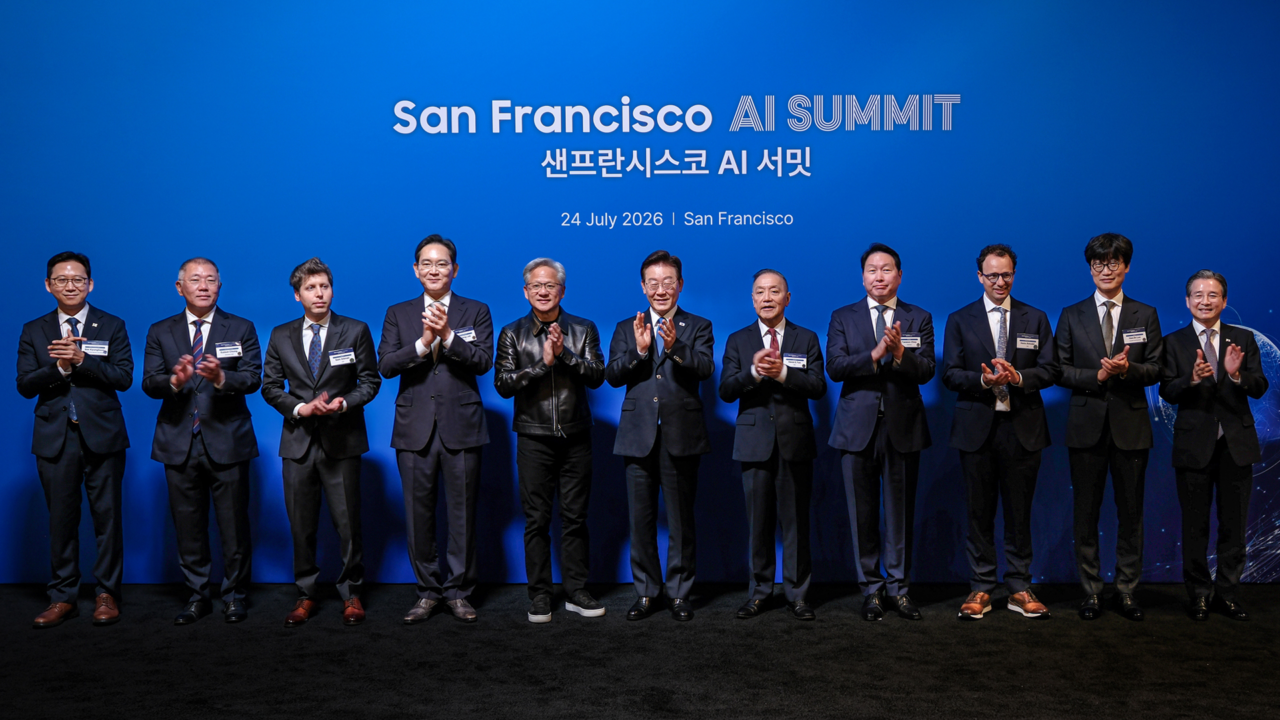
South Korea said domestic companies and global technology firms agreed on July 24 to pursue $950 billion in semiconductor cooperation and about 5 gigawatts of AI data centers using roughly 2 million B200-equivalent GPUs. The plans include a $200 billion Samsung-Broadcom memorandum and $750 billion in long-term SK supply cooperation, announced alongside President Lee Jae Myung's San Francisco AI Declaration.
South Korean officials said companies from South Korea and the United States agreed at a July 24 summit in San Francisco to pursue $950 billion in semiconductor cooperation and approximately 5 gigawatts of AI data-center capacity using about 2 million Nvidia B200-equivalent GPUs.
The figures describe planned cooperation, supply arrangements and memorandums of understanding, not money already spent or infrastructure already operating. The announcement was made as President Lee Jae Myung unveiled the San Francisco AI Declaration and met leaders from Nvidia, OpenAI, Anthropic and Broadcom.
The agreements span chips and data centers
The Republic of Korea's official policy briefing said Samsung Electronics and Broadcom signed a five-year memorandum covering up to $200 billion in advanced-memory supply and foundry cooperation for AI chips. It said SK would pursue $750 billion in long-term advanced-memory supply cooperation with Nvidia and other global technology companies over five years.
The same briefing said Korean companies and global partners would pursue about 5 GW of data-center projects. SK Telecom and Nvidia agreed to cooperate on expanding capacity to as much as 2 GW and on priority allocation of Vera Rubin systems. SK Telecom also plans investment cooperation with Anthropic on a gigawatt-scale Korean project and an expansion of its existing AWS data-center partnership.
Naver's portion is described as a $10 billion global AI-factory program: a $1 billion strategic investment from Nvidia for GPU supply and technical cooperation, plus as much as $9 billion in infrastructure support from Brookfield. These are separate components inside a broader package and should not be read as a single completed transaction.
Yonhap reported the same $950 billion semiconductor total, the five-year SK and Samsung components, and the target of 5 GW and 2 million GPUs. SBS separately reported Jensen Huang's description of the Nvidia-SK initiative as a $500 billion partnership. Nvidia's own summit account confirms the participation of Lee, Huang, Sam Altman, Dario Amodei, Hock Tan and senior Korean business leaders.
A declaration still awaiting delivery
Lee used the San Francisco AI Declaration to position South Korea as a production base and supply-chain partner for AI semiconductors, infrastructure and real-world deployment. The official government record frames the program as cooperation across the full AI stack, including chips, data centers, physical AI, models and skills.
For practitioners, the scale is meaningful because delivered memory, accelerators and powered data-center capacity can influence regional model-training and inference economics. The operational effect will depend on signed commercial terms, GPU delivery schedules, grid and network readiness, commissioning dates, cloud access and who can buy the resulting capacity. Until those details materialize, the headline numbers are commitments and cooperation targets rather than usable compute.
Key Points
- 1South Korea says the summit produced plans for $950 billion in five-year semiconductor cooperation, split between Samsung-Broadcom and SK-led arrangements.
- 2The broader package targets about 5 GW of AI data centers and roughly 2 million B200-equivalent GPUs, with separate SK Telecom and Naver projects.
- 3The practical impact depends on contracts, accelerator delivery, power, commissioning and customer access; announced cooperation is not yet operating capacity.
Scoring Rationale
The officially announced cooperation spans very large semiconductor supply arrangements and multi-gigawatt AI data-center targets involving major chip, cloud and model companies. It could materially affect compute and memory supply, although the figures remain agreements and targets whose delivery terms, schedules and access models are not yet public.
Sources
Primary source and supporting public references used for this report.
View 3 more sources
Practice interview problems based on real data
1,625 SQL & Python problems across 15 industry datasets — the exact type of data you work with.
Try 250 free problems

