Kunlunxin Seeks $50 Billion Hong Kong IPO
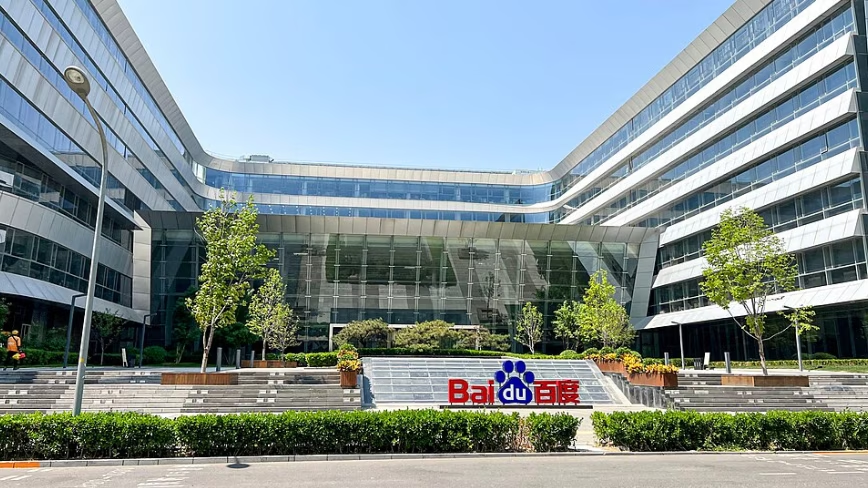
Kunlunxin, Baidu's AI chip unit, is targeting a $50 billion valuation for a Hong Kong IPO and asked prospective investors to also commit to purchasing its semiconductors, The Information reported June 28, 2026, in coverage relayed by The Next Web; Reuters said it could not independently verify the account. The reported structure -- tying share allocation to chip purchase commitments worth several times the investor's stock subscription -- echoes "circular financing" arrangements the Bank for International Settlements warned about the same weekend, calling such terms "typically poorly disclosed." The $50 billion target is a sharp jump from $14.7 billion, the valuation South China Morning Post reported in May 2026 citing sources familiar with the matter, and from a HK$100 billion (~$12.8 billion) figure TrendForce cited earlier. Kunlunxin filed confidentially for a Hong Kong listing in January, is pursuing a dual listing on Shanghai's STAR Market, and named CICC, Citic Securities, and Huatai Securities as lead banks.
For AI infrastructure buyers and procurement teams, this story matters less for the IPO size itself and more for the reported financing structure: an arrangement that could tie capital-markets participation directly to chip supply commitments, at a moment regulators are actively flagging exactly this kind of entanglement as a systemic risk.
What happened
The Information reported on June 28, 2026 that Kunlunxin, the AI chip unit Baidu founded internally in 2012, is targeting a $50 billion valuation for a Hong Kong IPO and asked prospective investors to also commit to purchasing its semiconductors -- with one report describing a requirement that investors buy chips worth three to seven times their planned stock subscription. The Next Web, which relayed The Information's reporting, noted Reuters could not independently verify the account. Kunlunxin filed confidentially for a Hong Kong listing in January, is separately pursuing a dual listing on Shanghai's STAR Market, and has named CICC, Citic Securities, and Huatai Securities as lead banks. CNBC reported June 29 that Baidu shares jumped 7% following the news. Hong Kong equity capital markets raised nearly $44 billion in H1 2026, the highest level in five years, according to The Next Web.
Financial context
The $50 billion target represents a large jump from earlier valuation estimates: South China Morning Post reported on May 8, 2026, citing two sources familiar with the matter, that Kunlunxin was seeking a valuation of roughly $14.7 billion; TrendForce had separately cited a HK$100 billion (~$12.8 billion) figure in May. SCMP's sourcing notes the valuation could change based on market conditions and final terms -- consistent with the subsequent jump reported in late June. Kunlunxin has been shifting from an internal Baidu supplier to a third-party chip seller, with external customers accounting for over half its 2025 revenue.
Regulatory context
The reported purchase-commitment structure resembles the "circular financing" arrangements the Bank for International Settlements warned about in its 2026 annual report, published the same weekend, in which chipmakers and AI labs exchange equity stakes and purchase commitments that the BIS says are "typically poorly disclosed." The BIS report names an AI capex bust and circular-financing collapse among the top risks to global financial stability.
For practitioners
Procurement and infrastructure teams evaluating Chinese AI chip suppliers should treat reports like this as a prompt to seek contract clarity on any capital ties between suppliers and their investors, since intertwined equity and purchase relationships can affect roadmap commitments, supply guarantees, and vendor-risk forecasting. Engineering teams tracking the broader Chinese AI hardware ecosystem should note Kunlunxin's growing external customer base as a signal of maturing third-party chip supply options.
What to watch
Whether Kunlunxin's IPO prospectus, once filed, discloses the specific terms of any purchase-commitment requirement, and whether Hong Kong or Shanghai exchange regulators comment on the practice given the BIS's warning.
Key Points
- 1Kunlunxin's reported $50B IPO target ties investor share allocation to chip purchase commitments, a structure regulators call poorly disclosed circular financing.
- 2The $50B valuation target is over 3x SCMP's $14.7B May estimate, reflecting either rapid re-pricing or wide uncertainty in early reporting.
- 3Procurement teams evaluating Chinese AI chip suppliers should seek contract clarity when capital and purchasing relationships are intertwined.
Scoring Rationale
Notable-tier story for AI infrastructure and procurement audiences: it links capital-markets activity to potential supplier-side purchase commitments, corroborated by SCMP's independently sourced valuation history and the BIS's concurrent circular-financing warning. Held at 6.7 -- the core purchase-commitment claim remains single-sourced to The Information and explicitly unverified by Reuters, and the valuation figures across outlets still diverge, so this stops short of the major-story tier pending prospectus confirmation.
Sources
Public references used for this report.
Practice interview problems based on real data
1,625 SQL & Python problems across 15 industry datasets — the exact type of data you work with.
Try 250 free problems